How to Play Jack-Seven Suited (J7s)
Jack-seven suited is a weak three-gapper that only belongs on the button and in blind defense. Here is when J7s is playable and when to fold it.
On this page · 7 sections
Jack-seven suited (J7s) is a three-gap suited hand and one of the weakest holdings you will ever voluntarily play. The three cards separating the jack and the seven remove most of its straight potential, and what remains is a hand that leans almost entirely on its flush possibilities and position. It wins about 51% heads-up against a random hand — barely better than a coin flip — so J7s belongs only at the very edges of your range: the button and blind defense. Everywhere else, it folds.
The button and the big blind — that is it
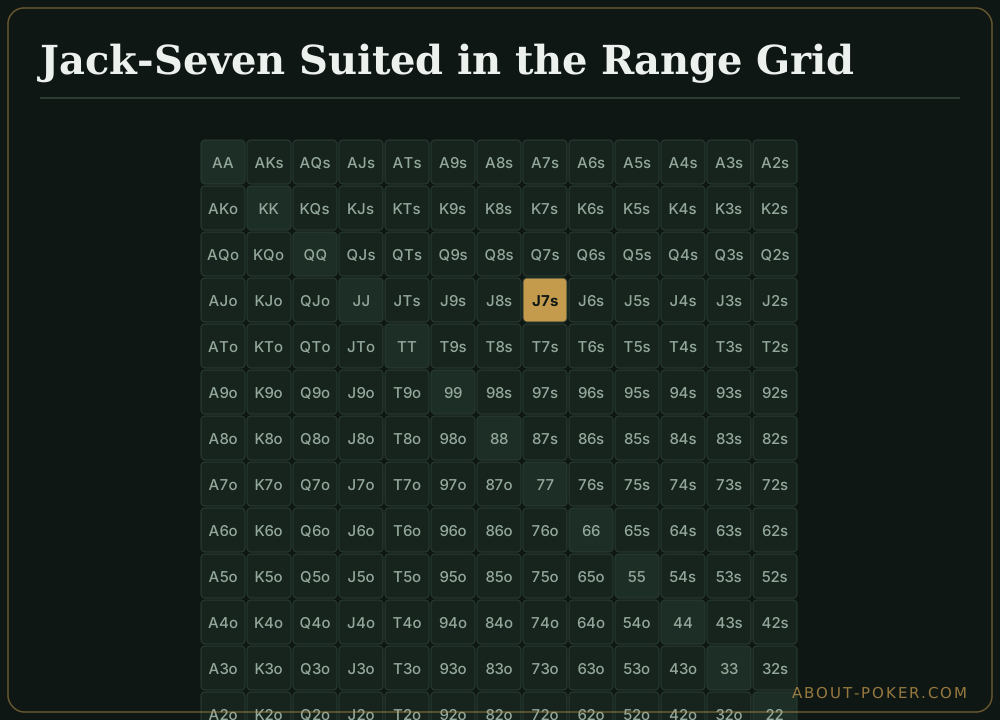
J7s enters your opening range only on the button, and only because you can open extremely wide there. With just the small and big blind left to act and guaranteed position for the rest of the hand, the button justifies hands that would be indefensible anywhere else. Even so, J7s is at the very bottom of that range — one of the last hands in before you start folding. Confirm it against your preflop opening ranges; you should never see it in a cutoff or middle-position open.
The other legitimate spot is big-blind defense. When you are getting a discount to close the action against a late-position raise, J7s can call because you are already partly invested and you close the betting. That is standard blind defense: suited hands defend far wider than they open, and J7s qualifies at the right price.
Why the gaps hurt
Each gap between your cards deletes straight combinations and increases the rate at which you flop a dominated pair or a weak draw. Where jack-eight suited is already marginal, J7s is a full step lower — it makes the fewest straights of the jack-suited family and depends heavily on the flush to win a meaningful pot. When it flops a pair, that pair is often outkicked; when it flops a straight draw, that draw is frequently not to the nuts.
A worked example
You hold J♣7♣ on the button and open to 2.5bb. The big blind calls. The flop comes K♣-9♣-4♠.
This is where J7s earns its keep: a flush draw, with any club completing your flush. That is nine outs — about 35% equity to make the flush by the river. This is a clear semi-bluff continuation-bet. You have real backup, and if a club arrives you often win a big pot. Contrast that with a flop like Q-8-3 rainbow, where you have jack-high and no draw — an easy check-fold to any pressure. The difference between those two flops is the entire story of J7s: it is only worth continuing when it flops genuine equity.
Keep it disciplined
The winning approach to J7s is restraint. Open it only on the button, defend it only cheaply from the big blind, and continue postflop only when you flop a flush draw, a strong pair, or two pair. When you miss — which is most of the time — let it go. Its profit comes from the rare flops where its suitedness turns a marginal hand into a genuine threat, not from stubbornly barreling jack-high into a board that has left you behind.
How the button open plays out
When you do open J7s on the button, plan for the hand as a whole rather than just the raise. The best-case outcome is that both blinds fold and you collect the dead money — that fold equity is a real part of why the open is defensible at the bottom of your range. When you get called, you are usually heads-up and in position, which is exactly the situation J7s needs. On the flop, a small continuation bet works on boards that favor your range (ace-high, king-high, and low disconnected textures), because you can credibly represent the strong broadway and ace hands you also open on the button. When you flop an actual piece — top pair jack, a flush draw, a pair-plus-draw — you have a genuine hand to bet for value or as a semi-bluff. When you flop nothing on a board that hits the big blind’s range (middling connected cards like 9-8-6), give up cheaply rather than firing a second barrel with no equity. The positional advantage is what lets you check back marginal hands, control the pot, and realize your equity without committing chips out of turn.
The big-blind defend in detail
Against a late-position open, J7s defends comfortably from the big blind because you are getting a discount and closing the action, but the price still sets the ceiling. Against a min-raise or a 2.2x button open you can call routinely; against a 3x or larger raise, or a raise from early or middle position, the hand’s value drops and it becomes a fold more often. Never 3-bet J7s for value — it is not strong enough — and use it as a light 3-bet bluff only rarely and only against opponents who fold too much to re-raises, since it unblocks few of the hands you want them to fold. Once you call and see a flop, the plan mirrors the button: continue with flush draws, straight draws, and real pairs, and fold the many boards where you flop jack-high air.
Common mistakes with J7s
The most common leak is opening J7s from the cutoff or earlier, where the range behind you is far too strong for a three-gapper that flops dominated pairs. The second is calling a 3-bet with it — J7s is a clear fold to re-raises, since it plays poorly in a bloated pot and is frequently dominated. The third is overplaying top pair: a jack with a seven kicker is routinely outkicked by better jacks, so it is a one- or two-street hand, not a stack-off. The fourth is barreling jack-high with no draw on a missed board; without equity or blockers, that is spewing chips. Keep J7s in its lane — a bottom-of-range button open, a cheap big-blind defend, and a flush-and-straight-draw hand postflop — and it contributes a small, steady edge. For the neighboring hand one gap tighter, see how jack-eight suited is played.
Frequently asked
Is jack-seven suited playable?
Only in very specific spots. J7s is a weak three-gap suited hand that appears at the very bottom of a button opening range and as an occasional big-blind defense at a good price. From every other seat it is a fold. Its value comes almost entirely from position and its flush potential.
Should you open jack-seven suited from the button?
Sometimes, as one of the widest hands you open. On the button you can open a very wide range because you have position and only two blinds to get through, so J7s sneaks in at the bottom. Fold it from the cutoff and every earlier seat.
Why is J7s so much weaker than J8s or J9s?
Each additional gap removes straight combinations and increases how often you flop a dominated pair or a weak, non-nut draw. J7s has three gaps, so it makes the fewest straights of the jack-suited group and relies mostly on flushes and the occasional two pair to win big pots.