How to Play Jack-Six Suited (J6s)
Jack-six suited is a near-trash four-gapper that folds almost everywhere. Here is the narrow set of spots where J6s is playable and how to handle it.
On this page · 6 sections
Jack-six suited (J6s) is a four-gap suited hand and sits at the very bottom of what any winning player considers playable. Those four gaps between the jack and the six erase nearly all straight potential, leaving a hand that survives almost entirely on its flush possibilities. It wins about 49% heads-up against a random hand — literally worse than a coin flip against a completely unknown holding. The honest answer for J6s is that it folds in the overwhelming majority of situations, and its rare appearances are limited to cheap big-blind defense.
Big-blind defense, and little else
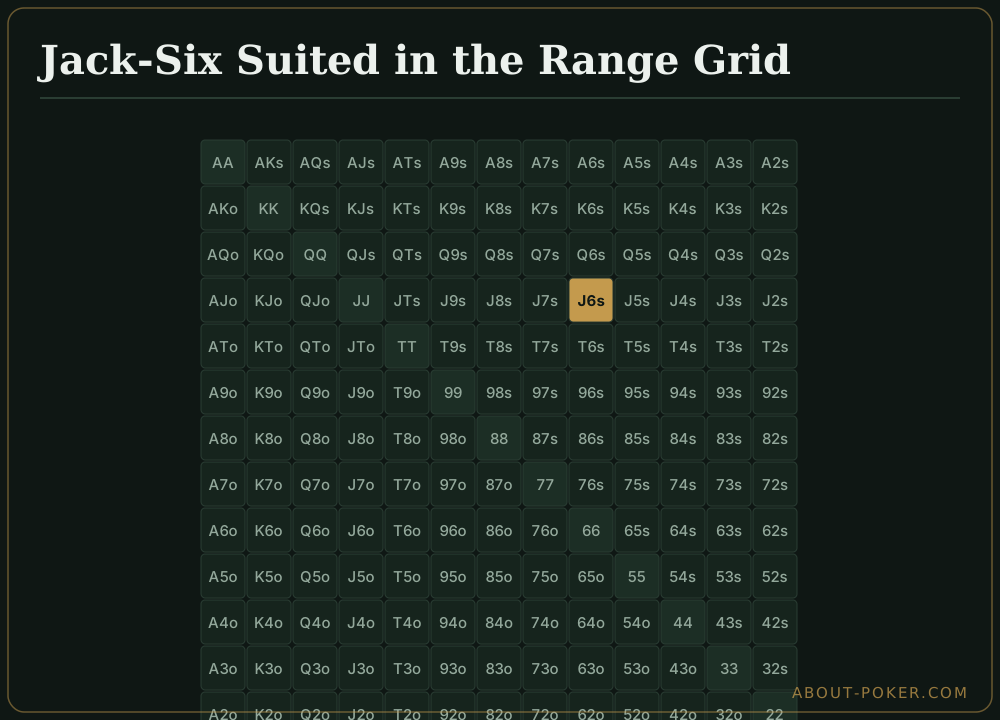
The one legitimate home for J6s is defending the big blind at a deep discount. When a late-position player min-raises or makes a small open and you are getting excellent pot odds to close the action, J6s can call — you are already partly invested, you close the betting, and your suitedness gives you a flush to chase. That is the widest edge of correct blind defense: you defend far more hands than you would ever open, and J6s scrapes in only at the best prices.
As an open, J6s is essentially always a fold. Even on the button, where jack-seven suited barely qualifies, J6s usually falls below the line. Only the very widest button ranges against extremely tight blinds might include it, and folding it costs you almost nothing. Your preflop opening ranges should show it as a fold from every standard seat.
Why it is so weak
The pattern by now is clear: each gap removes straights and adds dominated pairs. J6s has four gaps, the most in the jack-suited family, so it makes the fewest straights and the most easily outkicked pairs. When it flops top pair, a jack, it is regularly outkicked by better jacks; when it flops the six, it is almost always second-best. The flush is the only holding that reliably wins a big pot, which is why suitedness is the sole reason this hand is ever in your range at all.
A worked example
You defend the big blind with J♥6♥ against a button open and see a flop of Q♥-8♥-3♣.
This is the flop J6s needs to justify its existence: a flush draw, with any heart completing your flush. That is nine outs — about 35% equity to hit by the river. You can check-call one reasonable bet with this much equity and a chance to win a large pot when a heart lands. Now change it to a K-9-2 rainbow flop, and you have jack-high with no draw and no plan — a trivial check-fold to any bet. That contrast is the entire strategy for J6s: continue only when you flop genuine equity, and give up cheaply the rest of the time.
How position, price, and opponent shift the defend
Even in its one home — big-blind defense — J6s is not an automatic call. The three levers that decide it are raise size, the raiser’s range, and how the flush will get paid. Against a 2x button min-raise you’re closing the action at a price near 3.5-to-1, and a flush-draw-or-fold hand can peek cheaply. Against a 3x or larger open, the discount evaporates and J6s becomes a clean fold; you no longer have the odds to justify a hand that whiffs most flops.
The opponent’s range is the second lever. A tight button that opens 20% of hands has a range full of pairs, strong aces, and broadway cards that dominate your jack and cooler your low flush; folding is fine. A loose button or a limped multiway pot is friendlier, because a made flush gets paid off by worse and nobody holds a premium. The third lever is disguise: J6s makes deceptive flushes and the occasional hidden two pair precisely because no one credits the big blind with jack-six, so on the rare flops where you connect hard, you tend to get paid in full.
A quick decision checklist for J6s
- Opening from any seat? Fold. Even the button leaves it out of all but the widest ranges.
- Cold-calling a raise from outside the blinds? Fold. Out of position with a four-gapper is a guaranteed loser.
- Big blind, small raise, closing the action, good price? A bottom-of-range call is fine, and still optional.
- Facing a 3-bet or a large open? Fold immediately; the price and the domination both work against you.
- Flopped a flush draw, strong two pair, or a disguised straight? Continue, usually check-calling, and play for the big pot when you complete.
- Flopped a lone weak pair or air? Check and fold. Barreling jack-high with no equity is a pure leak.
For the next rung up in the same family, compare how jack-seven suited earns its slightly wider role, and use the preflop opening ranges chart to confirm where the line actually falls.
The right mindset
Treat J6s as a fold-first hand. Never open it in a standard game, defend it only from the big blind at a real discount, and postflop continue solely with flush draws, strong two pair, or a rare disguised straight. Its tiny profit comes from the occasional flop where its suitedness turns nothing into a real threat — and from the discipline to release it the many times it flops nothing at all.
Frequently asked
Is jack-six suited ever worth playing?
Almost never as an open. J6s is a four-gap suited hand near the bottom of the deck's playability. Its only real home is defending the big blind at a deep discount against late-position raises. From every other seat, including most button opens, it is a fold.
Should you open jack-six suited on the button?
Usually not, or only in the widest button-opening ranges against very tight blinds. J6s is weaker than J7s and typically falls below the opening threshold even on the button. If you are unsure, folding it is the low-risk default that costs you almost nothing.
How do you play J6s after the flop?
Only continue when you flop a flush draw, a strong two pair, or a well-disguised straight. Its flush potential is the main reason to see a flop at all. If you flop just a weak pair or nothing, check and fold — barreling jack-high with no equity is a pure leak.