How to Play Jack-Six Offsuit (J6o)
J6o is a weak offsuit jack that is a fold from almost every seat. Learn the rare spots where J6 offsuit steals or defends, and how to play it after the flop.
On this page · 7 sections
Jack-six offsuit (J6o) is a hand that looks like it has some high-card value but almost never does. An unpaired jack with a small, disconnected six kicker is fragile. It’s dominated by every stronger jack (J7 through JT), by all queens and kings, and by the ace-x hands, and when it flops a pair it is usually beaten by the very hands that call raises. J6o is a fold from almost every seat, with only a razor-thin steal role from the back.
Where J6o belongs preflop
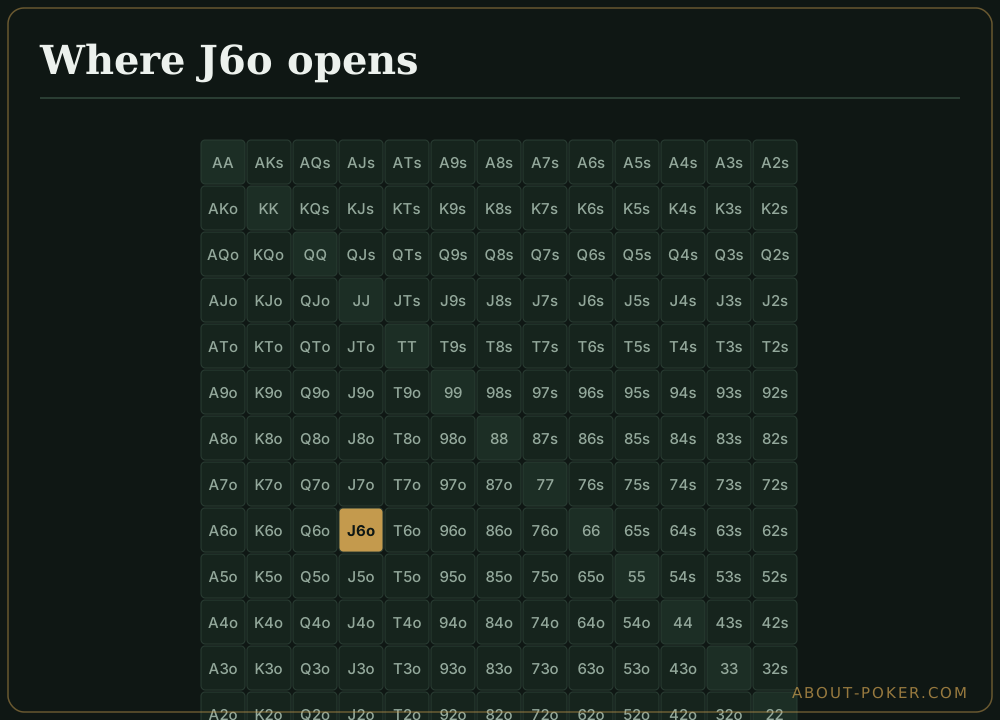
J6o is a raise-or-fold hand, and it barely qualifies to raise at all:
- Early and middle position: fold, without a second thought.
- Cutoff: fold in most solid ranges. It is too dominated to open profitably with players still to act.
- Button: at most a marginal steal. With only the blinds behind, J6o can pick up dead money and flop top pair against random defends, but it is at the very bottom of the button range.
- Small blind: open (raise) occasionally when it folds to you, or fold; do not limp it in.
- Big blind: defend against a single raise when you are getting a good price, then play cautiously.
For the exact borders seat by seat, ground yourself in the preflop opening ranges. J6o is below the cutoff for most positions and only flirts with the bottom of the button and small-blind ranges.
Why J6o is so weak
J6o suffers from domination and kicker trouble at the same time. A jack is not a premium high card — it is beaten on any queen-, king-, or ace-high board when those cards pair. And when you do flop top pair on a jack-high board, your six kicker loses to J7 through JT. J6o also has essentially no straight or flush potential, since it is a wide offsuit gapper, so it rarely improves to two pair, a straight, or a flush. Every part of the hand points the same direction: play it as little as possible.
The only situations that give J6o any life are very wide ranges. The jack blocks a few strong Jx and top pairs in a loose stealer’s range, so J6o can occasionally appear in a blind-versus-blind battle. Those spots are marginal and read-dependent; the framework lives in blind vs blind play and in defending the blinds.
Facing 3-bets and 4-bets
If you open J6o and get 3-bet, fold. You are dominated by stronger jacks, queens, kings, and aces, and you have no clean way to continue out of position. There is no meaningful 4-bet bluff case for a hand this weak either. Against any reraise, J6o goes in the muck.
A worked example
You open J♠6♥ from the button and the big blind, a solid regular, calls. The flop comes J♦ 8♣ 3♠ — top pair, weak kicker. You bet, and your opponent calls. The turn is a 5♦. Ask what continues against you: better jacks (JT, J9, J8 just made two pair), any set, and floats with a queen or king that could still outdraw you. Your six kicker beats bluffs and worse pairs but loses to almost everything that wants a big pot. You can check back or make one thin value bet against a passive player, but fold to real aggression — this is a weak one-pair hand. Heads-up, J6o has roughly 52% equity against a random hand, which is barely better than a coin flip and collapses once stronger hands stay in.
How the steal spot actually works
When J6o does open from the button, understand what it is doing and what it is not. It is not opening because it is a strong hand — it is opening because two random blind hands fold a large share of the time, and any raise that wins the blinds outright is instantly profitable regardless of your cards. That is the entire case for a button steal with trash: fold equity, not hand strength.
Two things break that case, and both should tighten you up. First, an aggressive blind that 3-bets a lot removes your fold equity and forces you to fold the best part of the time you get action, which turns the open into a slow leak. Against that kind of opponent, drop J6o from your button range entirely. Second, a loose caller in the big blind means you rarely win preflop and instead see flops out of position with a dominated hand — the worst combination. When either blind is sticky or aggressive, J6o is a fold even on the button.
Playing J6o after the flop
On the rare occasions you take J6o to a flop, keep the pot small and your decisions cheap. There are three realistic outcomes:
- You pair the jack: you have top pair, worst kicker. Bet once for value or protection against a passive opponent, but do not build a big pot. Against aggression, this is a one-street hand at most.
- You pair the six or flop bottom pair: treat it as a bluff-catcher against small bets only. Any real pressure means you fold.
- You miss entirely (the usual case): check and give up unless you pick up a real draw. A single small c-bet as a steal can work on a dry, disconnected board against one opponent, but do not fire multiple barrels with a hand that has no equity when called.
The discipline that keeps J6o from costing you money is refusing to get attached. It flops something usable rarely, and when it does, that something is fragile.
How J6o compares to its neighbors
It helps to see where J6o sits relative to hands one notch better. J7o and J8o are slightly stronger because the kicker gap shrinks and the straight potential improves marginally, but they are still weak and still fold from early and middle position. J9s or JTo clear a meaningfully higher bar because the suitedness or connectedness adds real equity. J6o has none of those upgrades — it is the offsuit jack with almost the worst legal kicker (only J5o through J2o rank below it), which is why it lives at the very bottom of what is ever playable.
Fold J6o from every early seat, treat it as a rare button and small-blind steal only, defend it cheaply in the big blind, and never call raises with it out of position.
Frequently asked
Is J6 offsuit a good hand?
No. J6o is a weak offsuit jack dominated by every stronger jack, by queens and kings, and by ace-x. It is a fold from almost every seat and only appears as a rare late-position steal.
Should I ever open J6 offsuit?
Only from the very back. J6o is at most a marginal button steal and a small-blind open when it folds to you. From early, middle, and even the cutoff it should be folded.
Can I call a raise with J6 offsuit?
No, apart from a cheap big-blind defend. Cold-calling an offsuit jack out of position is a clear leak because you are dominated so often and rarely improve to a strong hand.