How to Play Nine-Five Suited (95s)
Nine-five suited is a weak three-gap suited hand. Learn why 95s is mostly a fold, the rare spots where it opens, and how to play it when you defend the big blind.
On this page · 6 sections
Nine-five suited (95s) is a three-gap suited hand, and the gap is the problem. With three ranks separating the nine and the five, the hand makes very few straights — it needs a specific run of cards to connect — so almost all of its value comes from the flush. That makes 95s a weak, mostly foldable hand you include only at the very bottom of the widest ranges, and only when position and price are on your side.
Mostly a fold
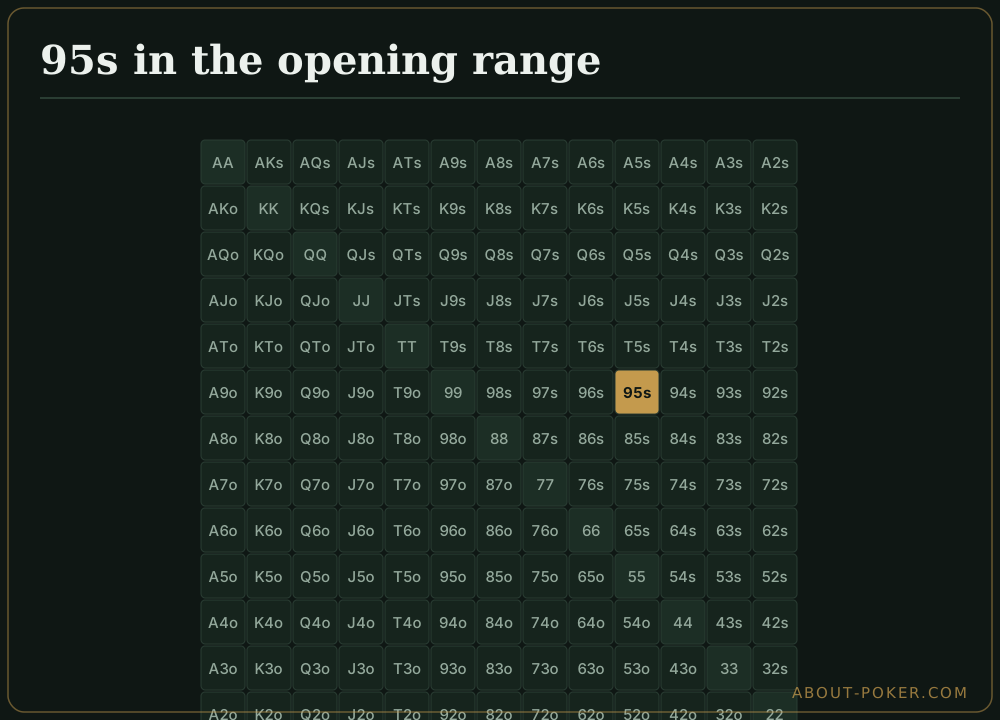
95s is a fold from every early and middle seat and, at best, a marginal button steal at the very bottom of your range. When the table folds to you on the button in a loose or passive game, you can occasionally open it to attack the blinds, leaning entirely on position and fold equity rather than the strength of the cards. In tougher games, or whenever the blinds fight back, it is a fold. Your preflop opening ranges should treat it as one of the first hands you cut when the lineup toughens up.
The comparison to nine-six suited is instructive: 96s already sits near the bottom of playability, and 95s is a full gap weaker again. Fewer straights, more dominated pairs, and the same reliance on the flush mean 95s should be folded in nearly every spot where 96s would be a marginal open.
Defending the big blind
The one recurring spot for 95s is the big blind against a single raise, where the price can justify a defend. You are closing the action and getting good pot odds, and the hand can flop a flush draw or the occasional straight draw. This is standard wide, price-driven big-blind defense — a call, never a 3-bet, because the hand is far too weak to want to build a big pot out of position.
A worked example
You hold 9♥5♥ in the big blind. The button opens to 2.5bb and you call. The flop comes K♥-8♥-3♣.
You have a flush draw — nine hearts give you the flush — which is about 35% equity by the river with two cards to come. This is the flop that makes 95s worth its occasional defend. You can check-call one reasonable bet drawing to the flush, or check-raise as a semi-bluff against an opponent who bets a wide range. What you should not do is get involved with a bare pair of nines or fives on this board; the flush draw is the hand, and once it misses across both streets you give up.
Postflop discipline
95s is a flush-or-fold hand more than a connector. Play it for its flush draws and the rare open-ender, and abandon it the moment the board is dry or high. Its pairs are among the weakest you can make — a nine-pair or five-pair is almost always dominated — so never treat them as value. Keep the pots small, take your free cards when the draw is live, and fold without hesitation when 95s bricks. Discipline with this hand means folding it far more often than you play it.
How the gap kills the straights
It helps to count exactly what the three-card gap costs. A true connector like 98s can make a straight four different ways — with 76, 7T, TJ, or JQ patterns filling around it — which is why it flops open-enders so often. 95s, by contrast, needs the board to bring specifically 6-7-8 to complete a straight through both cards, plus the two gutshot routes (6-7 giving a draw to the 8, or 7-8 giving a draw to the 6). In practice you will almost never flop an open-ended straight draw with 95s; you flop gutshots at best, and those are only four outs worth about 8.5% per street. That is the mathematical reason the hand leans so heavily on the flush: the straight equity that carries real connectors simply is not there.
Compare the two flops directly. On 7-6-4 a hand like 98s flops a monster wrap; 95s flops a bare gutshot to the eight. Same texture, wildly different equity. When you internalize that gap, folding 95s in marginal spots stops feeling like a laydown and starts feeling automatic.
How opponent type changes the spot
The rare times 95s is worth playing are almost entirely a read on the players behind you, not on the cards. Against a big blind that over-folds preflop and plays fit-or-fold postflop, a bottom-of-range button open picks up dead money often enough to profit, and your flush draws get paid when they hit. Against a big blind that defends wide and check-raises aggressively, the same open bleeds chips: you get floated, barreled off your gutshots, and forced to fold the many flops you miss.
The defend decision shifts the same way. Facing a small button open from a straightforward opponent who gives up when he misses, calling in the big blind with 95s and floating flop-to-turn to steal is reasonable. Facing a relentless triple-barreler, tighten up — your weak pairs cannot bluff-catch and your draws will not always get there. When in doubt with 95s, fold. The hand rewards discipline more than aggression, and the edge cases where it plays are narrow enough that folding is rarely a real mistake. For the neighboring hand that plays a touch more often, see nine-six suited, and lean on your preflop opening ranges whenever the seat is in question.
Frequently asked
Is nine-five suited a playable hand?
Barely. 95s is a three-gap suited hand with very limited straight potential. Its main value comes from making a flush. It is a fold from almost every position and only appears as a rare bottom-of-range button steal or a big-blind defend at a good price.
Should you open 95s?
In most games, no. 95s is too weak to open from early or middle position, and even on the button it is a marginal, bottom-of-range steal in loose or passive lineups. Against competent, aggressive blinds it is a clear fold.
What is the main way 95s makes money?
Flushes. Because the three-card gap kills most of its straight potential, 95s relies on its suitedness to make money. When it flops a flush draw, it can semi-bluff or realize equity cheaply, but its pairs and straight chances are weak and often dominated.