How to Play Nine-Four Suited (94s)
Nine-four suited is a very weak four-gap suited hand. Learn why 94s is almost always a fold, the rare big-blind defends, and how to play it when you must.
On this page · 7 sections
Nine-four suited (94s) is a four-gap suited hand, which is close to the floor of what is worth putting into any range. The four ranks between the nine and the four eliminate nearly all straight potential, leaving the flush as essentially the only way the hand makes a strong holding. That makes 94s a fold in almost every situation. It is worth knowing how to handle because it turns up occasionally in wide big-blind defenses, but the honest headline is that you fold it far more than you play it.
Almost always a fold
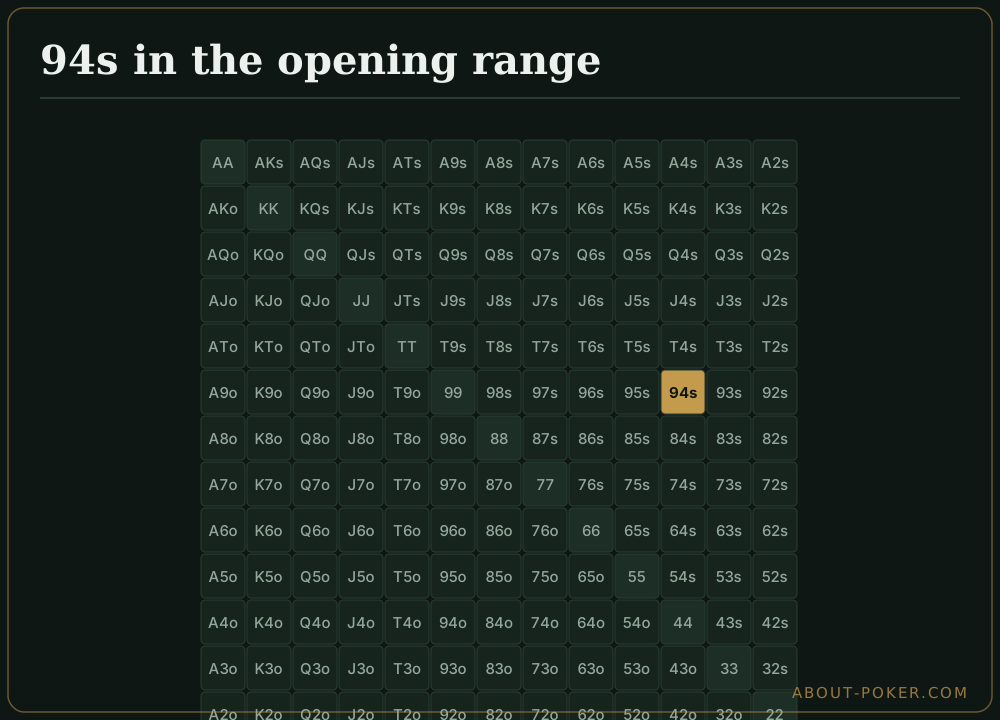
94s is a fold from every opening seat, the button included in most games. Unlike a true connector, it does not gain enough from position and fold equity to justify a raise-first-in, because when it gets called it makes weak pairs and few draws. If your preflop opening ranges include 94s as an open, they are almost certainly too loose for a competent game. The only environment where a rare button steal might be defensible is an extremely passive lineup where the blinds fold too much and never play back.
Compare it to nine-five suited, which is already a marginal, mostly foldable hand. 94s is another gap weaker, with even fewer straights and the same dependence on the flush, so it should be folded in essentially every spot where 95s would be a stretch.
The rare big-blind defend
The one place 94s appears is the big blind against a single raise at a good price. You are closing the action and getting pot odds, and the hand can flop a flush draw and realize some equity. This is bottom-of-range big-blind defense — a call, never a 3-bet, and one of the first hands to drop when facing a large raise or a strong, aggressive opener. Against big sizings or tough opponents, folding 94s preflop is completely standard.
A worked example
You hold 9♣4♣ in the big blind. The button opens to 2.5bb and you call. The flop comes Q♣-7♣-2♦.
You have a flush draw — nine clubs complete it — worth roughly 35% equity by the river with two cards to come. This is the flop that justifies the occasional defend. You can check-call one bet drawing to the flush, or check-raise as a semi-bluff against an opponent who continuation-bets a very wide range. If the flush misses on the turn and river, you are done: a bare pair of nines or fours on this board is essentially never good, and there is no straight potential to fall back on.
Postflop discipline
94s is a flush-or-fold hand with almost nothing else going for it. Play it strictly for its flush draws, and let it go the instant the board is dry, high, or disconnected from clubs. Its pairs are the weakest you can make and are dominated by nearly every hand that continues, so never value bet them. The discipline with 94s is mostly preflop discipline: fold it before the flop in the overwhelming majority of situations, and when you do defend it in the big blind, play it small, chase only the flush, and give up cheaply when it bricks.
Why the four-card gap is so costly
It helps to see exactly what the gap between the nine and the four takes away. A true connector like 98s can make four different straights (using the ranks around it), so it flops open-enders and gutshots constantly. Every extra rank of gap removes straight combinations. By the time you reach a four-gap hand like 94s, there is essentially only one long-shot straight left (a very specific 5-6-7-8 runout that uses both your cards), and it almost never materializes. In practice you should treat 94s as having zero straight equity. That leaves the flush and the occasional weak pair, and a flush draw only appears on roughly one flop in eight. Strip away the straights and you are left with a hand that connects hard very rarely — which is the whole reason it lives at the bottom of the chart alongside hands like nine-five suited.
When you can steal with it, and when you cannot
The rare case for putting 94s into a button range is pure fold equity, not the cards. If both blinds fold far too often — say a loose-passive live game where they surrender to any raise — a small button open can show a profit before the flop regardless of what two cards you hold. That is the only real justification. As soon as the blinds defend at a normal frequency, or as soon as one of them is a competent player who 3-bets and floats, 94s stops being profitable and should come out of the range. It is one of the first hands to cut when you tighten up, and one of the last to add when you loosen.
A short decision checklist
- Am I in the big blind getting a cheap price? If yes, a call is defensible; otherwise fold.
- Did I flop a flush draw? That is the only board texture worth continuing on with any real interest.
- Is there a bet and a raise in front of me? Fold immediately — 94s has no business in a contested pot.
- Are the blinds folding far too much and I am on the button? Only then consider a low-frequency steal.
Nearly every honest answer with 94s points to folding, and that is exactly the point. For the wider framework on which hands make the cut from each seat, see the preflop opening ranges and the guide to defending the blinds.
Frequently asked
Is nine-four suited a playable hand?
Barely, and only in one spot. 94s is a four-gap suited hand that makes almost no straights, so its only real value is the flush. It is a fold from every opening seat and appears mainly as a rare, price-driven big-blind defend.
Should you ever open 94s?
In almost all games, no. 94s is too weak to raise-first-in from any position, including the button in most lineups. If you find yourself wanting to open it, you are almost certainly opening too wide.
How does 94s make money?
Through flushes and the occasional cheap steal of the pot when a scary board hits your perceived range. Because the four-card gap removes nearly all straight potential, the suitedness is doing almost all the work, and even that is a thin edge.