How to Play King-Two Suited (K2s)
K2s is the weakest suited king and only opens from the button and small blind. Learn where K2s plays, when to fold it, and how to play it postflop.
On this page · 6 sections
King-two suited (K2s) is the very bottom of the suited-king family — the last combo to make it into any raising range and the first to get cut when a table plays back at you. Like every suited king it offers a king-high flush draw and a king blocker, but the deuce kicker is completely dead weight. K2s is a positional and pricing hand: you play it because you’re in the right seat and getting the right odds, not because the cards are good.
Where K2s belongs preflop
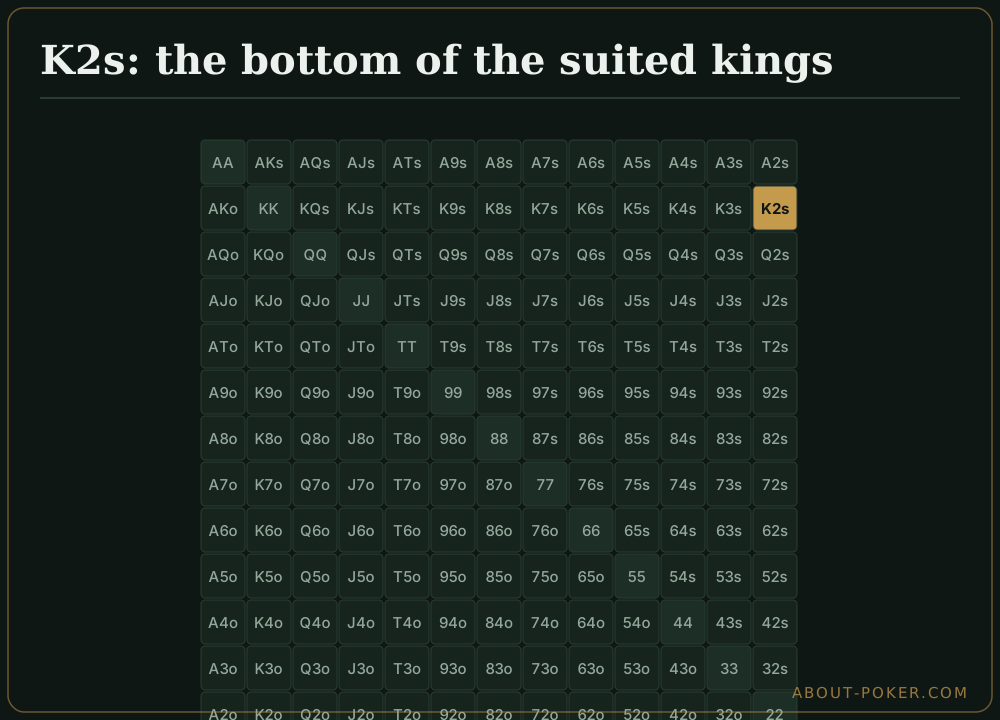
By position, K2s is almost exclusively a button, small-blind, and big-blind-defend hand:
- Early, middle, and cutoff: fold. There’s no seat this early where a hand this weak belongs. You’d be opening into players who dominate your king and derive nothing from the deuce.
- Button: a marginal but standard open. You’re raising your widest range here and you’ll have position on every street, which is exactly what a draw-and-blocker hand needs.
- Small blind: open (raise) rather than limp when it folds to you, since a raise gives you a chance to win uncontested and avoids playing a weak hand passively out of position.
- Big blind: defend against button and small-blind opens with a good price.
If you’re unsure where the line falls, lean on the preflop opening ranges and see how ranges balloon in late position in poker ranges by position.
Why the deuce kicker matters so much
The problem with K2s is domination without kicker help. When you flop top pair with a king, the deuce contributes nothing — you’re a pure bluff-catcher, ahead of a random weaker king but crushed by A-K, K-Q, K-J, K-T, and K-9. Unlike a hand such as K9s, you can’t even fall back on second pair having value, because the two rarely pairs into anything meaningful.
That’s why K2s only opens from the two latest seats. From the button, the field is nearly exhausted and you have position to keep the pot small; anywhere earlier, the odds that someone holds a better king climb fast, and a weak top pair out of position is a chip-leak waiting to happen.
Facing a raise
Against an open, K2s is a fold in nearly every spot. It’s far too weak to 3-bet for value, and it’s a poor 3-bet bluff because higher suited kings and suited connectors do the blocking job better while retaining more equity. Out of position it can’t call profitably. The lone exception is the big blind defending against a late-position open with a great price, where closing the action cheaply justifies seeing a flop.
A worked example
The action folds to you on the button and you open K♣2♣. The big blind defends. The flop comes Q♣ 8♣ 3♦ — you’ve flopped the king-high flush draw with two overcards to nothing useful. This is your best-case flop: a nine-out draw plus a king overcard.
You continuation-bet; the big blind calls. Turn is the 6♠, a brick. You can fire again as a semi-bluff — you still have nine clean flush outs and fold equity — but keep sizing reasonable so a raise doesn’t cost you much. River is the 2♠, pairing your deuce but leaving you with just bottom pair and a busted draw. You check. Bottom pair with no showdown value against a calling range is not a bet; you give up and lose the minimum. Notice the pattern: K2s made its money as a draw, not as a made hand. When the draw misses, you fold quietly. That is the entire life cycle of the hand.
Postflop in one paragraph
When K2s flops a flush draw, it’s the king-high flush draw and the reason to play the hand at all — semi-bluff it while respecting that a higher flush exists. When it flops top pair, treat it as a bluff-catcher: bet small once for thin value and control the pot, because a big pot with no kicker is a losing pot. When it flops air, the king blocker plus backdoor equity make it a fine give-up on most boards. K2s is a draw-first hand; its made-hand value is almost always thin.
Where to go next
K2s marks the floor of the suited-king range — a pure button-and-blinds hand that any earlier seat should fold. Anchor the seat logic in poker ranges by position, calibrate your widest opens with preflop opening ranges, sharpen the small-blind and big-blind spots in blind vs blind play, and tie it together at the preflop strategy hub.
Frequently asked
Is K2 suited a good hand?
K2s is the weakest of all suited kings and a marginal hand overall. It's playable only from the button and small blind, where the range is very wide, and it should be folded everywhere else. Its entire value is the king-high flush draw and the king blocker.
Should I 3-bet with K2 suited?
Almost never. K2s is too weak to 3-bet for value and a poor bluff candidate because suited connectors and stronger suited kings block more of your opponent's continuing range. Occasionally it can be a low-frequency bluff, but there are far better choices.
Can I defend K2 suited in the big blind?
Yes, against a button or small-blind open with a good price. You're closing the action cheaply with a hand that can flop flushes, straights via the wheel, and pairs. It's still a low-equity hand, so play cautiously postflop and don't get attached to a weak pair.