How to Play Pocket Sevens (77)
Pocket sevens is a raise-first hand that plays for sets against big raises. Learn where 77 opens, when to call for set value, and how to handle it postflop.
On this page · 7 sections
Pocket sevens (77) is a small-to-middling pair that plays two ways at once: as a raise that wins pots preflop and on low boards, and as a set-mining hand that occasionally flops the nuts and stacks someone. It is comfortably a raise-first hand from every seat, but it demands discipline — an unimproved pair of sevens is fragile on high boards. Knowing when 77 is a monster and when it is just one pair is the whole game.
Where 77 belongs
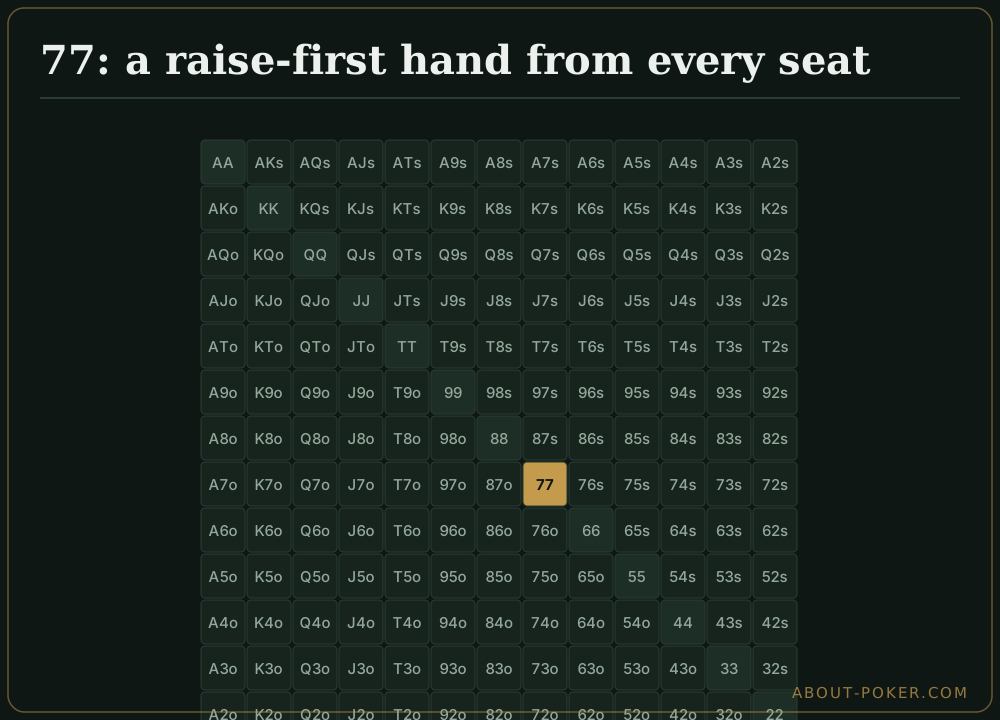
77 is a raise-first hand from every position. Open it from under the gun through the button in both 6-max and full-ring; it sits inside all of your preflop opening ranges. You never limp it — the raise wins the pot outright often enough, and when called you still have the set-mining upside. This is different from the marginal offsuit hands that only open late; a pocket pair has value from any seat, which is a core lesson of poker ranges by position.
Against a raise, 77 usually prefers to call and set-mine, particularly versus tight early-position opens where a 3-bet just isolates you against a range full of overpairs. As an occasional 3-bet it works best from the blinds or against a wide late-position steal, where fold equity is higher.
Set-mining and the math
The reason to call with 77 is the set. You flop three of a kind about 11.8% of the time — roughly 1 in 8.5. A flopped set is enormously strong and often invisible, which lets you win big pots against overpairs and top pair. But because sets come only one flop in eight-and-a-half, you need the implied odds to justify a call: as a rule of thumb, you want to be able to win about 10 times the amount you call. Deep stacks and opponents who pay off make set-mining profitable; shallow stacks against a tight raiser do not.
Equity-wise, 77 is a small pair — it is roughly a coin flip against two overcards like AK (about 52–54% for the pair), and a big underdog to a higher pocket pair (about 19% against, say, TT or QQ). That is why an unimproved 77 does not want to play a huge pot against a raising, re-raising opponent.
Playing 77 postflop
The board decides everything. On a low, dry flop like 8-4-2, an unimproved 77 is often the best hand and can bet for value and protection. On a high or coordinated flop like K-Q-9, your sevens are usually behind and should be played as a cheap pair — check, control the pot, and give up to real pressure rather than paying off overpairs and top pair.
And when you flop a set, get the money in. A set on a wet board wants to bet and raise now, before a scare card kills your action. The contrast with a hand like pocket eights is only a matter of degree — every small and middling pair lives on this same line between “best hand on low boards” and “one pair that must fold to pressure on high ones.”
A worked example
You open 77 to 2.5 big blinds in the cutoff. The button 3-bets to 8 big blinds and stacks are 100 big blinds deep. You call to set-mine. The flop comes 7-5-2 rainbow — you have flopped a set on a dry board against a likely overpair or big Broadway range. You check, the button continuation-bets, and you can call or raise; against a strong range, calling once to keep worse hands in and then building the pot on the turn often wins the most. Either way, this is where 77 makes its money — the eight-times-out-of-nine you miss are the price of admission for the one time you flop the near-nuts and get paid.
Set-mining only works at the right stack depth
The whole set-mining plan lives and dies on implied odds, and implied odds scale with stack depth. If you flop a set only one time in 8.5, you need to win roughly 10 times your call on the times you do hit to break even on the pure set-mine. That is easy at 100bb or deeper, where a stacked-off overpair pays you 30 or 40 big blinds. It falls apart short.
Work a concrete number. Suppose you are 40bb deep and facing a 3-bet that costs you 6bb to call. To justify calling purely to set-mine, you want to win about 60bb when you hit — but there are only 40bb behind, so the math does not clear on the set alone. That is why, as stacks get shorter, 77 stops being a call-and-set-mine hand and becomes a 3-bet-or-fold hand: at 20 to 25bb it is a fine re-shove that dominates a loose range and flips against overcards, but a poor flat, because you can no longer get paid enough on your sets.
Reading the opponent
Who raised matters as much as the price. Against a loose-passive player who opens wide and pays off big, set-mining is a dream — flat freely and stack them when you hit. Against a tight, aggressive regular who only 3-bets premiums and folds their overpair when the board gets scary, your implied odds shrink, because the times you flop a set they often will not pay. Against a maniac who barrels every board, 77 gains value as a bluff-catcher and occasional 3-bet, since their range is full of air you are already ahead of.
A quick decision checklist
- Always raise 77 first-in from any seat; never limp.
- Facing a raise, default to call and set-mine — especially versus early-position opens.
- Only set-mine when effective stacks are roughly 10x the call or deeper.
- Short (20–25bb), treat 77 as a 3-bet or re-shove, not a flat.
- Flop a set: get the money in, faster on wet boards than dry.
- Unimproved on a high or coordinated board: play it as one pair — control the pot and fold to real pressure.
For the very next pair up, whose story is almost identical but a notch stronger on high boards, see pocket eights; to place 77 inside your full seat-by-seat strategy, revisit poker ranges by position.
Frequently asked
Can you open pocket sevens from any position?
Yes. 77 is inside every opening range, from under the gun to the button, in both 6-max and full-ring. It is a clear raise-first hand — you never limp it — because it makes money as a preflop raise and can flop the strongest hand in poker, a set.
Should you call or 3-bet with 77 facing a raise?
Usually call, especially against early-position opens, so you can set-mine and realize your equity cheaply. It works as an occasional 3-bet from the blinds or against late-position steals, but its main plan against a strong range is to see a flop and hit a set.
What are the odds of flopping a set with 77?
About 11.8%, or roughly 1 in 8.5. That is why deep enough stacks and the right price make set-mining profitable — you need implied odds around 10-to-1 or better to call purely to flop a set.