How to Play Pocket Sixs (66)
Pocket sixes is a small pair that lives on set value. Learn how to open, set-mine, and pot-control 66 preflop and postflop when overcards are almost guaranteed.
On this page · 6 sections
Pocket sixes (66) is a real pocket pair, which puts it ahead of most starting hands, but it’s a small one. It’s a favorite against two random overcards, yet almost every flop brings a card higher than a six — you’ll be looking at overcards on well over 90% of boards. That means 66 leans heavily on set value: its biggest profits come from flopping a set and stacking someone, not from winning showdowns with an unimproved pair of sixes.
Where 66 belongs preflop
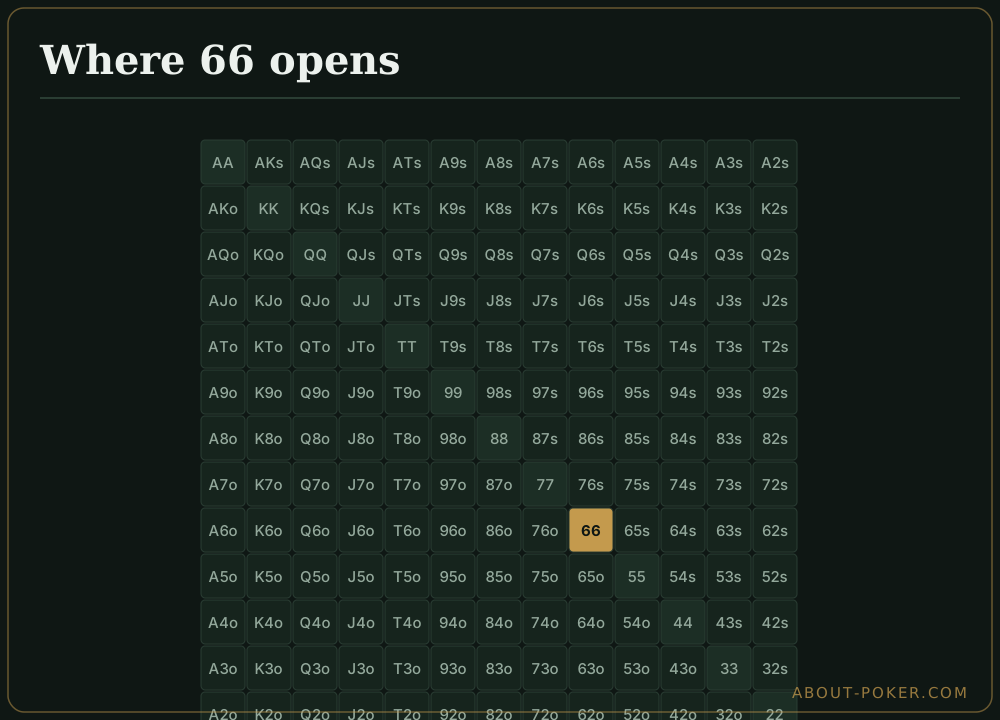
66 is strong enough to open from every seat:
- Early through late position: a standard open. It is ahead of a large chunk of the field and makes money by raising first in.
- Small blind: open (raise) when it folds to you.
- Big blind: defend widely; 66 is comfortably inside your defending range against a single raise.
For the exact opening frequencies by seat, ground yourself in the preflop opening ranges. 66 sits in the same “open everywhere” tier as the other small and middle pairs.
Set-mining is the core plan
The number to internalize is that you flop a set roughly once in every eight tries (about 11.8%). When you do, you have a hidden monster; when you don’t, you usually have a mediocre pair on an overcard board. That asymmetry drives how you play 66 against raises. To set-mine profitably, you generally want the implied odds to justify the call — a common shorthand is that you’d like to be able to win around 10-15 times the amount you call when you hit, which requires deep enough stacks and an opponent who will pay you off.
Because 66 realizes its equity mostly by flopping a set, it is usually a better call than 3-bet against tight ranges. If you 3-bet and get 4-bet, you fold a hand that could have made you a big pot cheaply. This is the same logic you apply with slightly larger pairs like pocket eights; the smaller the pair, the more it wants to see a flop cheaply rather than bloat the pot preflop.
Playing 66 after the flop
When you flop a set, play it fast in most spots — bet and raise to build the pot while your hand is disguised. When you flop an overcard board and hold just a pair, shift into pot control: check back or make small bets, and be ready to fold to serious aggression. Sixes are rarely worth stacking off with once several overcards are out and opponents show strength. Facing a 3-bet, calling to set-mine in position is standard; the broader continuing framework is covered in defending against 3-bets.
A worked example
You open 6♣6♦ from the cutoff and a tight big blind calls. The flop comes K♠ 9♥ 4♣ — two overcards, no set. Your pair of sixes is almost certainly behind any king and beats only bluffs and worse pairs. When your opponent bets, this is a clean fold or cheap-check spot, not a hand to defend hard. Contrast that with the same open where the flop is 6♠ 9♥ 4♣: now you have a set, you’re crushing top pair and overpairs, and you should bet to grow the pot. The two boards look similar but the difference between flopping your set and not is the whole story of pocket sixes.
For reference, 66 has roughly 80% equity against two random overcards like A♣K♦ before the flop, but that is a preflop snapshot — postflop it’s the set, not the raw equity, that pays the bills.
Common mistakes with pocket sixes
Three leaks cost players the most money with 66, and all of them stem from overvaluing an unimproved pair.
The first is calling raises with the wrong stack depth. Set-mining only works when the implied odds are there. If you are 40 big blinds deep and call a 3-big-blind raise hoping to flop a set, you are risking 3 to win a pot that can never get large enough to justify the 7.5-to-1 you are effectively drawing at. A rough rule: your remaining stack should be at least 10 to 15 times the amount you call preflop, or the set-mine loses money over the long run.
The second is stacking off with an overpair that isn’t. When the flop comes all low — say 5-3-2 — sixes is technically an overpair, but it is the weakest possible one. A single call and a scary turn can leave you guessing, and against a raise you are usually behind a bigger pair, a set, or two pair. Treat low-board sixes as a medium-strength hand, not a monster.
The third is folding sets too passively out of fear. Once you flop your set, the mistake flips: players slow-play and let free cards kill their action. On a wet board like 6-7-8 two-tone, bet and raise fast — your set is strong but vulnerable, and charging draws is worth more than trapping.
How 66 changes by position and opponent
Against a tight opener, 66 is almost purely a set-mine: their range is full of bigger pairs and strong broadways, so your unimproved sixes are behind and only the set is reliably good. Call, hit or fold, and keep the pot small when you miss.
Against a loose or aggressive opponent, 66 gains value as a made hand. A wide late-position range contains many unpaired big cards and weaker pairs, so your sixes are often ahead preflop and can even take a flop down with a single bet on a low board. Against these players you can occasionally 3-bet 66 as a semi-bluff, especially in position, because you fold out overcards and set-mine the times you get called. The same 66 that is a passive set-mining call against a nit becomes an active, aggressive hand against a maniac.
Open 66 everywhere, prioritize set-mining over 3-betting into strong ranges, size your set-mines to the stacks, and pot-control hard when you miss. For the neighboring pair one rung up, compare the plan in pocket eights.
Frequently asked
Is pocket sixes a good hand?
66 is a playable small pocket pair that opens from every seat, but it is a set-mining hand at heart. It flops an overcard almost every time, so its value comes mostly from hitting a set or holding up in small pots.
Should I 3-bet with pocket sixes?
Occasionally. 66 works better as a set-mining call than a value 3-bet against tight ranges full of bigger pairs. Against very wide late-position opens it can 3-bet as a semi-bluff, but calling to see a cheap flop is often the higher-EV line.
How often does pocket sixes flop a set?
About one flop in eight — roughly 11.8% of the time you flop a set or better. That single number drives most of your decisions with 66, especially when the pot could get big against a stronger range.