How to Play Pocket Threes (33)
Pocket threes is a tiny pair that lives on set mining and implied odds. Learn how to open, call, and play 33 across positions and stack depths without spewing chips.
On this page · 6 sections
Pocket threes (33) is about the smallest pocket pair you will play seriously, and small pairs are all about one thing: flopping a set. On its own, 33 makes a tiny pair that nearly any two overcards can outdraw, but when a three hits the flop you hold a hidden, powerful hand that can win stacks. That set-mining upside — plus the fact that a pair already beats two random overcards — makes 33 a genuine hand, clearly stronger than trash offsuit holdings but a step below middling pairs like pocket fives. Preflop, 33 wins about 52% against two overcards such as ace-king but is roughly a 4-to-1 underdog against any larger pair.
The core idea: set mining
The reason to play 33 is that you flop a set about 12% of the time — roughly one flop in eight, or 7.5-to-1 against. When you do, you have a disguised monster that can stack an overpair or top pair. The rest of the time you flop an underpair or worse and usually give up cheaply.
Because almost all of 33’s profit is packed into those set flops, the key question is always: can I win a big enough pot when I hit to pay for the times I miss? With deep stacks and an opponent likely to pay you off, set mining is highly profitable. With shallow stacks, the payoff shrinks and 33 loses most of its appeal.
Opening and facing raises
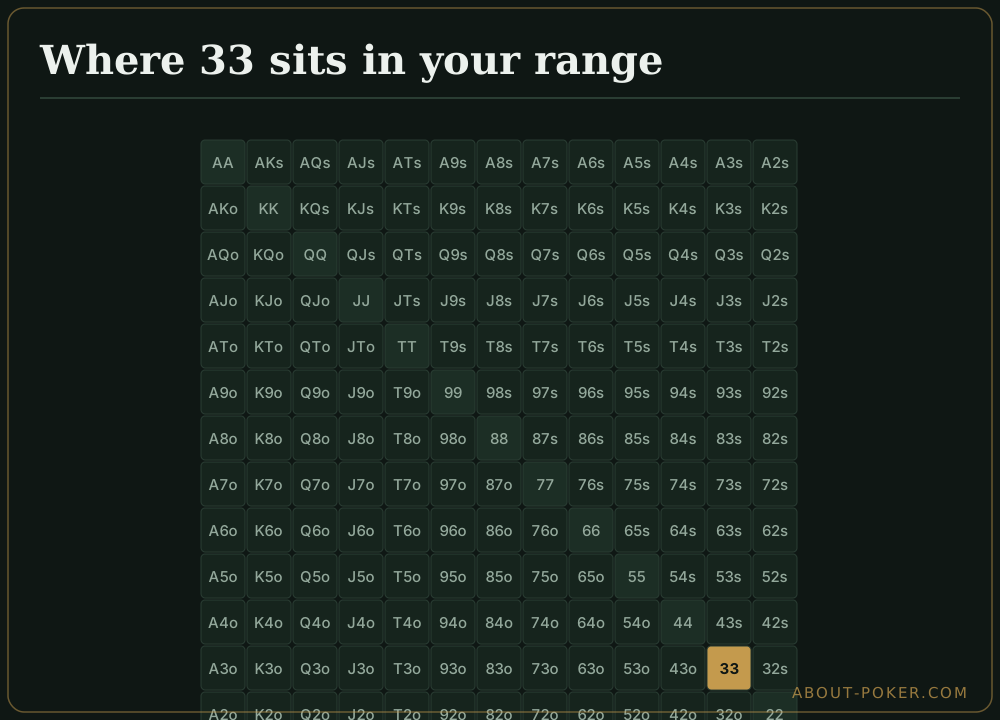
As an open, 33 is comfortable from middle position through the button and the small blind in most 6-max games. It makes a pair that beats many random hands and carries set-mining upside when called. Your preflop opening ranges should include it from those seats; under the gun in full ring it is more marginal.
Facing a raise, 33 generally prefers to call and set mine rather than 3-bet, especially with deep stacks against a wide opener. Against a very tight early-position raiser with shallow stacks, folding is fine — you are dominated by bigger pairs and cannot get paid enough on your sets. From the big blind, 33 is a fine defend against late-position steals thanks to the price and set potential.
A worked example
You open 3♠3♣ from the cutoff, the button calls, and the flop comes K♥-3♦-8♣.
You have flopped bottom set — three threes on a king-high board. This is close to ideal. The king gives opponents plenty of top-pair and overpair hands to pay you off, while your set is well hidden. Bet for value across the streets and be ready to get the chips in: your set beats every top pair, two pair, and overpair. At roughly 100-big-blind stacks, this is exactly the payoff that makes set mining with 33 profitable over time.
Now picture the flop as Q♥-J♠-9♦. You hold an underpair on a coordinated, overcard-heavy board and did not improve. Here 33 is weak — you are behind most hands that continue, so check and give up cheaply instead of pouring chips into a losing pot.
Stack depth changes everything
Set mining depends entirely on stack depth. A useful implied-odds guideline is to want at least 10 to 15 times your preflop call available behind, because you flop a set only about one time in eight. With deep 100-big-blind stacks and a player who will pay off a set, calling a raise with 33 is comfortably profitable. With 30 big blinds or fewer, you simply cannot win enough when you hit, so 33 shifts toward either open-raising or folding rather than passive set mining.
This is why 33 plays differently as tournament stacks shorten. When deep, prioritize cheap flops to hunt sets. When short, lean on 33’s raw pair equity: it is a fine hand to open-shove or 3-bet-shove, since it beats two overcards and only badly trails larger pairs, which are a small slice of most calling ranges. Handled with that discipline, pocket threes quietly banks money without ever needing to be a big hand.
Playing the flop when you hit — and when you don’t
Flopping a set with 33 is the payoff, but it still has to be played well to collect. A few points separate a winning set from a mediocre one.
- Bet, don’t slowplay, on wet boards. On a board like 9-8-3 with two of a suit, your set of threes is vulnerable to straights and flushes that complete on the turn. Charge the draws now. Slowplaying is a luxury reserved for dry, disconnected boards where nothing realistic is drawing out on you.
- Value bet the whole way on dry boards. On a K-3-8 rainbow flop, there is almost nothing to fear. Here you can bet smaller, let opponents catch a top pair or bluff, and build the pot across three streets.
- Watch for the overfull. Bottom set is the weakest set. On paired boards or against passive players who suddenly wake up with aggression on a high board, keep an eye out for a bigger set or a full house. Bottom set is a strong hand, not an unbeatable one.
When you miss — which is seven flops out of eight — the discipline is just as important. An underpair on an overcard board is a check-fold most of the time. Do not turn a set-mining hand into a bluffing station; the entire profitability of 33 assumes you give up cheaply on the many flops where you brick.
A second worked example: facing a 3-bet
You open 3♠3♣ from the button and the small blind 3-bets. Stacks are 100bb.
Here the set-mining math tightens. You are calling a larger price to see a flop, and you will only stack the 3-bettor’s overpairs and strong top pairs when you actually hit your one-in-eight set. With 100bb behind and a 3-bettor whose range is full of hands that will pay off a set (AA, KK, QQ, AK), calling to set-mine is defensible. But shrink the stacks to 40bb and the same call is a clear fold — there is no longer enough money behind to reward the rare set, and 33 has no other way to win the pot against a strong, capped-out-of-your-league range. This is the implied-odds guideline in action: the deeper the effective stack, the more a 3-bet call with 33 makes sense; the shallower it gets, the faster 33 becomes a fold. Compare this to the slightly-more-flexible pocket fives, which can occasionally flop an overpair to low boards that 33 rarely can.
Frequently asked
Is pocket threes a good hand?
It is a small but real hand. Preflop, 33 is a slight favorite over two overcards (about 52%) but a big underdog to any larger pair. Its value comes almost entirely from set mining: flopping three of a kind gives you a disguised hand that can win a big pot.
Should you open pocket threes?
Yes, from later positions. 33 opens comfortably from the cutoff, button, and small blind in most 6-max games, and from middle position too. From under the gun in full ring it is marginal. Facing a raise, it usually prefers to call and set mine when stacks are deep.
When should you fold pocket threes?
Fold 33 when you cannot realize its set-mining value: facing a raise and a 3-bet with shallow stacks, against very tight ranges that dominate you, or postflop on overcard-heavy boards where you missed and face real aggression.