How to Play Pocket Fives (55)
Pocket fives is a small pair that thrives on set mining and clean board coverage. Here is how to open, call, and play 55 across positions and stack depths.
On this page · 5 sections
Pocket fives (55) is a small pocket pair, and small pairs are all about one thing: flopping a set. On its own, 55 makes a modest pair that plenty of overcards can outdraw, but when a five hits the flop you hold a hidden, powerful hand that wins stacks. That set-mining upside, plus the fact that a pair is already ahead of two random overcards, makes 55 a real hand — clearly stronger than the trash offsuit holdings, and a step below the premium pairs like pocket eights and higher. Preflop, 55 wins about 52% against two overcards such as ace-king (a small favorite) but is a big underdog — roughly 19% — against any larger pair.
The core idea: set mining
The reason to play 55 is that you flop a set roughly 12% of the time — about one flop in eight, or 7.5-to-1 against. When you do, you have a disguised monster that can stack an overpair or top pair. The rest of the time you flop an underpair or worse and usually give up cheaply.
Because most of 55’s profit is concentrated in those set flops, the key question is always: can I win a big enough pot when I hit to justify the times I miss? With deep stacks and an opponent likely to pay you off, set mining is highly profitable. With shallow stacks, the payoff shrinks and 55 loses much of its appeal.
Opening and facing raises
As an open, 55 is comfortable from middle position through the button and the small blind in most games. It makes a pair that is ahead of many random hands and carries set-mining upside when called. Your preflop opening ranges should include it from those seats; under the gun in full ring it is more marginal, though six-max ranges open it routinely.
Facing a raise, 55 generally prefers to call and set mine rather than 3-bet, especially when stacks are deep and the opener’s range is wide. Against a very tight early-position raiser with shallow stacks, folding is fine — you are dominated by bigger pairs and cannot get paid enough on your sets. From the big blind, 55 is a strong defend against late-position steals thanks to the price and its set potential.
A worked example
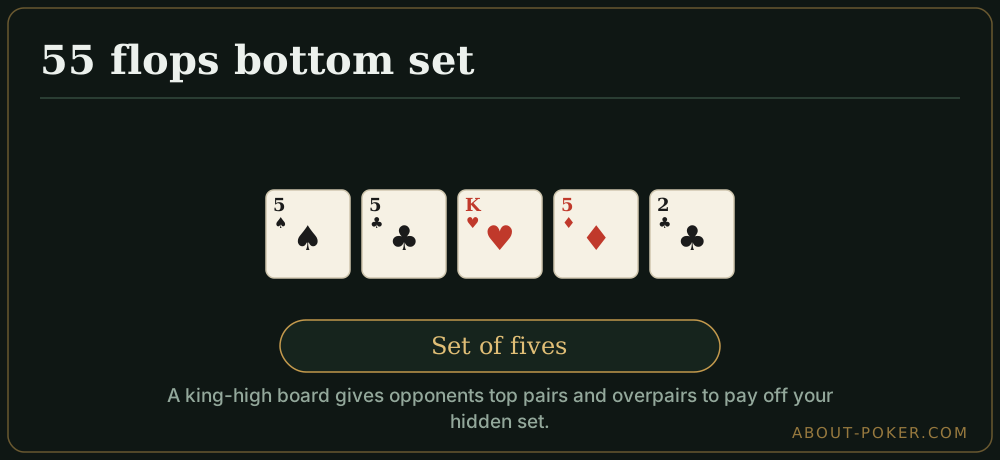
You open 5♠5♣ from the cutoff, the button calls, and the flop comes K♥-5♦-2♣.
You have flopped bottom set — three fives on a king-high board. This is close to a dream flop. The king gives an opponent plenty of top-pair and overpair hands to pay you off, while your set is well hidden and rarely suspected. Bet for value across the streets and be prepared to get all the chips in: your set beats every top pair, two pair, and overpair. Against roughly 100-big-blind stacks, this is exactly the payoff that makes set mining with 55 profitable over the long run.
Now imagine the flop is Q♥-J♠-9♦. You hold an underpair on a coordinated, overcard-heavy board and have not improved. Here 55 is weak — you are behind most of the hands that continue, and you should check and give up cheaply rather than pour chips into a losing spot.
Stack depth changes everything
Set mining lives and dies on stack depth. A common rule of thumb is the implied-odds “5-and-10” guideline: you want to be able to win at least 10 to 15 times the amount you call, because you flop a set only about one time in eight. With deep 100-big-blind stacks and an opponent who will pay off a set, calling a raise with 55 is comfortably profitable. With 30 big blinds or fewer, the payoff shrinks — you simply cannot win enough when you hit — and 55 loses much of its calling value, shifting toward either open-raising or folding rather than set mining.
This is why 55 plays differently in tournaments as blinds climb and stacks shorten. When you are deep, prioritize seeing cheap flops to hit sets. When you are short, lean on 55’s raw pair equity: it is a fine hand to open-shove or 3-bet-shove with, since it is ahead of two overcards and only badly behind bigger pairs, which make up a small slice of most calling ranges.
The right mindset
Play 55 as a set-mining hand first. Open it from most seats, call raises to see cheap flops when stacks are deep enough to reward a set, and defend it in the big blind at a good price. Postflop, get aggressive when you flop a set and let go quickly when you miss on scary boards. The discipline to fold your unimproved underpair is what keeps 55’s frequent misses cheap and its rare sets pure profit.
Frequently asked
Is pocket fives a good hand?
It is a solid but small pocket pair. Preflop, 55 is a modest favorite over two overcards but an underdog to any bigger pair. Its main value is set mining: flopping three of a kind gives you a strong, well-disguised hand that wins big pots.
Should you open pocket fives?
Yes, from most positions. 55 is a standard open from middle position through the button and small blind. From under the gun in a full-ring game it is closer, but in six-max it opens comfortably. Against a raise, it usually prefers calling to set mine when stacks are deep.
When should you fold pocket fives?
Fold 55 when you cannot realize its set-mining value: facing a raise and a 3-bet with shallow stacks, against very tight ranges where you are dominated by bigger pairs, or postflop on overcard-heavy boards where you have not improved and face real aggression.