How to Play Queen-Four Suited (Q4s)
Q4s is a marginal suited queen that only opens from late position and the small blind. Learn where Q4s belongs, when to fold it, and how to play it after the flop.
On this page · 6 sections
Queen-four suited (Q4s) is one of the weakest suited queens you’ll ever consider playing. It survives only on the two features every suited hand shares — a flush draw and the occasional top pair — but the four kicker is so low that its top pair is almost always second best when money goes in. This is a hand for stealing, not for grinding out value, and it belongs in your range in only a couple of spots.
Where Q4s belongs preflop
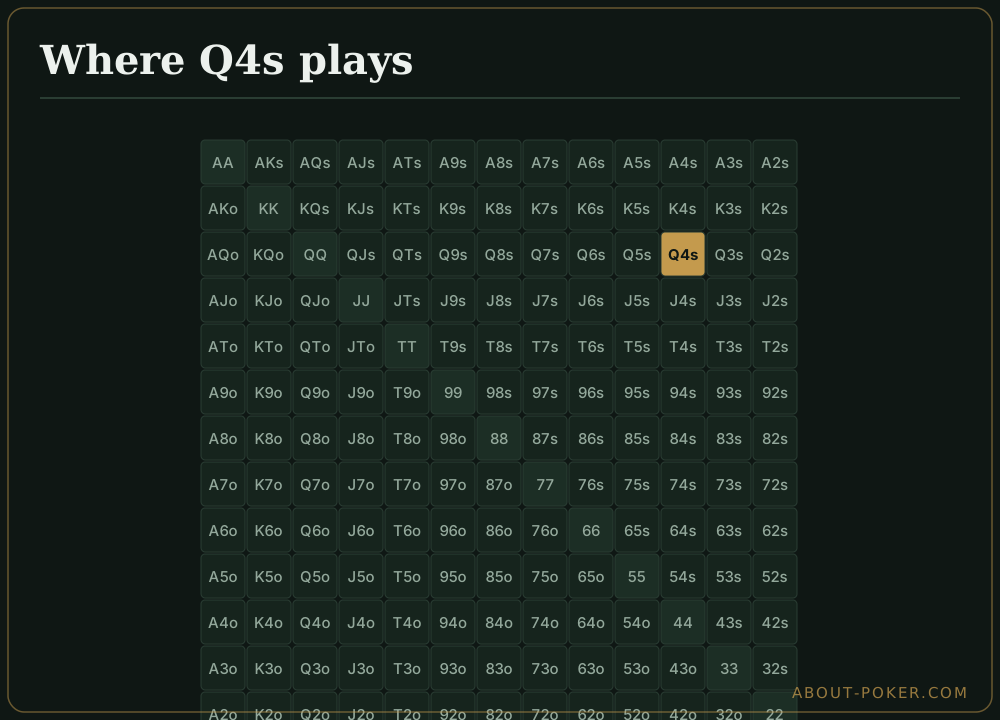
By position, Q4s is a late-position-only open:
- Early and middle position: fold. You’re opening into too many players and Q4s is well below the threshold of a profitable open here.
- Cutoff: mostly a fold in tighter games, a thin open in loose ones. Treat it as the very bottom of your considering range.
- Button: an open. You’re raising a wide range to attack the blinds, and Q4s clears the bar because it can steal outright and flops flushes and top pairs.
- Small blind: open (raise) rather than limp when the action folds to you. You have only one player left to get through and a suited hand plays fine heads-up.
- Big blind: defend selectively against a single late-position open at a good price.
If the exact borders feel fuzzy, anchor yourself in the preflop opening ranges and see how they widen by seat in poker ranges by position.
The domination problem
The core weakness of Q4s is domination. When you flop top pair with the queen, you’re frequently up against a better queen — KQ, QJ, QT, or another queen with a live kicker. Your four almost never plays as a kicker, so your top pair is really “top pair, no kicker.” That means your hand wants to see a cheap showdown, not build a big pot.
This is also why Q4s doesn’t want to play multiway. The more opponents in the pot, the more likely one of them has a dominating queen or a made hand that beats a single pair. Q4s is at its best heads-up, in position, where you can control the size of the pot and win a lot of pots uncontested.
Facing a raise
When someone has already raised, Q4s is a fold in nearly every seat. It’s too weak to call an open out of position and too weak to 3-bet. The one exception is the big blind: closing the action against a button or cutoff open, getting a discounted price, you can call and take a flop. See how wide those defenses run in defending the blinds.
Never 3-bet Q4s. It’s not a value hand, and it’s a weak bluff — the queen blocks few of the hands your opponent continues with, and the four blocks nothing useful.
A worked example
You open Q♥4♥ from the small blind after everyone folds. The big blind calls. The flop comes Q♠ 9♦ 4♣ — you’ve flopped top two pair, which for Q4s is close to a dream flop.
You bet, the big blind calls. Turn is the 2♠. You bet again for value; a worse queen or a nine will pay you off. River is the 8♦, completing no obvious draw. Now think about what calls a third bet: a worse queen, a stubborn pocket pair, a nine that refuses to fold. A moderate value bet is correct — you’re targeting the queen-x hands that can’t let go. Two pair from a hand this weak is exactly the payoff that makes the occasional Q4s steal worthwhile.
Contrast that with flopping just top pair — Q♠ 8♦ 3♣. Now your queen-with-a-four-kicker is fragile, and the right play is usually a single small bet and then pot control. You do not want to stack off with one pair and the worst possible kicker.
Postflop in one paragraph
When Q4s flops a flush draw, play it aggressively — you have real equity and fold equity, and you can win a big pot when it comes in. When it flops top pair, keep the pot small: bet once for thin value or protection, but don’t commit stacks with a bare queen. When it flops two pair or better, it becomes a genuine value hand you can bet across streets. And when it flops air, give it up cheaply — there’s no kicker or blocker equity worth barreling for. Q4s is a hand whose whole profit comes from stealing preflop and hitting hard postflop, not from grinding thin edges.
Where to go next
Q4s marks roughly the floor of the suited-queen family: playable as a late-position and small-blind steal, unplayable everywhere else. Tighten your opens with preflop opening ranges, learn where the seat-by-seat borders sit in poker ranges by position, and connect it all through the preflop strategy hub.
Frequently asked
Is Q4 suited a good hand?
Q4s is a marginal hand. It's a fine open only from the button and small blind, where you can steal the blinds and still make a flush or top pair when called. From every earlier seat it belongs in the fold pile because the four kicker leaves you dominated too often.
Should I 3-bet with Q4 suited?
Almost never. Q4s doesn't have enough equity to 3-bet for value, and it's a poor bluff because the queen blocks few of your opponent's continues while the four does nothing. If you want a suited-queen bluff, hands with more straight potential are better choices.
Can I defend Q4 suited in the big blind?
Yes, against a single late-position raise at a good price you can call. You're getting a discount to see a flop with a hand that can flop a flush draw or a pair. Fold it against early-position opens and against multiple raises.