How to Play Six-Four Suited (64s)
64s is a small suited connector with straight and flush potential. Learn where 64 suited opens, why it's a blind-defense hand, and how to play it postflop.
On this page · 8 sections
Six-four suited (64s) is a small suited connector — a speculative hand that earns its keep through the straights and flushes it makes, not through raw high-card strength. On its own, 6-high is nothing. What you’re buying when you play 64s is a lottery ticket with reasonable odds: the chance to flop a strong draw or a hidden two pair and stack someone who can’t fold top pair.
Where 64s belongs preflop
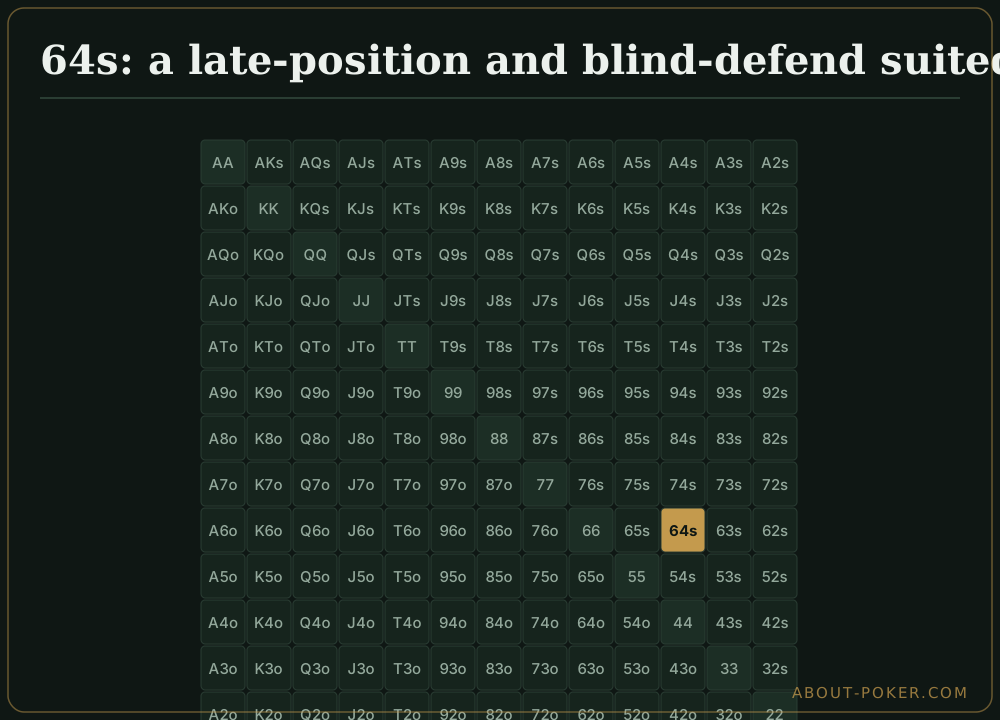
Because 64s has no showdown value until it improves, it’s very positionally sensitive:
- Early position: fold. Opening a small connector into a full table of undealt ranges invites 3-bets you hate and pots you struggle to realize equity in.
- Middle position: fold at a full ring, a very marginal open at 6-max.
- Cutoff and button: a standard open. Fold equity plus position lets you realize its draws profitably.
- Small blind: open by raising when the action folds to you; the connectedness makes it a reasonable steal.
- Big blind: defend it against small opens — this is one of 64s’ best homes. See defending the blinds for the pot-odds math that makes wide defends correct.
For how a hand like this fits inside a full opening chart, compare it against neighbors in preflop opening ranges.
Why suitedness matters so much here
The gap between 64s and 64 offsuit is enormous — far larger than the gap between, say, AKs and AKo. Suitedness adds roughly 4% raw equity and a huge amount of playability: flush draws let you barrel, and backdoor flush equity turns thin spots into profitable continuation bets. 64 offsuit is a fold from almost everywhere; 64s is a live speculative hand. When you build a range, this is the theory from preflop range construction in action — the suited combos make the cut, the offsuit ones don’t.
A worked example
You defend 6♠4♠ in the big blind against a button open and see a flop heads-up.
Flop: 7♠ 5♦ 2♠. You’ve flopped a monster draw for a small pair: an open-ended straight draw (any 3 or 8 makes the straight) plus the flush draw. That’s 8 straight outs and 9 flush outs, with two shared — about 15 clean outs, worth roughly 54% equity against a single overpair by the turn-and-river. This is a hand you can check-raise: you have more equity than most of the button’s made hands and enormous barreling power on later streets.
Turn: 7♠ 5♦ 2♠ Jc. You still hold the wrap of draws. You continue applying pressure — if the flush or straight lands, you get paid; if it bricks, you’ve represented a credible line the whole way. The point is that 64s doesn’t win by making a pair — it wins by flopping big draws and playing them aggressively.
Postflop shorthand
- Straight or flush: the payoff hand. Bet for value; these are well disguised and get action from top pair.
- Combo draw (like the example): semi-bluff hard — you often have the equity lead.
- One small pair: usually a fold or a check; there’s little value and lots of ways to be behind.
- Air with a backdoor draw: a fine give-up or a single-barrel bluff on the right texture.
How stack depth changes the hand
More than almost any other holding, 64s lives and dies by stack depth. Its entire proposition is implied odds — the promise that on the rare occasions you flop a straight or flush, you can win a stack. That promise only exists when there are stacks to win.
- Deep (150bb+): 64s gets better. The bigger the effective stack, the more you profit on the times you crush someone’s overpair or top two, and the more the small pots you lose in between are covered. Deep-stacked cash games are the natural home of small suited connectors.
- 100bb (standard): the baseline. Open it late, defend it wide, play it for its draws.
- Short (40bb or less): 64s drops sharply. You can’t win enough on your good flops to pay for all the flops you whiff, so the implied-odds math collapses. In a 20-40bb tournament stack, quietly retire it from your opening range and defend it far less often.
The rule of thumb: the shallower you get, the more you want hands with immediate showdown value (pairs, big cards) and the less you want pure draws like 64s.
Common mistakes with 64s
- Opening it too early. The most frequent leak. 64s from under the gun or middle position at a full ring is a money-loser — you face 3-bets you can’t continue against and multiway pots where you can’t realize equity. Late position only.
- Calling 3-bets with it out of position. When you open 64s on the button and the blinds 3-bet, folding is usually correct. Calling a 3-bet out of the small blind with 64s bleeds chips; the pot is bloated, you’re capped, and you rarely flop enough.
- Paying off with one pair. Flopping a pair of sixes is not the goal. When your only made hand is a weak pair, keep the pot small — the value in 64s is the draws, not the pairs.
- Overvaluing bottom-end draws. A gutshot with no flush and no backdoor is not a hand to fire three barrels with. Save the aggression for the combo draws where you have real equity.
When to fold it preflop
Skip 64s entirely when the pot is likely to go multiway against aggression, when you’re facing a raise and a 3-bet, or when stacks are shallow enough that implied odds evaporate. Speculative hands need deep stacks and the chance to win a big pot when they hit — take that away and 64s is just 6-high. When in doubt from a middle seat, the fold is almost never a mistake; compare it against the neighbors in preflop range construction.
Where to go next
64s is the textbook small suited connector: fold it early, open it late, defend it wide, and let its draws do the work postflop. Drill where it fits in preflop opening ranges, master the blind spots in defending the blinds, and tie it together at the preflop strategy hub.
Frequently asked
Is 64 suited a good hand?
64s is a speculative hand, not a strong one. Its value comes entirely from implied odds — the straights and flushes it occasionally makes. It's a marginal open from late position and a fine blind defend, but it should be folded from early and middle position.
Should you open 64 suited?
Only from the cutoff, button, or small blind at a full table, and slightly wider at 6-max. From earlier positions the hand simply doesn't make enough to justify opening into deeper ranges behind you.
What does 64 suited flop well?
It flops open-ended straight draws (with 3-5, 5-7, or 7-8 boards), gutshots, flush draws, and the occasional two pair or trips. Most of its equity is drawing equity, so it plays best in single-raised pots where you can realize it cheaply.