How to Play Ten-Five Offsuit (T5o)
Ten-five offsuit is a four-gap trash hand with no flush and almost no straights. Here is the only spot T5o is playable and how to fold it everywhere else.
On this page · 5 sections
Ten-five offsuit (T5o) is a bottom-tier starting hand. It has four gaps between the ten and the five, which strangles its straight potential, and being offsuit it can never make a flush — the one feature that keeps a hand like ten-five suited marginally alive. What remains is a hand that flops weak, dominated top pairs and little else. T5o wins only about 40% heads-up against a random hand, worse than a coin flip against an unknown holding. The verdict is straightforward: T5o folds in nearly every situation.
Why T5o folds preflop
A hand earns a place in an opening range through high-card strength, connectedness, or suitedness. T5o has almost none of those. Its ten makes a top pair that better tens and any overpair dominate, and its five is largely a dead card for straights. Because it is offsuit, it lacks the flush equity that lets marginal suited hands justify seeing a flop.
For that reason your preflop opening ranges should mark T5o as a fold from under the gun through the button. Wide button steals reach for connected offsuit hands and suited junk well before they get down to a four-gap offsuit ten. When in doubt, fold it — the cost of doing so is essentially zero.
The one spot where T5o plays: cheap big-blind defense
The lone situation that gives T5o life is defending the big blind at a deep discount. When a late-position player makes a small raise, you close the action, and the pot lays you a large price, T5o becomes a thin call. You are already invested through your blind, no one can raise behind you, and you reach a flop cheaply.
This is the widest edge of correct blind defense: you defend a far broader range than you would ever open, and hands like T5o slip in only at the very best prices against the widest ranges. Against a bigger raise, an early-position opener, or a tight strong range, fold and wait for a better spot.
A worked example
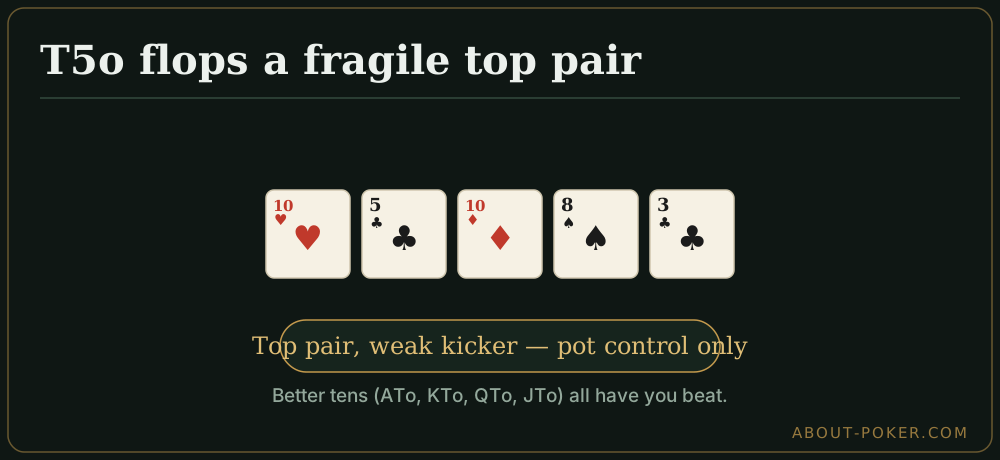
You hold T♥5♣ in the big blind and a loose button min-raises. Getting a large discount to close the action, you call. The flop comes T♦-8♠-3♣.
You have flopped top pair with a weak kicker. Resist the urge to overvalue it. Better tens — ace-ten, king-ten, queen-ten, jack-ten — already beat you, and your five kicker rarely plays. The correct plan is pot control: check-call one small bet if the price is right, but never build a large pot with one fragile pair. If your opponent applies pressure across multiple streets, your hand is beaten far too often to continue.
Change the flop to K♠-9♥-4♦ and you hold ten-high with no pair, no draw, and no plan — an easy check-fold to any bet. That is the outcome T5o delivers on the large majority of flops.
Common leaks with T5o
The most expensive mistake with T5o is overvaluing a flopped ten. Top pair with a five kicker looks playable, but on a ten-high board the hands that want to build a pot against you — ace-ten, king-ten, queen-ten, jack-ten, and any overpair — dominate you almost every time. Firing multiple streets for value with ten-five is a reliable way to pay off better hands. Keep the pot small or fold.
A second leak is defending T5o too loosely in the big blind. Without a flush and with only fringe straight potential, it needs the best available price to be worth a call. Defending it against a middle-position open, or a larger late-position raise, quietly loses money over time. The third leak is bluffing on missed flops: T5o has almost no backup equity when it whiffs, so turning it into a bluff into a stronger range just donates chips. When it misses — which is most of the time — the correct play is to check and let it go.
The right mindset
Play T5o as a fold-first hand with a single narrow exception. Never open it, defend it only from the big blind at a genuine discount, and postflop continue only with a controllable top pair or a rare two pair. Its small profit comes entirely from folding the many times it flops air and keeping the pot small the few times it flops a weak pair.
Frequently asked
Should you open ten-five offsuit?
No. T5o is a four-gap offsuit hand that sits below the folding line from every position, including the button. Standard opening ranges do not include it, and folding it costs you nothing.
Is T5o ever a defend in the big blind?
Only at the very best prices. Against a late-position min-raise when you are closing the action and getting a large discount, T5o is a marginal call. Against bigger sizings or earlier openers, fold it.
How do you play T5o postflop?
Cautiously and cheaply. With no flush and minimal straight potential, T5o only continues on flops where it makes top pair with a plan or two pair. Most of the time it flops nothing and should check-fold.