How to Play Ten-Eight Suited (T8s)
Ten-eight suited is a strong one-gapper that flops big draws and disguised straights. Here is how to open, 3-bet bluff, and play T8s postflop.
On this page · 6 sections
Ten-eight suited (T8s) is a one-gapper — the ten and eight straddle a missing nine — and one-gappers are the quieter cousins of true suited connectors. T8s keeps most of what makes suited connectors good: it flops plenty of draws, makes disguised straights, and is rarely dominated preflop. What the gap costs it is a handful of straight combinations and a bit of raw connectivity, which nudges it a rung below ten-nine suited. The result is a solid late-position and blind hand that lives on its draws, not its high-card value.
Where T8s belongs preflop
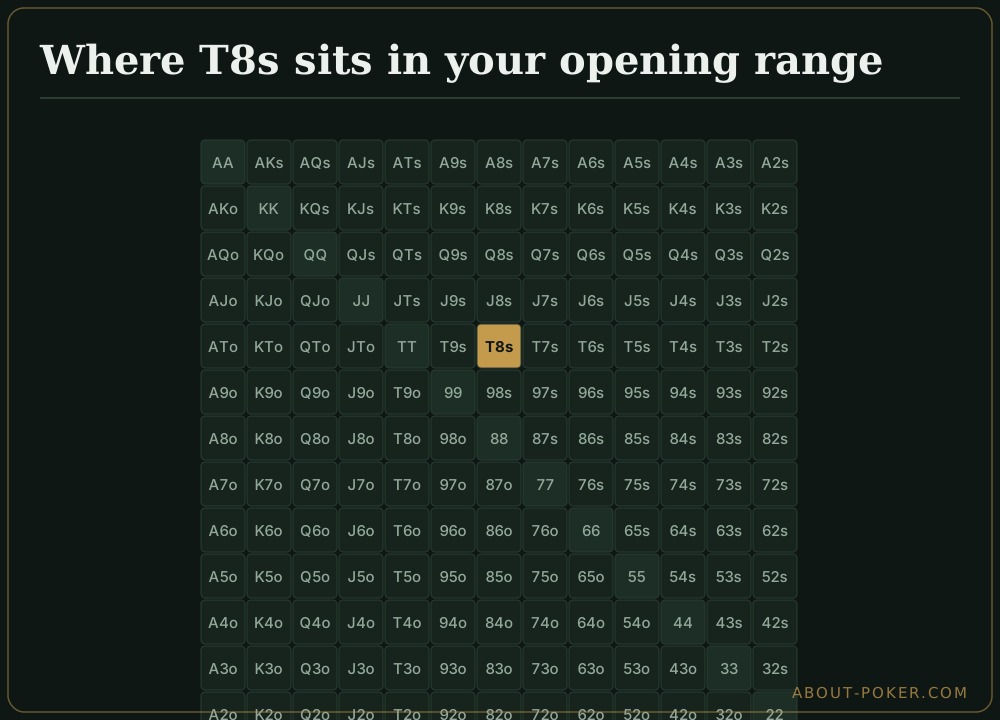
By seat, T8s is a late-position and blind hand:
- Early position: fold. There are too many players behind, and T8s needs position to realize its equity.
- Middle position: usually a fold, a marginal open at best in loose games.
- Cutoff: a reasonable open in most games.
- Button: a standard open — position plus draw equity carries it.
- Small blind: open (raise) when it folds to you.
- Big blind: defend against late opens; this is one of T8s’s better spots.
Anchor the borders in the preflop opening ranges, and note that T8s opens a little tighter than the fully connected ten-nine suited because of the gap.
How the gap changes things
A one-gapper makes straights, but through a slightly different door than a connector. T8s completes straights with boards containing the 9 (the “fill-the-gap” straights, like 9-J or 7-9) and open-ended runs like 9-7. In practice it makes roughly one fewer distinct straight structure than T9s, which is exactly why it sits a step lower in every range chart. What it keeps is the suited-connector core: draw-heavy flops, disguised value, and reverse-domination protection. Like all these hands, T8s wants to play in position, where it can barrel its draws and give up cheaply when it whiffs.
Facing a raise
Against an opener, T8s is a 3-bet bluff or a positional flat, not a value 3-bet. From the blinds or the button against a wide late opener, 3-bet bluffing T8s is fine: it has good equity when called and blocks ten-x and eight-x hands. In position at a good price, calling a single raise is reasonable because you flop so many draws. Out of position against a tight, early raiser, fold — a one-gapper is too speculative to play from bad position against a strong range. Fit it into your bluffing structure with the 3-bet range.
A worked example
You open T♣8♣ from the button and the big blind calls. The flop comes 9♦ 7♠ 2♣ — you have flopped an open-ended straight draw (any jack or six completes a straight, giving you eight outs) plus a backdoor flush draw. The big blind checks. You continuation-bet as a semi-bluff: with eight outs you have roughly 31% equity to reach the river with two cards to come, plus fold equity when a weak hand folds now. The big blind calls. The turn is the J♥ — you make a disguised straight that a nine or a seven will pay off, because the board does not scream danger. You bet for value and get called by top pair. That hidden-straight payoff is where T8s makes its money.
Now suppose the flop had come T♥ 6♦ 2♠ — top pair, ten-high, with an eight kicker. That is a marginal one-pair hand; take thin value at most and fold to real pressure. T8s earns with draws and straights, not with its pairs.
Postflop in one paragraph
When T8s flops a straight or flush draw, semi-bluff it aggressively, because the equity and the disguised payoff are large. When it completes a draw, bet for value and expect to get paid by hands that cannot read the straight or flush. When it flops top pair or a weak made hand, control the pot and take small value. When it whiffs, give up cheaply. As with every one-gapper, its strength is potential, so lean into the draws and stay disciplined on the misses.
Where to go next
T8s is a solid one-gap suited connector that rewards position and aggression while asking for discipline out of position. Sharpen your opens with preflop opening ranges, compare it to the stronger ten-nine suited, and connect the framework at the preflop strategy hub.
Frequently asked
Is ten-eight suited a good hand?
Yes, in the right seats. T8s is a solid one-gap suited connector that opens from late position and defends the blinds. It flops straight draws, flush draws, and top pairs, but it is a notch below T9s because the gap costs it some straight combinations and it makes slightly weaker pairs.
Should you open ten-eight suited under the gun?
In most 6-max games, no. T8s is usually a fold or a marginal open from the earliest seat because there are too many players left to act. It becomes a reasonable open from the cutoff and a clear open from the button and small blind.
Can you 3-bet bluff ten-eight suited?
Yes. T8s is a fine suited-connector 3-bet bluff, especially from the blinds or button against a late opener. It has good equity when called and blocks some ten-x and eight-x hands. It ranks a step below T9s in bluffing priority but is still an acceptable candidate.