What Is Blank in Poker?
A blank in poker is a card that helps neither player's range and changes little. Learn what a blank means, how it differs from a brick, and how to use it.
On this page · 6 sections
A blank is a card that helps neither player’s range and leaves the hand essentially unchanged. When the turn or river blanks, no draws complete, no new strong hands appear, and the equities barely move. The player who was ahead going into the card is still ahead after it. Because a blank adds nothing, players describe such a card as, quite literally, a blank in the runout.
The word is one of poker’s most common bits of shorthand. If a commentator says “the turn is a blank,” they mean the card did not matter, and the pre-existing situation continues. Understanding blanks helps you plan your betting across streets instead of reacting to every card as if it were a threat.
What a blank actually means
A blank is a low-impact card, defined by what it does not do. It does not put a flush card out, it does not fill a straight, and it does not bring a high card that connects with the caller’s range. Since nothing improved for either side, the incentives on the street stay the same as they were.
That stability is the whole point. On a blank, whoever held the range advantage keeps it, and there is no new draw to charge or fear. This is the opposite of an action card, which shakes up the ranges and gets chips moving.
Blank vs brick
Blank and brick are near-synonyms, and most players swap them freely. If there is any distinction, it is subtle:
- A blank is any card that helps neither range.
- A brick often specifically means a card that missed a draw you were chasing.
You can treat them as the same in almost every conversation. Both describe a card that keeps the equities where they were and keeps the pot from exploding.
A worked example
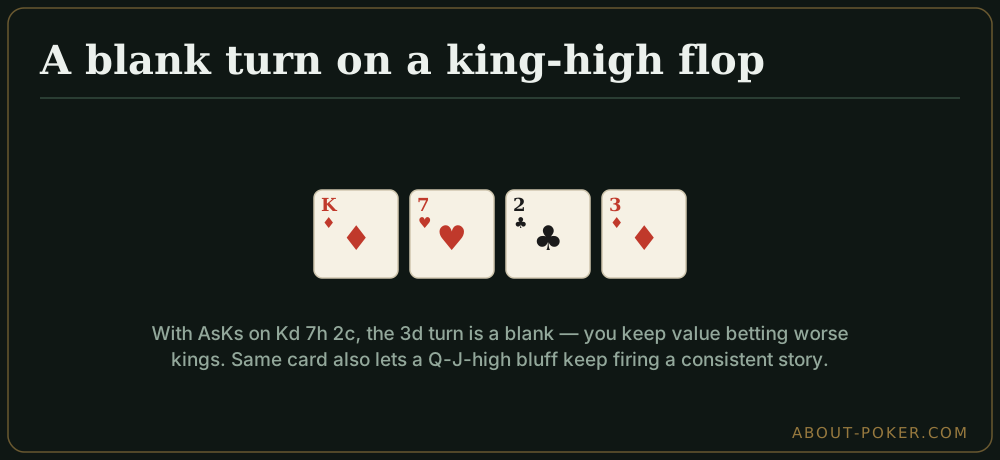
You raised preflop with As Ks and got one caller. The flop is Kd 7h 2c, giving you top pair top kicker, and you bet. The turn is the 3d. That is a blank. It brings no flush, no straight completion, and no card that beats your top pair. Your hand is still comfortably ahead, so you can keep value betting against worse kings, sevens, and pocket pairs that call.
Now imagine you were bluffing instead, holding Qs Js with nothing. The 3d is still a blank, and that can actually help your bluff. Because the card did not obviously improve you or your opponent, you can keep firing a consistent story, and your opponent cannot tell the blank did nothing for you. The same quiet card serves value bets and bluffs alike, depending on your hand.
How to use a blank
When you are ahead, a blank is a green light to keep betting for value. Your opponent’s range did not improve, so worse hands that called before will often call again. Consistent value betting on blanks is how you extract the most from a made hand across a runout.
When you are bluffing, blanks are frequently your best barreling cards. Because the card is neutral, your opponent cannot rule out that you have a strong hand, and your earlier aggression still tells a believable tale. The key is that your line has to make sense: firing a blank as a bluff works when the hands you are representing would also bet that card.
Common mistakes with blanks
A common leak is checking on blanks out of caution when you should be value betting. Players get nervous and slow down even though nothing changed and worse hands would still pay. If you were ahead before the blank, you are ahead after it, so keep charging.
The mirror-image mistake is bluffing blanks with no plan. A blank does not make a bad bluff good; it just fails to make it obviously bad. If your opponent is a station who never folds, a blank changes nothing about their calling, and firing again simply loses money. Pick your spots based on whether folds are actually possible.
A quick checklist
When a blank lands, ask:
- Did this card truly help neither range, or am I underrating a hidden draw?
- If I am ahead, can worse hands still call a value bet?
- If I am bluffing, does my story still hold on this card, and can my opponent fold?
- Am I slowing down out of habit rather than because the math changed?
Answer those and blanks become easy. A blank changed nothing about the hand, so let it change your plan only where a clear reason exists.
Frequently asked
What is a blank in poker?
A blank is a turn or river card that helps neither player's range and does not complete any obvious draws. Because it changes nothing, the person who was ahead stays ahead and the equities barely move. Players call these cards blanks because they add nothing to the picture.
Is a blank the same as a brick?
Effectively yes. Most players use blank and brick interchangeably to describe a card that misses everyone. If there is a nuance, a brick often refers to missing a specific draw you were chasing, while a blank describes any card that fails to help either range. In practice both mean a quiet, non-action card.
Why do blanks matter for betting?
Blanks keep the range advantage where it was, so the player who was ahead can often keep betting confidently. For a bluffer, a blank can be a good barreling card if the story is consistent, because the opponent cannot be sure the blank did not help you. Blanks are quiet, but they still shape the right bet size and frequency.