What Is Blocker Effect in Poker?
The blocker effect is how holding a card reduces the combos of hands your opponent can have. Learn how card removal shapes bluffs, calls, and value bets.
On this page · 6 sections
The blocker effect is a simple idea with deep consequences: holding a card removes it from the deck, which removes every hand your opponent could have made with it. There are only four of each rank and thirteen of each suit. Every card you can see — in your hand or on the board — is one your opponent cannot have. That accounting quietly reshapes their entire range.
Card removal is one of the most important edges in modern poker because it lets you reason about combinations, not just vibes. Instead of guessing “he probably has it,” you count how many ways he actually can have it.
How Card Removal Actually Works
Start with the raw math. Before any cards are dealt, there are exactly six combinations of any pocket pair (for example, six ways to make pocket aces) and sixteen combinations of any unpaired hand like ace-king. Suited versions account for four of those sixteen; offsuit versions the other twelve.
The moment you hold a relevant card, those counts shrink. If you hold one ace, your opponent can now only have three ways to make a pair of aces instead of six, and their ace-king combos drop from sixteen to twelve. You have not seen their cards — but you have made certain holdings mathematically rarer.
That is the whole engine behind the blocker effect. You are not reading souls; you are subtracting combos from a fixed deck. For a fuller primer on the individual cards that do this work, see what are blockers in poker.
A Worked Example on a Flush Board
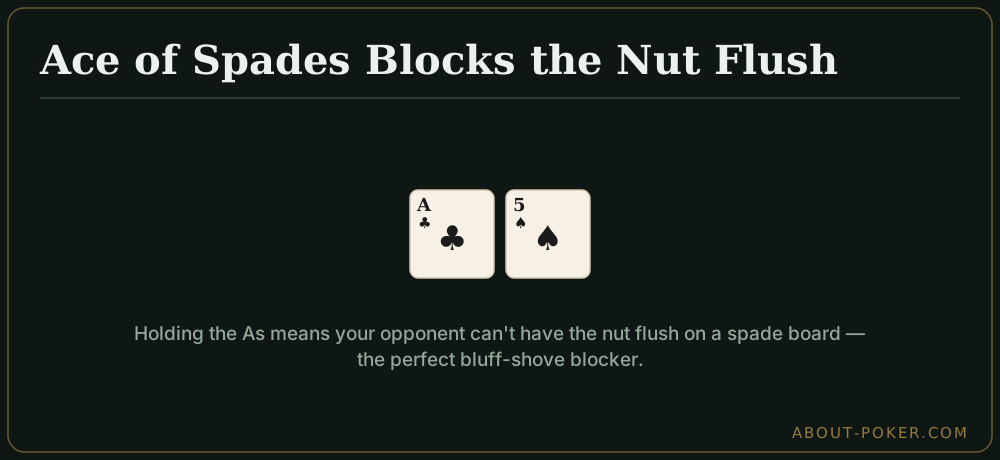
Picture a river where the board is Ks 9s 4s 2h 7d — three spades on a flush board. Your opponent bets big, and you are deciding whether to bluff-raise as a bluff.
Now compare two of your possible hands:
- You hold Qc Jd — no spade. Every nut-flush and strong-flush combination your opponent could hold is still fully live. If you shove, they can comfortably call with the ace-high flush.
- You hold Ac 5s — the ace of spades. Now your opponent literally cannot hold the nut flush, because you have the card that makes it. Their strongest possible flush is removed. A bluff-shove works far more often because you have blocked the exact hand that beats you.
Same board, same action, wildly different bluff success — purely because one hand blocks the nuts and the other does not. That is the blocker effect converting into real expected value. It is also why a well-chosen blocker bet can lean on the same logic.
Blockers for Bluffing vs. Value
The most common mistake is treating blockers as universally good. They are not — they are direction-dependent.
- When bluffing, you want to block the hands that would call or beat you. Holding the ace of the flush suit, or a card that makes the top straight, means fewer strong hands remain to snap you off.
- When value betting, you want to unblock the hands that pay you. If you hold a card that removes your opponent’s likely calling range, you have accidentally reduced the number of worse hands willing to give you money.
So the same card can be a gift or a tax depending on your plan. A card that blocks the nut flush is fantastic as a bluff and mediocre as a thin value bet, because it also removes some of the second-best flushes that might have called.
Where Blockers Matter Most
Blockers gain power as the pot grows and ranges narrow. On the river, with all cards out and the action condensed to a small set of credible hands, one blocked combination can swing a decision. Preflop, blockers matter for 5-bet bluffing: holding an ace makes it less likely the opener has aces or ace-king.
They matter least in muddy, wide-range spots — a limped multiway pot on a dry flop — where nobody’s range is defined enough for one removed combo to move the needle. Blocker reasoning is a scalpel for narrow ranges, not a hammer for every pot.
A Quick Checklist for Using Blockers
Before you turn a hand into a bluff or a thin value bet, run this:
- What is the nut hand here? Do you hold a card that blocks it?
- What calls me? Do my cards remove those calling combos, or leave them all live?
- Bluff or value? Bluffs want to block calls; value bets want to unblock them.
- Is the range narrow enough? On the river with a defined range, blockers matter a lot. In a wide multiway mess, they matter little.
Answer those honestly and you will stop bluffing into unblocked nut hands and start firing when the math is quietly on your side.
Common Misconceptions
New players often think a blocker “makes their hand better.” It does not — your hand strength is unchanged. What changes is the distribution of your opponent’s likely holdings. A blocker is information about the deck, not power in your hand.
The second trap is overvaluing tiny blockers. Blocking one combo of a hand your opponent rarely has barely matters. Save the effort for cards that block the top of their range — the nut flush, the top straight, the overpairs — where removing combos actually changes the decision.
Frequently asked
What is the blocker effect in poker?
The blocker effect is the way holding a specific card removes combinations of hands from your opponent's range. If you hold the ace of spades, your opponent cannot hold that exact card, so every hand that needs it, such as the nut flush, is impossible for them. That removal changes how likely they are to have strong hands or bluffs.
Why do blockers matter when bluffing?
Blockers matter when bluffing because they reduce the number of strong hands your opponent can call with. If you hold a card that blocks their most likely value hands, your bluff succeeds more often because there are simply fewer combinations left that beat you.
Are blockers useful for value betting too?
Yes, but in reverse. When you value bet, you want to unblock your opponent's calling range so they have more hands that can pay you off. Holding a card that removes their likely calls actually costs you value, so blocker analysis cuts both ways.