What Is Condensed Range in Poker?
A condensed range is packed with medium-strength hands and few nuts or bluffs. Here's what it means, how it forms, and how to play with and against one.
On this page · 6 sections
A condensed range is what you get when a player’s possible hands all cluster around the middle of the strength spectrum — plenty of medium hands, almost no monsters, and almost no pure air. It’s the mirror image of a polarised range, and knowing how to spot one, on either side of the table, is a real edge.
What the term means
Your range is the full set of hands you could be holding in a given spot. A range can take different shapes. When it’s packed with medium-strength holdings and thin at both the top (the nuts) and the bottom (bluffs), it’s condensed — the strength is squeezed into a narrow band in the middle.
Compare that to a polarised range, which keeps only the extremes and empties the middle. Condensed is the opposite: it keeps the middle and empties the extremes. That single structural difference drives almost everything about how the range should be played.
How ranges get condensed
Condensed ranges usually appear through the action itself. A few common ways:
- Flat-calling instead of raising. When a player just calls a bet rather than raising, they often strip the strongest hands out of their range (those would have raised) and the weakest (those would have folded). What’s left is a band of medium hands — a condensed, and typically capped, range.
- Checking back in position. A player who checks the flop instead of betting often does so with medium hands that don’t want to build a big pot, condensing their range.
- Calling down passively. Repeated calls with no raises tend to represent bluff-catchers and second-tier hands.
The betting story is the tell. Passive, call-heavy lines condense a range; aggressive, raise-and-overbet lines polarise it.
A worked example
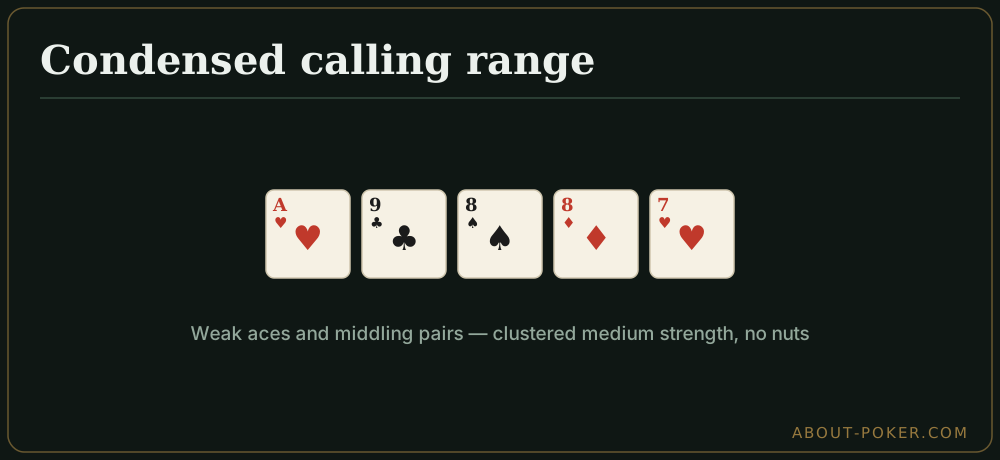
You raise from the button and the big blind calls. Flop comes A♥ 8♣ 5♦. The big blind checks, you bet, and they call. Turn is the 2♠; they check, you bet again, they call. River is the 9♥; they check.
Think about what the big blind has left. With two pair, sets, or better, most players would have check-raised at some point to build the pot — so those are largely gone. With total air, they’d have folded on the flop or turn — so those are mostly gone too. What remains is a condensed range: hands like A-x with a weak kicker, pocket pairs like 88 or 99 that made a set… wait, 99 just made a set on the river, but the bulk is weak aces and middling pairs. Because the top and bottom have been filtered out, this is a textbook condensed range, and it’s very hard for them to continue against a big river bet.
How to play against a condensed range
Attack it. The whole weakness of a condensed range is that it lacks nut hands, so it can’t stand heavy pressure. Against the big blind above, a large bet or overbet on the river is brutal: they have few hands strong enough to call comfortably, and they can’t raise to bluff you off it because they’d need nut hands they mostly don’t have. Betting a polarised range into a condensed one is one of the cleanest exploits in poker.
How to play when your own range is condensed
When you’re the one with the condensed range, don’t try to blast big — you’ll only get called by better and raised off your medium hands. Instead:
- Check to control the pot and reach a cheap showdown, since your medium hands have real showdown value.
- Bet small when you do bet, protecting equity without bloating the pot.
- Bluff-catch selectively, calling one street rather than stacking off, because you rarely hold the nuts to raise with.
The goal is to realize the modest value of your medium hands without turning them into big losers.
Common mistakes
- Overbetting a condensed range. Big bets need nut hands to be credible; a condensed range can’t support them.
- Folding too much when the pot is small. Medium hands are exactly what bluff-catchers are made of — don’t over-fold your entire condensed range to small stabs.
- Failing to attack a condensed opponent. If you recognize the passive line but bet small anyway, you leave the exploit on the table. Size up against ranges that can’t defend.
Reading range shape is the skill underneath all of this. When you can tell whether an opponent is polarised or condensed from the way the chips went in, you’ll know instantly whether to pile on pressure or pump the brakes.
Frequently asked
What is a condensed range in poker?
A condensed range is one dominated by medium-strength hands, with very few nut hands and very few pure bluffs. It's the opposite of a polarised range — the strength is concentrated in the middle rather than at the extremes.
How is a condensed range different from a polarised one?
A polarised range is strong value hands plus bluffs with the middle removed. A condensed range is the reverse: lots of medium hands and almost nothing at the top or bottom. Polarised ranges bet big; condensed ranges prefer to check or bet small.
Is a condensed range the same as a capped range?
They overlap but aren't identical. A capped range simply has no nut hands — it has a ceiling. A condensed range is capped and also short on bluffs, so it's tightly clustered around medium strength. Every condensed range is capped, but not every capped range is condensed.
How do you play against a condensed range?
Attack it. Because a condensed range holds few nut hands, it can't comfortably call big bets or overbets. Applying pressure with a polarised betting range exploits the fact that the opponent rarely has a hand strong enough to continue.