What Is Cooler in Poker?
A cooler is a hand where two strong holdings collide and the loser could not fold. Learn what counts as a cooler, how it differs from a bad beat, and examples.
On this page · 6 sections
A cooler is a hand where two very strong holdings smash into each other and the losing player could not reasonably have gotten away. The chips go in, someone loses a big pot, and the honest verdict is: there was nothing to be done. Coolers are the price of admission for playing strong hands strongly.
What makes a hand a cooler
Three conditions define a cooler:
- Both players have big hands. A cooler is not top pair versus a set. It is set versus set, or the nut flush versus a smaller flush, hands that are almost always worth stacking off with.
- The loser was behind the whole time. The money went in with the weaker of two strong hands.
- Folding was not realistic. Given the strength of the losing hand, no reasonable player folds. That is what separates a cooler from a punt.
If any one of those is missing, it probably was not a true cooler. Losing with top pair to a set is not a cooler; it is a spot where you often should have folded.
Cooler versus bad beat
People mix these up constantly, but they are opposites. In a bad beat, you were ahead when the money went in and lost to a lucky card, like aces losing to a rivered flush. In a cooler, you were behind when the money went in and your strong hand simply ran into a stronger one.
A suck-out is closely tied to a bad beat: it describes the winning side, the player who was behind and hit the card to win. A cooler has no suck-out because the winner was ahead the whole way. Understanding which one happened matters, because a bad beat is variance against a mistake by your opponent, while a cooler is variance with no mistake by anyone.
A worked example: set over set
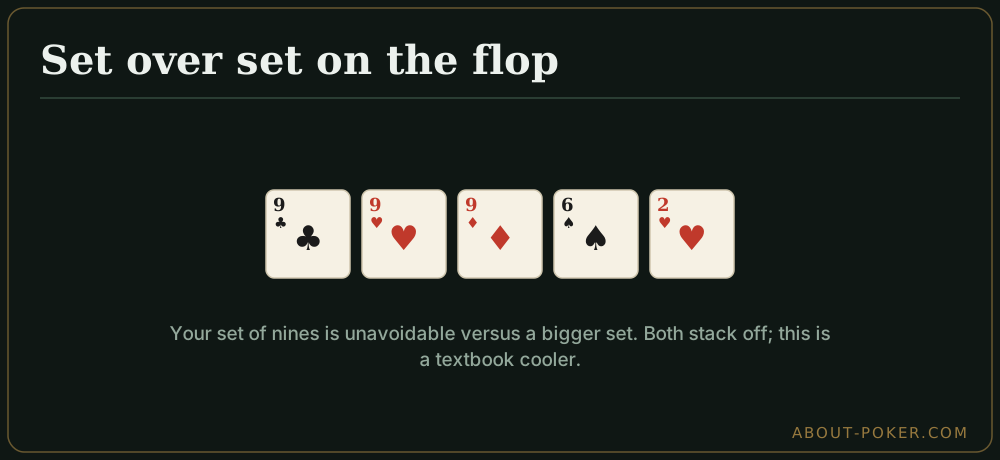
You hold 9c-9h and the flop comes 9d-6s-2h. You have flopped a set of nines, and you are thrilled to get all the money in. Your opponent holds Qc-Qs and has flopped a set of queens.
Both of you are stacking off here every time. Sets are among the most disguised, most powerful flopped hands in Hold’em, and folding one on a dry board like this would be a huge error. The money goes in on the flop, the turn and river are blanks, and your nines lose to the queens. That is a cooler. You did nothing wrong. Your opponent did nothing special. Two monsters collided and yours was smaller.
Other classic coolers
- Flush over flush. You make the king-high flush, your opponent makes the ace-high flush. Both are stacking off on most runouts.
- Full house over full house. The board pairs and both players fill up, with the higher boat winning.
- Aces versus kings all in preflop. Kings is a monster you cannot fold; aces just happens to be the one hand that dominates it (aces beat kings roughly 82% of the time preflop). The kings player was coolered.
- Straight over straight. On a board like J-T-9, king-queen makes Broadway and queen-eight makes a lower straight.
How to think about coolers at the table
The single most important skill around coolers is accepting them. A cooler is not a leak. If you find yourself replaying a set-over-set hand looking for the fold, stop. There was no fold. The mental-game trap is treating variance like a mistake, which leads to tilt and chasing losses.
That said, be honest with yourself. Real winners occasionally mislabel a punt as a “cooler” to avoid facing a leak. Losing your stack with top pair, or calling a huge river bet with a marginal bluff-catcher and losing, is usually not a cooler. Ask whether a strong, thoughtful player would also have committed the chips. If yes, it was a cooler. If a good player folds, it was a mistake you can learn from.
Can you avoid coolers?
Mostly no, and that is fine. But you can slightly reduce how often you are on the wrong end:
- Play deep-stacked pots with position. Position helps you control the pot size and sometimes pot-control a second-best big hand.
- Reassess on dangerous runouts. Set over set is unavoidable, but a bare overpair can sometimes slow down when the board gets ugly, saving a bet.
- Do not overfold to phantom coolers. The bigger long-term leak is folding strong hands out of fear of the rare cooler. Stack off with your monsters and accept that occasionally a bigger one shows up.
Coolers are simply part of the game. Understand them, label them correctly, and move on without tilting, and they will cost you nothing beyond the chips that were always going in.
Frequently asked
What does cooler mean in poker?
A cooler is a hand where two very strong holdings run into each other and the losing player realistically could not have folded. Classic examples are set over set or a flush over a smaller flush. Nobody misplayed it; the money simply had to go in.
What is the difference between a cooler and a bad beat?
In a cooler, the loser was behind when the money went in and their strong hand simply lost to a stronger one. In a bad beat, the loser was ahead when the money went in and got outdrawn on a later card.
Is a cooler bad play?
No. A cooler is by definition unavoidable. Both players had hands strong enough to commit their stacks, so losing to a cooler is not a mistake, it is just variance.