What Is Dead Button in Poker?
A dead button is when the dealer button sits in front of an empty seat so the blinds stay fair after a player busts. Learn the rule with a clear example.
On this page · 6 sections
A dead button is when the dealer button sits in front of an empty seat — a spot where a player used to be before they busted or left the table. It looks strange to see the button on nobody, but it is a deliberate rule that keeps the blinds fair after the table’s seating changes. Nothing is being dealt to that empty chair; the button is simply resting there for one hand so the rotation stays honest.
The dead button exists to solve a small but real problem. When a player leaves, the neat cycle of button, small blind, and big blind gets disrupted. Without a fix, some players would end up posting the big blind twice in quick succession or dodging it entirely. The dead button, and its cousin the dead small blind, restore order.
Why the blinds need protecting
In poker the button and blinds move one seat clockwise each hand. That rotation is the fairness engine of the game: over a full orbit, everyone pays the small blind once, the big blind once, and enjoys the button once. The big blind is the most expensive forced bet, so the rule that matters most is that no one pays it twice before everyone else has paid it once.
When a player busts, their seat empties mid-rotation. If you simply skipped the empty seat and slid everything along, the player who was next could be forced to post the big blind again a hand too early, or another player could slip past it for free. Either outcome hands someone an unfair edge measured in real chips.
How the dead button rule works
The rule keeps the big blind advancing correctly and lets the button and small blind land wherever the math requires — even on an empty seat.
The guiding principle is simple: the big blind always moves forward to the next eligible player, and the button is then placed so the rotation stays consistent, even if that means it sits on an empty seat. When the small blind position lands on an empty seat, no one posts it. That is a dead small blind — the small blind is skipped for that hand while the big blind is still posted normally.
So in any given hand you might see a live button on a real player, a dead button on an empty seat, or a dead small blind where no small blind gets posted. In each case the goal is identical: protect the correct order and frequency of the big blind, which is the forced bet with the most money attached.
Worked example: a player busts
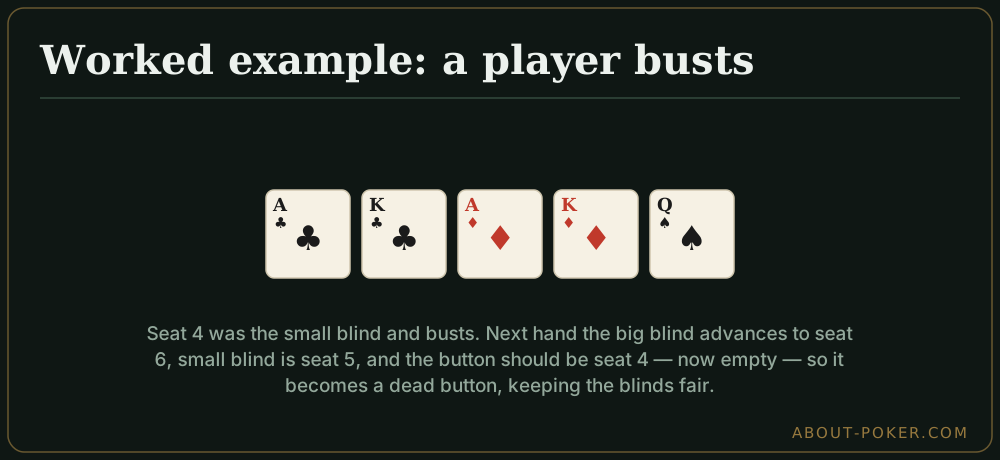
Say a six-handed table is in seats 1 through 6. This hand, seat 3 has the button, seat 4 is the small blind, and seat 5 is the big blind. Seat 4 then loses their whole stack and busts, leaving their chair empty.
Next hand, the big blind must advance to the next active player, seat 6. Working backward, the small blind should be seat 5, and the button should be seat 4 — but seat 4 is now empty. So the button becomes a dead button, sitting in front of the empty seat 4. Seat 5 posts the small blind, seat 6 posts the big blind, and play proceeds. Nobody paid a blind out of turn, and nobody skipped one. The empty chair simply “holds” the button for a hand until the rotation naturally moves on.
Had the empty seat instead fallen on the small blind position, you would get a dead small blind: that blind goes unposted for the hand while the big blind is still collected normally.
Where you will run into it
The dead button is most associated with tournaments, where players bust constantly and seats keep emptying. It also appears in casino cash games when a player leaves between hands and the house uses a moving-button rule to keep the blinds honest. In formats that also use an ante, the antes are collected normally regardless of the dead button — only the blind posting is affected.
Common misunderstandings
- Thinking cards are dealt to the dead button seat. They are not. The seat is empty; the button is just a marker resting there.
- Assuming a dead small blind means less money in the pot for good. Only that single hand’s small blind is missing; the rotation corrects itself immediately.
- Confusing it with a broken rule. A dead button looks odd but it is the correct, standard fix, not a dealer error.
- Expecting it in every game. Many home games and some cash formats just move the button to the next active seat and re-post blinds; the strict dead button rule is most rigorous in organized tournaments.
Keep going
The dead button is a quiet piece of poker plumbing — you rarely think about it until a player busts and the button ends up on nobody. Knowing the rule means you will never be confused, or short-changed, when the seats shuffle. For related mechanics, read up on the ante, and browse the full poker glossary for the rest of the table’s terminology.
Frequently asked
What is a dead button in poker?
A dead button is when the dealer button is placed in front of an empty seat because the player who would have had it has left or busted. It keeps the blind rotation fair so no one pays the big blind twice in a row or skips it.
Why do casinos use the dead button rule?
The rule preserves the correct order of the blinds after a player leaves. Rather than skipping seats and forcing players to overpay or dodge blinds, the button can sit on an empty seat for a hand so everyone posts blinds the right number of times.
What is a dead small blind?
A dead small blind happens when the small blind position falls on an empty seat. No one posts it, so the small blind is 'dead' for that hand, but the big blind is still posted normally by the next active player.
Does the dead button rule apply in cash games?
It can, but it is most associated with tournaments where players bust and seats empty. Some cash games use a moving button with forced blinds instead, though the dead button approach is common when a seat opens between hands.