What Is Depolarisation in Poker?
Depolarisation in poker means betting a range of strong and medium hands without pure bluffs. Learn what it is, its sizing, and when it beats polarising.
On this page · 6 sections
Depolarisation is the mirror image of polarisation, and understanding one clarifies the other. A depolarised range is built from strong and medium-strength value hands with few or no pure bluffs. Instead of the “nuts or air” shape, it looks like “good and decent hands lined up together.” Because the range is packed with hands that want calls from worse, it prefers small, comfortable bet sizing rather than big, threatening bets.
What a depolarised range looks like
Think of a linear ladder rather than two magnetic poles. If you bet a depolarised range on the turn, it might include top pair, top pair with a good kicker, overpairs, and strong second pairs. It does not include your busted draws as bluffs, and it does not need overbets. This shape is closely related to a merged range, where value and semi-value hands are grouped for a modest bet.
The purpose is different from a polarised bet. A polarised bet wants to either get maximum value from the nuts or fold out better hands with bluffs. A depolarised bet wants to get called by worse. You are targeting the second-best hands in your opponent’s range and charging them a small, palatable price they are happy to pay.
Why depolarise instead of polarise
The choice comes down to how strong your opponent’s range is and how much medium value you hold. Depolarisation is strongest when:
- The board is dry and your opponent holds few nutted hands to punish you
- You hold many medium-strong hands that beat their calling range but not their raising range
- A small bet can extract value from a wide range of weaker holdings
In these spots a big polarised bet actually earns less, because your opponent folds their many weak hands and only continues with hands that beat you. A small depolarised bet keeps their weak range in and milks it. This is the essence of depolarising a spot.
A worked example
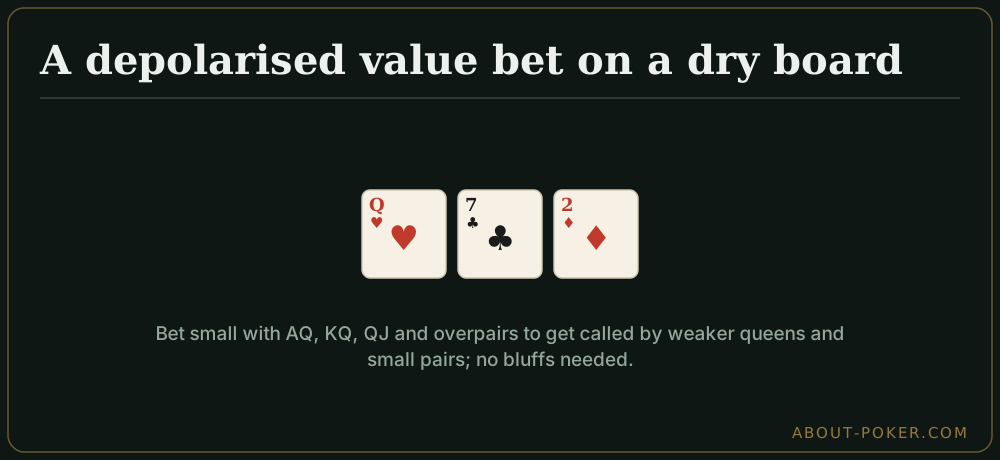
You raise from the button with Ad Qs and the big blind calls. The flop is Qh 7c 2d. You have top pair, top kicker on a dry board. Your opponent’s range is full of weaker queens, pocket pairs like 88 to JJ, and floats.
This is a textbook depolarising spot. If you bet big and polarised, weak queens and small pairs fold and you win a small pot. Instead you bet around a third of the pot with a depolarised range that includes AQ, KQ, QJ, and your overpairs. That small bet gets called by QT, Q9, pocket eights, and ace-highs floating for one card. You extract value from the entire soft middle of their range, exactly what a depolarised bet is designed to do.
Compare this to the river on a board like Qh 7c 2d Js Th, where straights and two pair are now possible. Suddenly the middle of your range is less safe, and a polarised big bet or check becomes correct for your best and worst hands. Same street, different texture, different range shape.
Common mistakes
The most common error is depolarising when you should polarise. If your opponent’s range is strong and full of nutted hands, betting medium hands for value invites raises and coolers. Medium hands hate action from strong ranges, so on those boards you either check them or move to a polarised structure.
A second mistake is overusing large sizing with a depolarised range. Big bets fold out the exact weak hands you want to call. If your goal is to be called by worse, keep the price friendly. Match the size to the intent.
A third mistake is including bluffs in a depolarised bet. By definition, a depolarised range is value-heavy. If you find yourself wanting to bluff, that is a signal your range should be polarised on this street instead.
Depolarised vs polarised at a glance
- Polarised: strong hands plus bluffs, no medium hands, big sizing, wants folds or max value.
- Depolarised: strong plus medium hands, few or no bluffs, small sizing, wants calls from worse.
Checklist for the table
- Does my opponent’s range have few nutted hands? Lean depolarised.
- Do I hold lots of medium value that beats worse calls? Lean depolarised.
- Is the pot likely to face raises from stronger hands? Reconsider and maybe check or polarise.
- Am I keeping the bet small enough to be called? Size for value.
Once you can flip between polarised and depolarised structures based on board texture and opponent range, your betting becomes far harder to read and far more profitable.
Frequently asked
What does depolarisation mean in poker?
Depolarisation means betting a range weighted toward strong and medium-strength value hands with few or no pure bluffs. It is the opposite of a polarised nuts-or-air range and usually uses smaller sizing.
Is a depolarised range the same as a merged range?
They overlap heavily. A merged (or linear) range bets your strong and medium hands together, which is a form of depolarisation. Both aim to get called by worse rather than to fold out better.
What bet size fits a depolarised range?
Small to medium sizing, often a third to half pot. Because your range includes medium hands that want calls from worse and do not want to bloat the pot, a smaller bet earns steady value across the whole range.