What Is Dominated Hand in Poker?
A dominated hand in poker shares a card with a stronger hand and needs help to win. Learn what domination means, why it matters, and how to avoid it.
On this page · 7 sections
A dominated hand shares one of its cards with a stronger hand and needs to improve just to have a chance. The classic case is ace-jack against ace-king: both hold an ace, but the king outkicks the jack. Unless a jack pairs the board or a straight or flush appears, ace-jack is stuck behind. Domination is one of the quiet ways that beginners bleed chips without ever making a dramatic mistake.
The reason it matters so much is that dominated hands look playable. Ace-jack feels strong, and it is, until it runs into a bigger ace. Learning to recognize domination before the money goes in is one of the biggest early leaps a player can make.
What domination actually means
Two hands are in a domination relationship when they share a card and the shared card is the one most likely to pair. The hand with the better second card, or kicker, dominates. The dominated hand can only win by hitting its weaker card, catching a lucky straight or flush, or seeing a board that plays entirely.
The trap is the shared card. Because both hands hope to pair the same rank, pairing it usually does not help the dominated hand at all. If both players hold an ace and an ace flops, ace-jack and ace-king both make top pair, but ace-king wins because its kicker is higher.
Why dominated hands are so costly
The danger is not just that you lose, it is that you lose big. When you flop top pair with a dominated kicker, you often feel confident enough to put in a lot of chips against the exact hand that beats you. You are drawn into building a pot you cannot win.
Meanwhile, the times you are not dominated, opponents fold and you win little. This asymmetry, small wins and large losses, is what makes kicker domination such a persistent leak. Understanding an opponent’s range is the key to sensing when your kicker is likely behind.
A worked example
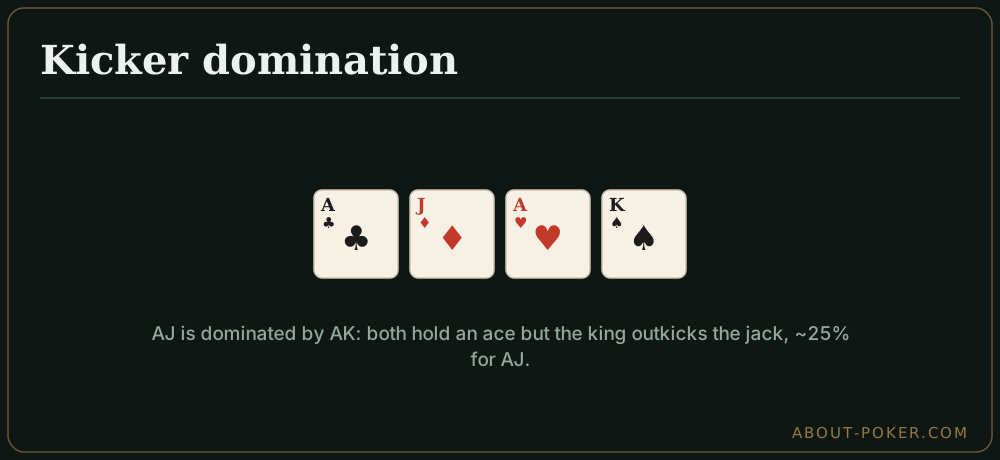
You raise with Aj offsuit and a solid player three-bets you. You call and the flop comes Ah 8c 3d. You have top pair, jack kicker, and it feels great.
But think about what a good player three-bets. Their range is heavy with AK, AQ, and big pairs. Against AK on this exact board, you are drawn nearly dead: you need running cards or a jack, giving you only about three clean outs. Preflop, AJ against AK is roughly a 25 to 75 underdog, a 3 to 1 dog. On this ace-high flop, you are in even worse shape. Committing chips here is how dominated hands turn a good-looking flop into a disaster.
Common domination traps
- Weak aces from early position. Hands like A5 through AT play poorly against a raising range full of bigger aces. Position and range matter more than the ace itself.
- King-jack and queen-jack facing raises. These look pretty but are routinely dominated by KQ, AK, AQ, and AJ. They are trap hands out of position.
- Calling three-bets with dominated broadways. When a tight player re-raises, your AJ or KQ is often exactly what they crush.
- Overplaying top pair with a bad kicker. Flopping a pair with a weak second card is where the biggest losses happen, because you commit against the one hand that beats you. This is close cousin to a cooler, except domination is often avoidable with better hand selection.
How to avoid being dominated
The main defense is hand selection tied to position. From early seats, play tighter and drop the weak aces and offsuit broadways that get dominated. From late position against limpers, those same hands gain value because fewer strong hands remain.
The second defense is respecting aggression. When a solid player raises or re-raises, ask which hands they would do that with. If most of their range beats you and few worse hands continue, you are the dominated one and should fold or proceed cautiously. Suited hands help here too, because a flush draw or straight potential gives a dominated hand real outs when the kicker is behind.
Quick checklist
- Do I share a card with the likely stronger hands in this range?
- Is my kicker better or worse than what a raiser typically holds?
- Am I in position to control the pot if I flop a weak pair?
- Can this hand make a straight or flush, or does it rely only on its kicker?
The bottom line
A dominated hand shares a card with a stronger hand and usually has just three outs to catch up. It is dangerous precisely because it looks playable and flops well against nothing. Tighten your range from early position, respect raises, and always weigh your kicker against the hands that would put money in against you. Avoiding domination will save you more chips than almost any flashy play you can learn.
Frequently asked
What does it mean to have a dominated hand?
A dominated hand shares one of its cards with a stronger hand and is beaten unless it improves. Ace-jack is dominated by ace-king because they share the ace, but the king outkicks the jack. The dominated hand usually has only three clean outs to take the lead.
How bad is it to be dominated?
It is one of the worst preflop spots. A dominated hand like AJ against AK is roughly a 3 to 1 underdog when the money goes in preflop, winning only about 25 percent of the time. Kicker domination quietly loses more money for weak players than almost anything else.
How do I avoid playing dominated hands?
Play tighter from early position, respect raises with weak aces and weak kings, and think about the raiser's range. If the only hands that call your raise are ones that beat you, you are dominated far too often. Position and range awareness are the main defenses.