What Is Default Line in Poker?
A default line is the standard, solid play you make in a spot before any read tells you to deviate. Learn how defaults anchor good decisions at the table.
On this page · 7 sections
A default line is the standard, solid play you make in a given spot when nothing tells you to do otherwise. It is your baseline — the sequence of actions you take automatically, without agonizing, until a specific read justifies deviating. Every strong player runs on defaults: they have a reliable answer for the common spots and reserve their mental energy for the moments that genuinely call for something else. A default is not lazy play; it is the disciplined starting point that everything else builds on.
Why Defaults Exist
Poker throws the same situations at you thousands of times — you raise and get called, you flop top pair out of position, you face a river bet after two streets of calling. If you re-solved each of these from scratch every time, you would be slow, exhausted, and prone to error. Defaults let you handle the routine automatically so your focus goes to the spots that matter.
Defaults also protect you from yourself. When you are card-dead, frustrated, or multi-tabling, a solid default keeps you from inventing fancy, losing plays. It is the guardrail that keeps a bad session from becoming a disaster.
Default Line Versus GTO
A good default is usually close to the GTO or theoretically sound play, but the two are not identical. GTO is the full, precise, balanced solution — often too complex for a human to execute in real time. A default is a simplified rule of thumb that approximates that solution in a form you can fire instantly.
For example, “continuation bet a third of the pot on most dry flops when I was the preflop raiser” is a default. The true GTO frequency and sizing might vary board by board, but the default captures the bulk of the value in one clean, executable rule. See our guide to the c-bet for how one of the most common defaults is built.
A Worked Example
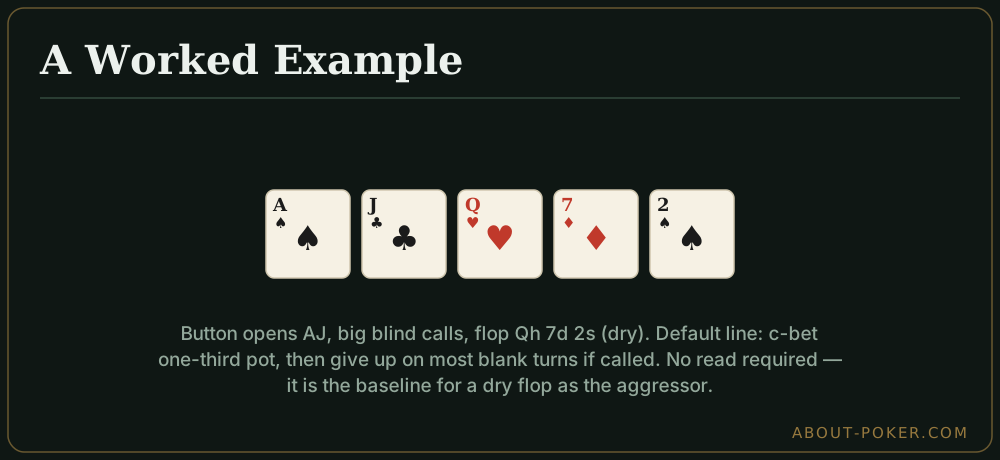
You open-raise from the button with A-J offsuit, and the big blind calls. The flop is Q-7-2 rainbow — a dry board that heavily favors your raising range. What is your default?
Your default line is a small continuation bet, around one-third of the pot, then give up on most turns if called and you do not improve. This is not a read-based decision; it is your baseline for a dry flop as the preflop aggressor with a hand that has some equity and can barrel some turns. You fire the c-bet, get called, the turn is a blank, and you check-fold your air. No agonizing required — the default handled a routine spot cleanly, and you saved your thinking for the hands that need it.
Deviating From the Default
The default is the anchor; deviations are the exceptions you earn with information. If you have a read — a population tendency or an individual pattern — that the default is wrong against this opponent, you deviate. Against a big blind who folds far too much on dry flops, you might c-bet even wider than the default suggests; against one who never folds, you might check back your air instead of firing. That move away from the baseline is exactly a GTO deviation, and it only makes sense because you had a solid default to deviate from.
The logic is always: default first, deviation second, and never deviate without a reason.
Building Good Defaults
Strong defaults are simple, robust, and close to balanced. Build them for the spots you face most: your opening ranges by position, your c-bet sizing on wet versus dry boards, your response to a 3-bet, your river bluff-catching threshold. Write them down, drill them, and make them automatic. The goal is that in the common spots you are never deciding — you are executing, and thinking only about whether a deviation is warranted.
Common Mistakes
- Having no default. Re-inventing every spot is slow and leaks EV.
- Never deviating. A default with no exceptions leaves exploit money on the table.
- Deviating without a read. Abandoning a solid baseline on a hunch usually costs you.
- Overcomplicating the default. If you cannot execute it instantly, it is not a good default.
Quick Checklist
For each common spot, know your default cold, then in the moment ask one question: is there a concrete read that makes the default wrong here? If yes, deviate deliberately. If no, execute the default without hesitation and save your energy for the spots that actually require it.
Frequently asked
What is a default line in poker?
A default line is the standard, solid sequence of actions you take in a spot when you have no specific read telling you to do something else. It is your reliable baseline — the play you make automatically until information justifies deviating.
Why do you need a default line?
Defaults save mental energy, prevent tilt-driven mistakes, and give you a stable baseline to deviate from. Without a default you re-solve every spot from scratch, which is slow and error-prone, especially under pressure or when multi-tabling.
Is a default line the same as GTO?
Not exactly. A good default is usually close to the GTO or theoretically sound play, but defaults are simplified rules of thumb built for speed, whereas GTO is the full balanced solution. Defaults approximate GTO in a form a human can execute instantly.
When should you deviate from a default line?
Deviate only when you have a concrete read that the default is wrong against this opponent — a population tendency or an individual pattern. Absent a reason, the default is correct because it is solid against the field on average.