What Is Effective Nuts in Poker?
The effective nuts is the best hand you can realistically be up against, given your opponent's range. Here's what it means and how to use it in real spots.
On this page · 6 sections
The “effective nuts” is one of those concepts that separates players who read a board from players who read a range. The absolute nuts is the single best hand possible on a board. The effective nuts is the best hand you can realistically run into — given who’s in the pot and how they got there. Often those two things are different, and betting like they’re the same costs you money.
What the term means
Think of the absolute nuts as a math fact about the board and the effective nuts as a fact about the situation. On any board there’s exactly one hand that can’t be beaten. But your opponent doesn’t have every hand — they have a range shaped by how they’ve played. If the true nuts isn’t in that range, then the best hand they can actually hold is weaker. That weaker hand is the effective nuts.
When you hold a hand that beats everything in your opponent’s range, you hold the effective nuts even if a technically stronger hand exists somewhere in the deck. Practically, you’re unbeatable — so you should play as if you are.
Why it matters
If you only ever bet and stack off with the absolute nuts, you’ll almost never get paid, because that exact hand is rare. Real winning play means value-betting hands that beat everything your opponent can realistically have. The effective-nuts idea is what gives you permission to pile chips in with a very strong — but not literally unbeatable — hand.
It cuts the other way too. Sometimes you hold the second- or third-best possible hand, but every hand above yours is either impossible for the opponent or blocked. That promotes your holding to the effective nuts and turns a cautious call into a confident raise.
A worked example
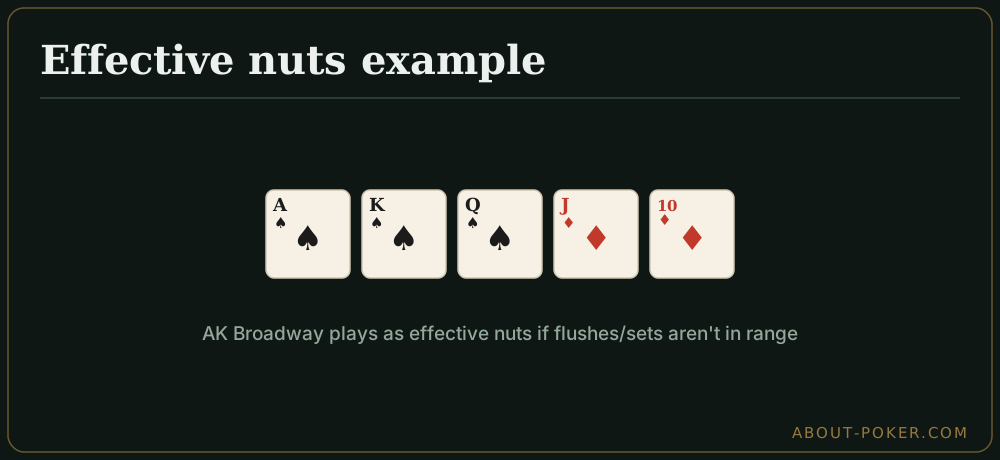
You hold A♠K♠ on a board of Q♠J♠T♦. You’ve made the Broadway straight, A-K-Q-J-T. Is it the nuts? Technically no — because there are two spades on board, someone with two more spades could make a flush, and on a paired runout a full house is possible. So the absolute nuts on this exact texture isn’t your straight.
But now consider the range. Suppose the action went: you 3-bet preflop, a tight opponent called, and the flop checked to you. A tight caller of a 3-bet rarely holds a low suited pair that flopped a set here, and often doesn’t have the exact flush combos either. If your read is that flushes and sets aren’t in their calling range on this line, your Broadway straight is the effective nuts. You can bet three streets for maximum value and never fear the check-raise. Change the opponent to a loose player who defends any two suited cards, and the flush becomes real — now your straight is no longer the effective nuts, and you slow down.
Blockers and the effective nuts
Sometimes your own cards do the work. Suppose the only hand that beats you is the nut flush, and you happen to hold the ace of that suit in your hand. Now no one can have the nut flush — you block it. This is the blocker effect: by removing the top of your opponent’s range, you promote your own hand to the effective nuts. Recognizing these blocker-driven promotions is a huge source of thin value and confident bluffs at the higher stakes.
Common mistakes
- Confusing the two. Players say “I had the nuts” when they mean the effective nuts. The distinction matters the moment a stronger hand is possible.
- Ignoring the opponent. The effective nuts depends entirely on range. A hand that’s the effective nuts against a nit is far from it against a maniac.
- Overtrusting a read. If you decide your straight is the effective nuts and you’re wrong about the range, you can stack off drawing thin. Give weight to the story the betting tells.
How it shifts by opponent and street
Against tight, straightforward players, ranges are narrow, so more of your strong hands qualify as the effective nuts — bet them hard. Against loose, tricky players, the possible-hand list stays wide, so hold a higher standard before you treat a hand as unbeatable.
And it changes street by street. A hand that’s the effective nuts on the flop can lose that status when a scare card completes an obvious draw on the turn. Re-evaluate every street: ask “what is the best hand this specific player can now have, and do I beat it?” That question — not the raw board — is what the effective nuts is all about.
Frequently asked
What is the effective nuts in poker?
The effective nuts is the strongest hand you can realistically hold or face given the actual range in play, even if a stronger hand is technically possible. Because the opponent's range doesn't contain that stronger holding, a slightly weaker hand functions as if it were the nuts.
How is the effective nuts different from the absolute nuts?
The absolute nuts is the single best possible hand on a board, considering every card combination. The effective nuts is the best hand within a specific range — it can be weaker than the absolute nuts when the true nuts is impossible for that player to hold.
Why does the effective nuts matter?
It lets you value-bet and get all-in with hands that aren't literally unbeatable but are unbeatable against the range you're facing. Playing only the absolute nuts aggressively would leave a lot of money on the table.
Can blockers create effective nuts?
Yes. If you hold a card that blocks the only hands that would beat you, the strongest hand your opponent can have becomes weaker, effectively promoting your hand toward the top of the practical rankings.