What Is Freeroll in Poker?
A freeroll has two meanings: a free-entry tournament, and a hand where you cannot lose but can win more. Learn both uses of freeroll in poker with examples.
On this page · 6 sections
Freeroll is one of those poker words with two completely different meanings, and both are worth knowing. It can mean a free-to-enter tournament that still awards real money, or it can describe a specific in-hand situation where you cannot lose but might win everything. Beginners usually meet the first meaning; the second is the one that wins money at the table.
Meaning one: the free tournament
A freeroll tournament costs nothing to enter but pays out real prizes, whether cash, tournament tickets, or entry into a bigger event. Poker rooms run them to attract new players and reward loyalty. Because there is no financial risk, thousands of players pile in, so fields are enormous and the early play is wild and loose.
Freerolls are a legitimate way to build a bankroll from zero. Many players have turned a free entry into a real roll over time. But be realistic: with huge fields and tiny prize pools, the expected value per hour is low. Play them for practice and the occasional score, not as a reliable income. They are also excellent for getting reps in a tournament format without risking a cent, which pairs well with learning concepts like the satellite bubble.
Meaning two: the freeroll in a hand
This is the meaning serious players care about. You are freerolling when you and your opponent currently hold the same made hand, but only you can improve to beat them. You risk nothing beyond a chop, and you have upside to scoop the entire pot. It is the best possible spot to get money in.
The purest version comes up all the time in Omaha, but it happens in Hold’em too. The key features are:
- You are currently tied for the best hand (you both have, say, the same straight).
- Only you have a way to improve past that tie (a flush draw, a redraw to a bigger straight, or a full-house draw).
- Your opponent’s best case is a split; your best case is winning it all.
A worked example
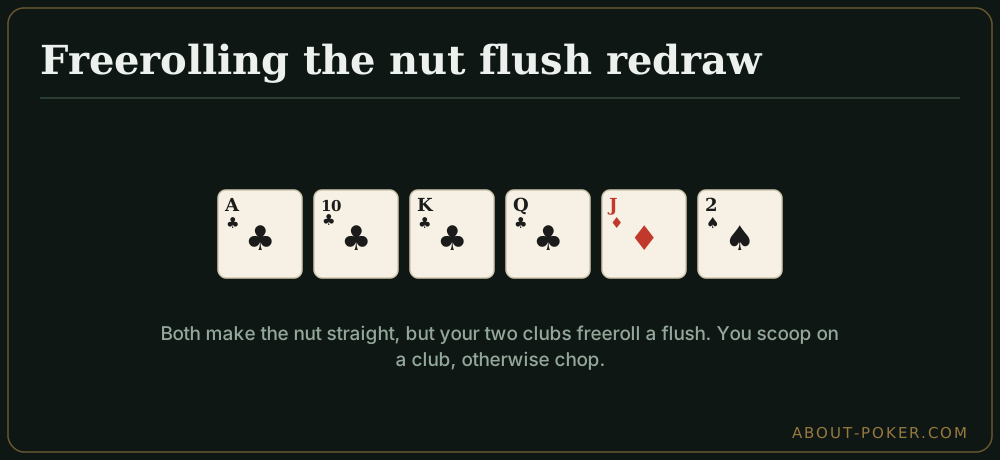
The board reads Kc-Qc-Jd-2s. You hold Ad-Tc and your opponent holds As-Th. Both of you have made the exact same nut straight, ace-high (A-K-Q-J-T). Right now it is a dead chop.
But suppose instead you held Ac-Tc while villain held As-Th. Now you both still have the identical nut straight, but you also hold two clubs with the Kc and Qc on board, giving you a draw to the nut flush. If a club falls on the river, you scoop the whole pot. If it does not, you simply chop. You cannot lose this hand. That is a freeroll: your opponent is drawing dead to a share of the pot while you have live cards to take it all. Getting all the money in here is free profit.
Why freerolls are the dream spot
In most all-in confrontations there is real risk: even the aces that beat kings roughly 82% of the time can still lose. A freeroll removes the downside entirely. Your worst outcome is getting your money back in a split, and your best outcome is the whole pot. When you recognize you are freerolling, you should almost always be pushing the action to build the pot as large as possible, because every extra chip in the middle is a chip you might scoop and can never lose.
Freeroll versus freeroll draw
These are closely related. A freeroll draw emphasizes the drawing element, the live cards that let you improve past a tie. A freeroll is the broader situation of being tied with upside. In practice people use them interchangeably. The important thing is the structure: currently even, only you can pull ahead, worst case a chop. Compare this to holding the nuts, where you already have the best possible hand and are not relying on improvement.
How to spot and use freerolls
- Look for shared strong hands with a redraw. Whenever you and a likely opponent both hit the same straight or flush, ask if you have any card that improves you further. If yes, you are freerolling.
- Bet and raise aggressively. With no downside, maximize the pot. This is the rare spot where you want as much money in as possible.
- In Omaha, hunt for them constantly. The four-card hands make freerolls extremely common, especially with double-suited holdings and connected boards.
- Do not confuse a freeroll with a coin flip. A real freeroll cannot lose. If there is any card that makes your opponent win, it is not a freeroll, just a favorable draw.
Whether you are grinding a free tournament to build a bankroll or scooping a pot you could never lose, the word freeroll always points to the same happy idea: upside with no cost.
Frequently asked
What is a freeroll in poker?
Freeroll has two meanings. As a tournament, it is a free-to-enter event that still pays real prizes. In a hand, it is a spot where you are tied for the current best hand but have a chance to improve and win the whole pot while your opponent can only chop or lose.
Are freeroll tournaments worth playing?
They are worth playing to build a bankroll from nothing, since they cost nothing to enter. But fields are huge, play is loose, and prizes are small, so the hourly value is low. Treat them as free practice rather than a serious income source.
How does a freeroll work in a single hand?
You freeroll when you and your opponent are currently tied but only you can improve. For example, both have the same straight, but you also hold a flush draw. You can win the whole pot and cannot lose it, only chop.