What Is Heater in Poker?
A heater is a hot streak where you keep winning far beyond your normal rate. Learn what a heater means, how it differs from run good, and how to handle one.
On this page · 6 sections
A heater is a hot streak — a stretch where you keep winning far beyond your normal rate. Everything clicks: your big hands get paid, your flips hold, your deep tournament runs stack up one after another. Players say they are “on a heater” when the results just keep coming, sometimes across a single wild session and sometimes across weeks of a tournament series.
The word borrows from sports, where a shooter “gets hot.” In poker it carries the same meaning and the same trap. A heater feels like you have unlocked something, but underneath it is mostly positive variance running unusually long and unusually strong.
Heater vs. run good: closely related
These two terms overlap so much that many players use them interchangeably, but there is a subtle difference in emphasis.
Run good describes the cards themselves falling your way — favorites holding, draws hitting, coolers landing on your side. A heater emphasizes the winning streak and its momentum, usually over a bigger stretch: a long session, a series, a run of cashes. In practice, a heater is an intense and sustained period of running good. When someone final-tables three tournaments in a week, that is a heater. When their aces simply held up one night, that is run good.
Why heaters happen
Poker results in the short term are dominated by variance, and variance clusters. Random outcomes do not spread themselves out evenly; they arrive in streaks, both hot and cold. A heater is one of those clusters landing in your favor.
In high-variance formats the swings are enormous. Tournament players can go months barely cashing, then win two events in a fortnight. That is not a sudden leap in skill — it is the same true ability producing a lucky cluster. Skill sets the size of your edge over time; variance decides how the results bunch up in the short run, and a heater is variance bunching them up beautifully.
Worked example: a tournament heater
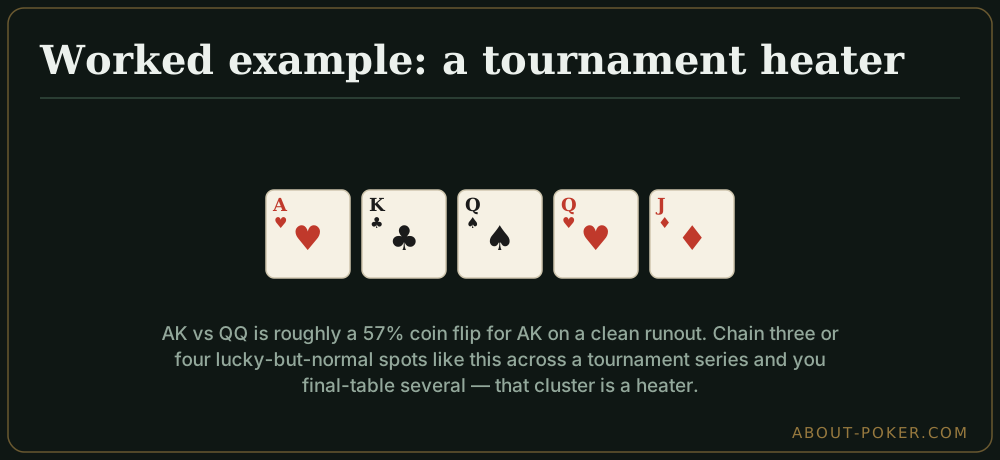
Suppose you are a break-even-to-small-winner tournament player who enters ten events over two weeks. Your realistic expectation might be one or two small cashes.
Instead, you win a flip with AK vs QQ (a near coin flip, about 57% for AK if the board runs clean), you hold with AA vs a shorter stack’s KK (an 82% favorite that finally behaves), and you spike a two-outer set on the turn to survive a bustout spot (roughly a 4% shot). Chain three or four of those lucky-but-not-crazy outcomes together across several tournaments and you final-table three of them.
Nothing about that requires new skill. Each spot was a normal poker situation whose random result happened to favor you, and they all clustered inside the same two weeks. That is a heater.
How to handle a heater
The mature response to a heater is to bank the money and stay exactly the same player you were before it started.
- Do not move up in stakes. Bankroll rules exist precisely so a hot streak does not talk you into games you are not rolled for.
- Keep your session lengths sane. “I can’t lose” is the thought that ends heaters badly. Fatigue and overconfidence quietly cost you.
- Withdraw and protect winnings. A heater is a good time to lock away profit, not to gamble it up.
- Judge your play, not your results. Ask whether your decisions were correct. A heater can hide leaks because winning papers over mistakes.
The counterpart is worth remembering too: the same variance that builds a heater produces long stretches of bad beats and downswings. Handling both with the same steady mindset is what separates professionals from players who ride the emotional wave.
Common mistakes during a heater
Players torch their winnings by mistaking luck for a new level of skill. They start calling wider “because it’s my night,” take shots at stakes their bankroll cannot support, and play marathon sessions that erase the edge fatigue destroys. The heater does not last forever, and the version of you that played loose and overconfident is exactly the one variance punishes when it turns.
Keep going
A heater is one of poker’s great pleasures and one of its most dangerous illusions. Enjoy the ride, protect the profit, and remember that the cards owe you nothing next week. For the wider picture on positive variance, read the run good guide, and browse the full poker glossary for the rest of the vocabulary you will hear at the table.
Frequently asked
What is a heater in poker?
A heater is a hot streak where you keep winning well above your normal rate for a session, a series, or a run of tournaments. It is a burst of strong positive variance, often paired with playing well, but the winning itself is driven by luck.
What is the difference between a heater and run good?
They overlap heavily. Run good describes cards falling your way; a heater emphasizes the winning streak and its momentum, often over multiple sessions or a tournament series. A heater is essentially an intense, sustained stretch of running good.
How long does a heater last?
There is no set length. A heater can be one explosive session or a multi-week run in tournaments, where variance is huge. It ends when the cards normalize, which they always eventually do as the sample grows.
Should I move up in stakes during a heater?
No. Stake decisions should follow bankroll rules, not a hot streak. Moving up on a heater is one of the fastest ways to give back winnings and more once variance turns against you.