What Is Hijack in Poker?
The hijack (HJ) is the seat two to the right of the button — the first of the late positions. Here's where it sits and how to play it well.
On this page · 6 sections
The hijack (HJ) is the seat two to the right of the button, sitting directly to the right of the cutoff. It is the first of the three late positions and the place where profitable, aggressive preflop play really begins.
The hijack is a transition seat. You are past the tight, cautious ranges of early and middle position, but you are not yet in the premium late spots. Two players — the cutoff and the button — still have position on you, so you have to open wider than the players before you while respecting the strong seats yet to act. Get this balance right and the hijack becomes a steady earner.
Where the hijack sits
At a nine-handed table, count backward from the button: button, then cutoff, then hijack. The hijack is the third-to-last seat to act preflop, followed only by the cutoff, the button, and then the blinds.
The name describes its purpose. When you raise from the hijack you are trying to “hijack” the pot before the two best seats can get involved — grabbing the initiative that would normally belong to the cutoff or button. It is the earliest position from which routine blind stealing makes sense.
Why the hijack matters
Position is the biggest structural edge in hold’em, and the hijack is where you first get enough of it to open aggressively. When the action folds to you, only four players remain, and two of them are forced blinds who defend with weak ranges. That gives you real fold equity: a well-timed raise often takes the pot down before the flop.
But the hijack carries a warning that the cutoff and button do not. Two skilled, position-having opponents sit behind you. If either wakes up with a hand, they can 3-bet and force you to play out of position for the rest of the hand. That threat is exactly why your hijack range stays tighter than your cutoff range.
How wide to open from the hijack
A solid default is the top 18 to 22 percent of hands. That means all pocket pairs, suited aces, suited broadways, suited connectors down to roughly 76s, and offsuit broadways like KJo and QJo. Weak offsuit aces and thin suited gappers that you would happily open on the button should usually be folded here.
Think of your ranges as a staircase widening toward the button: middle position around 15 percent, hijack around 20 percent, cutoff around 28 percent, button around 45 percent. Each seat earns a little more reach because fewer players can act behind it.
A worked example
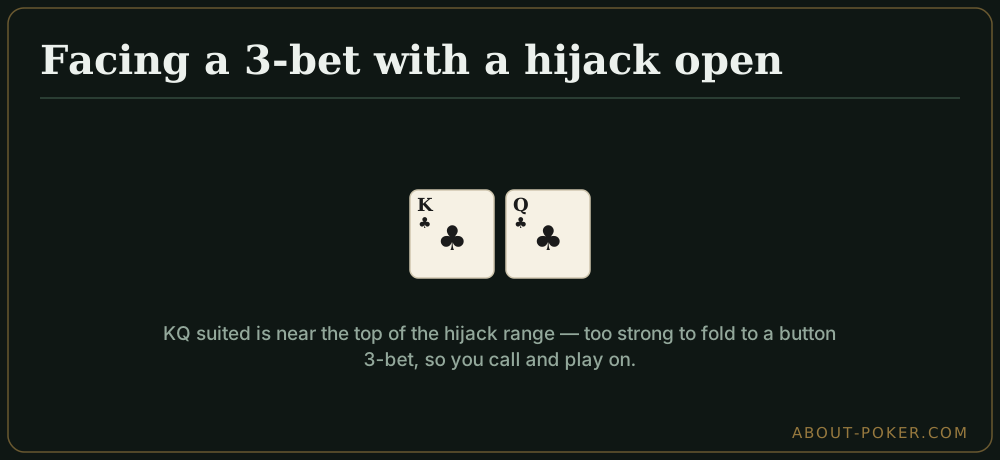
It folds to you in the hijack with Kc Qc. You open to 2.5 big blinds. The cutoff folds, but the button — an aggressive regular — 3-bets to 8 big blinds. The blinds fold. Now you are heads-up out of position against a wide 3-betting range.
KQ suited is far too strong to fold here. It flops well, has two overcards to most boards, and dominates the offsuit broadways the button is bluffing with. So you call. The flop comes Qd 8h 3s, giving you top pair with a strong kicker. When the button continuation-bets, you call and let them keep bluffing. Because KQs was near the top of your hijack range, you have an easy, profitable hand rather than a marginal guess.
Common mistakes in the hijack
- Treating it like the button. The hijack is not a free-for-all. Two players with position remain — do not open trash just because you are “in late position.”
- Playing it like early position. The opposite error. Folding hands like KJo or 98s from the hijack leaves easy profit unclaimed.
- Flat-calling raises out of position. If someone opens ahead of you, prefer a 3-bet or a fold over a cold call that traps you between aggressive late-position players.
- Ignoring who is behind you. Loose, aggressive players in the cutoff and button should make you tighten. Passive, tight players behind you let you widen.
Quick hijack checklist
Each time the action reaches you in the hijack, ask three things: Is it folded to me, letting me open a full 20 percent range? Are the players behind me aggressive enough to punish loose opens? And is my hand strong enough to continue if I get 3-bet? Answer those honestly every orbit and the hijack will quietly pad your winrate.
Frequently asked
Where is the hijack at a poker table?
The hijack sits two seats to the right of the button, immediately to the right of the cutoff. Going clockwise the last three positions before the blinds are the hijack, the cutoff, and the button.
Why is it called the hijack?
The name comes from raising to 'hijack' the pot before the two better late positions, the cutoff and button, can open it. It steals the initiative those seats would normally enjoy.
How wide should you open from the hijack?
Roughly the top 18 to 22 percent of hands in a full-ring game — wider than middle position but tighter than the cutoff. Two players with position on you still act behind you, so you cannot open quite as loosely as the cutoff or button.