What Is Insurance in Poker?
Poker insurance is a side deal that pays you if your strong all-in hand gets outdrawn. Learn how it works, the math, and why it usually costs you money.
On this page · 6 sections
Insurance in poker is a side deal that pays you money if your strong all-in hand ends up losing to an opponent’s draw. You pay a premium up front, and in exchange you get a payout if the “bad” card comes. It shows up in some high-stakes cash games, on certain poker apps, and as a formal casino offering. The catch: like most insurance, it’s priced so the seller — usually the house — profits over the long run.
The core idea: hedging an all-in
Insurance only comes up after the money is already in the middle and the hands are on their backs — an all-in with cards to come. Suppose you’re a big favorite but your opponent has outs to a draw. Even as a favorite, you’ll sometimes lose. Insurance lets you pay a fee now so that if the draw hits, you’re compensated.
You’re essentially betting against yourself. If you win the pot, you lose the premium. If you get outdrawn, the insurance payout softens (or covers) the loss. It converts a big swing into a smaller, more predictable one — for a price.
A worked example with real numbers
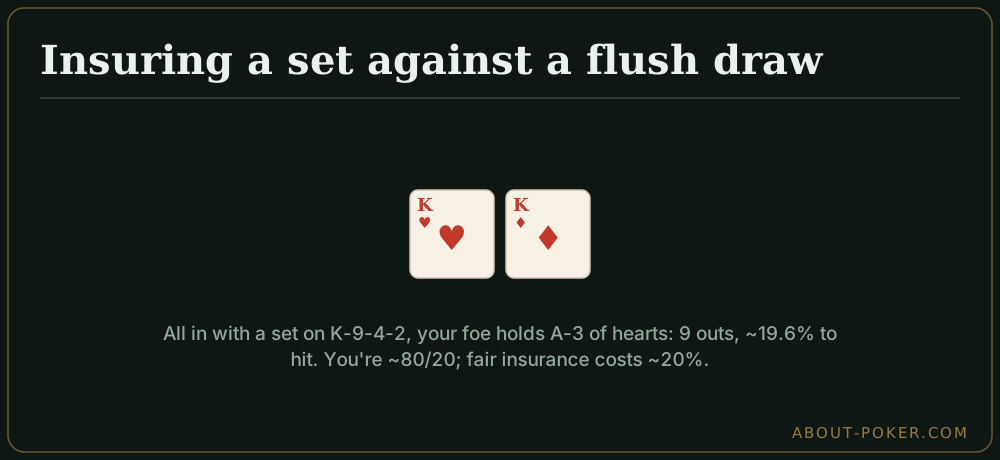
You’re all in on the turn with a set of kings on a K♠ 9♦ 4♣ 2♥ board. Your opponent holds A♥ 3♥ and needs a heart on the river to make a flush. There are 9 hearts left among the unseen cards, and about 46 unseen cards remain. So he hits roughly 9 out of 46, or about 19.6%. That makes you close to an 80/20 favorite to win the pot.
A fair insurance price would charge you about 20% of the amount you’re insuring, since that’s your true chance of losing. But a house-run insurance desk might charge you more than the fair 20% — say a rate that implies a 24–26% chance of losing. That extra margin is the house edge. Over hundreds of insured spots, paying above fair value guarantees you lose money on the insurance itself, even though it feels safe in the moment.
The lesson: the favorite is already expected to win 80% of the pot; buying insurance at worse-than-fair odds gives away part of that edge.
Where insurance shows up
- High-stakes cash games. Players occasionally arrange informal insurance deals or “run it twice” alternatives to reduce swings on huge pots.
- Poker apps and clubs. Some online clubs offer a built-in insurance button on all-in pots with a house margin baked in.
- Casino side offerings. A few rooms formalize insurance as a house game. As with any casino product, the price includes the house’s profit.
A related but fairer variance-reducer is “running it twice,” where the remaining board is dealt out two times and the pot is split by results. That has no house edge — it just cuts variance symmetrically between the players.
Why it usually costs you money
Insurance is priced by whoever offers it, and they set the premium above the mathematically fair number so they profit long term — exactly how car or health insurers stay in business. Poker is already a game of managing variance with a big enough bankroll. If you’re properly rolled, taking negative-EV insurance turns a game you should beat into one you beat by a little less.
The main legitimate reason to take insurance is bankroll preservation in a genuinely life-changing pot: if losing the hand would cripple you, paying a small premium to avoid catastrophe can be rational even at a slight EV loss. That’s a personal risk-tolerance decision, not a strategic edge. This is different from getting coolered — insurance doesn’t change how often you get unlucky, only how much a single loss stings.
Common mistakes
- Buying it to “feel safe.” Emotional insurance decisions almost always cost EV. Favorites should usually just take the variance.
- Confusing it with running it twice. Running it twice is fair; casino insurance is not.
- Insuring small pots. The premium overhead makes insuring routine pots clearly unprofitable. It’s only ever worth considering on unusually large pots.
- Forgetting the house edge exists. If the price were fair, the house wouldn’t offer it.
Quick checklist
- Insurance pays out if your all-in favorite loses.
- You pay a premium based on your opponent’s outs.
- The price is usually set above fair value — a house edge.
- Over time, insurance costs money; it doesn’t make it.
- Only consider it for bankroll survival in an enormous pot.
In short: poker insurance is peace of mind sold at a markup. Know the math, and take it only when protecting your bankroll matters more than squeezing out every last unit of expected value.
Frequently asked
What is insurance in poker?
Insurance is a side deal, offered in some cash games and casinos, that pays you a fixed amount if your favored all-in hand gets outdrawn by an opponent's draw. You pay a premium up front, and if you lose the hand the insurance pays out.
Should you take insurance in poker?
Usually no. Casino and app insurance carries a built-in house edge, so over time it costs money. It only makes sense for bankroll-preservation reasons in an unusually large pot, not as a way to make a profit.
Is poker insurance the same as blackjack insurance?
The concept is similar — a side bet against a bad outcome — but poker insurance covers being outdrawn after going all in, while blackjack insurance covers the dealer having a natural. Both typically favor the house.