What Is M-Ratio in Poker?
M-ratio measures how many rounds you can survive before the blinds and antes eat your stack. Learn the formula, the Harrington zones, and how to use it.
On this page · 7 sections
M-ratio — often just called your “M” — measures how many full orbits of the table you can survive on your current stack before the blinds and antes blind you out, assuming you never play a hand. It is one of the most important numbers in tournament poker because it tells you how much time you have and, by extension, how aggressive you must become. The concept was popularized by Dan Harrington in Harrington on Hold’em, and it remains a core mental tool for every serious tournament player.
The Formula
Your M is your stack divided by the cost of one full round:
M = stack ÷ (small blind + big blind + total antes per orbit)
The denominator is everything you are forced to pay across one complete lap of the table. A high M means the blinds are trivial and you can wait for good spots. A low M means the forced bets are devouring you and you need to act.
A Worked Example
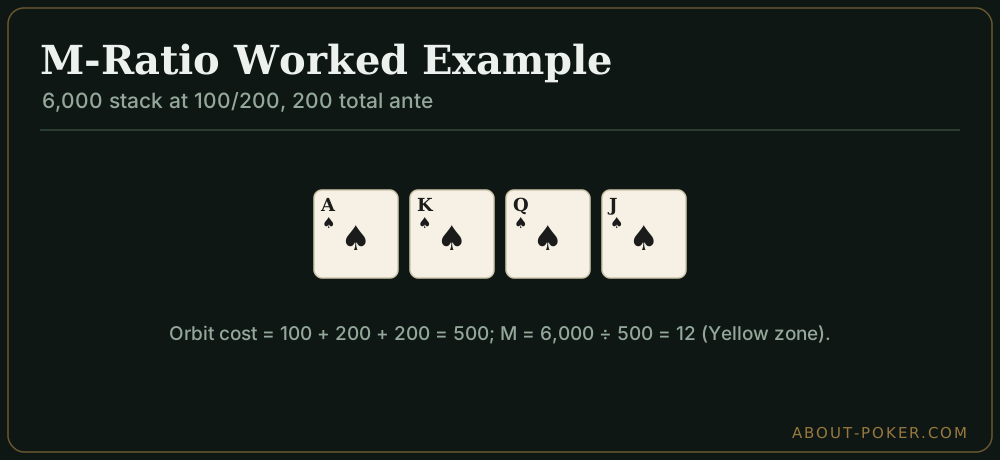
You have 6,000 chips. The blinds are 100/200 and there is an ante that totals 200 per orbit. One full orbit costs you 100 + 200 + 200 = 500 chips. Your M is 6,000 ÷ 500 = 12.
An M of 12 means you can fold for roughly twelve full rounds before you disappear — comfortable, but not deep. You are in the Yellow zone (see below), so you should tighten your speculative hands, look for spots to reraise all-in, and stop making moves that risk chips without a clear plan.
The Harrington M Zones
Harrington broke M into five zones, each dictating a different gear:
- Green (M above 20): You have room to play real poker — call, raise, set-mine, and outplay opponents postflop.
- Yellow (M 10–20): Tighten up. Speculative hands like small suited connectors lose value because you cannot afford to miss.
- Orange (M 6–10): Your main weapon is the first-in raise or shove. You are playing to steal blinds and pick your all-in spots.
- Red (M 1–5): Push-or-fold. You are looking for any reasonable hand to move all-in and pick up the blinds and antes.
- Dead (M below 1): You cannot even cover a full orbit. Shove the next playable hand and hope.
The lower your zone, the more your strategy collapses toward simple all-in decisions.
Effective M and Table Size
Raw M assumes a full table, but the blinds reach you more often when fewer players are seated. Effective M corrects for this: multiply your raw M by the number of players divided by a full table. At a 5-handed table instead of 10-handed, you pay the blinds twice as fast, so your effective M is roughly half your raw M. Always adjust when the table is short — a “safe” M of 14 shorthanded plays much more like a 7.
How M Changes Your Decisions
When your M is high, you can afford to see flops, float bets, and grind out edges — you are effectively deep-stacked relative to the blinds. As M drops, the value of implied odds and tricky postflop play evaporates because you no longer have the chips to leverage them. The single-best low-M play is often shoving all-in preflop to maximize fold equity: you win the pot uncontested a large share of the time, and when called you still have equity.
Near the money bubble and pay jumps, layer ICM on top of M. A low M does not automatically mean shove-any-two if a bustout costs you a big prize-pool jump — sometimes survival is worth folding a marginal shove.
Common Mistakes
- Ignoring antes. Beginners compute M from blinds alone and overestimate how much time they have; antes often double the orbit cost.
- Playing Green-zone poker with a Red-zone stack. Limping and set-mining with an M of 4 just bleeds chips.
- Forgetting effective M. A comfortable raw M can be dangerously low at a shorthanded final table.
- Shoving too wide too early. A high M does not require heroics — patience is a weapon when you have chips.
Quick Checklist
Each orbit, glance at your M: add the blinds and antes, divide your stack, adjust for table size, then pick the gear the zone demands. It turns a fuzzy “am I short?” feeling into a precise number you can act on.
Frequently asked
What is M-ratio in poker?
M-ratio is your stack divided by the total cost of one orbit — the small blind, big blind, and all antes. It tells you how many full rounds of the table you can sit through before the forced bets blind you out.
How do you calculate M-ratio?
Add up the small blind, big blind, and every ante posted in one full orbit, then divide your stack by that total. For example, a 6,000 stack at 100/200 blinds with a 200 total ante gives an M of 6,000 ÷ 500 = 12.
What are the Harrington M zones?
Dan Harrington split M into zones: Green (M above 20), Yellow (10–20), Orange (6–10), Red (1–5), and Dead (below 1). Each lower zone means fewer playable hands and a stronger push toward all-in poker.
What is effective M?
Effective M adjusts your raw M for the number of players at the table by multiplying by the fraction of a full table present. At a shorthanded table the blinds hit you more often, so your effective M is lower than the raw number suggests.