What Is Mandatory Straddle in Poker?
A mandatory straddle forces a designated seat to post double the big blind every hand. Learn the rules, how it changes effective stakes, and how to adjust.
On this page · 6 sections
A mandatory straddle is a table or house rule that forces a designated seat — almost always under the gun — to post a straddle of double the big blind on every hand. Unlike a normal straddle, which is voluntary, there is no opting out: whoever sits in that seat that hand must post. The result is a game that plays at meaningfully higher effective stakes than the posted blinds suggest.
You will see mandatory straddles most often in action-oriented private and casino games where the room wants bigger pots. If you sit down without understanding the rule, you can badly misjudge the stakes.
How the mandatory straddle works
Before each hand, the designated seat posts the straddle automatically. In a 2/5 game the mandatory straddle is 10 — double the big blind. Like any straddle, it is a live blind:
- The 10 counts toward the straddler’s wager.
- The straddle becomes the amount to call, so the effective preflop price is 10, not 5.
- The straddler acts last preflop and gets the option to check or raise.
The difference from a voluntary straddle is purely the “no choice” part — and the fact that it happens every single hand, so the elevated stakes are constant, not occasional.
The real effect: your stakes roughly double
This is the point most players miss. A big blind of 5 with a mandatory 10 straddle every hand means the true opening price and pot size track the straddle, not the blind. A 2/5 game with a mandatory UTG straddle plays much more like a 5/10 game.
Two big consequences follow:
- Effective stakes are higher. Every pot starts bigger, so every mistake costs more.
- You are shallower in meaningful terms. A 500 stack is 100 big blinds but only 50 straddles. Measured against the straddle — which is what pots are really sized to — you are half as deep as the blind count implies.
A worked example
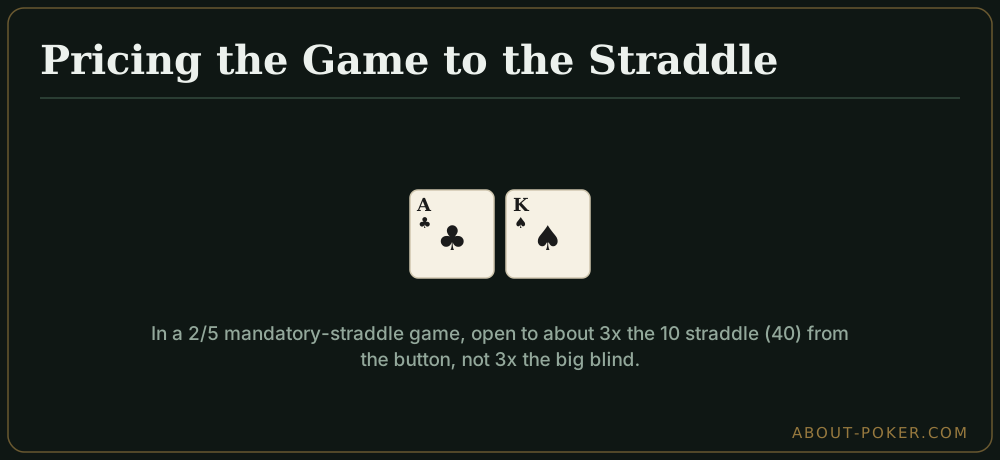
You sit in a 2/5 game with a mandatory UTG straddle to 10, buying in for 500. On paper that is 100 big blinds — a healthy deep stack. But because the straddle drives the action, the effective game is closer to 5/10, and your 500 is really about 50 straddles deep.
Now the hand plays out. The under-the-gun seat posts 10. Two players call 10, and it folds to you on the button. You raise to 40. That is a standard “3x the straddle” open — the correct reference point is the 10 straddle, not the 5 big blind. If you had sized to the big blind (say, raising to 15 or 20), you would be under-raising for a game whose real price is 10.
When the mandatory straddle comes around to your seat, you post 10 automatically and act last preflop. Play it as a marginal, out-of-position spot — you are in blind, just like a voluntary UTG straddle, so tighten up and lean on your option only with hands worth raising.
How to adjust your strategy
- Re-map every size to the straddle. Opens, 3-bets, c-bets, and pot-odds calculations should reference the 10 straddle, not the 5 big blind. Otherwise your bets are proportionally too small.
- Recount your effective stack. Think in straddles, not big blinds. Fewer straddles deep means play more straightforwardly and get stacks in with strong hands sooner.
- Open a touch tighter from early positions. Higher effective stakes and constant extra dead money in the pot reward discipline; loose early opens leak faster.
- Value position more, not less. With bigger pots every hand, the positional edge of acting last is worth more real money.
- Check your bankroll. A 2/5 mandatory-straddle game is a 5/10-ish bankroll requirement. Do not size your buy-in to the blinds and get short-stacked in disguise.
Common mistakes
- Sizing to the big blind. Raising “3x” the 5 blind in a mandatory-straddle game makes your opens far too small for the real stakes.
- Overvaluing the free option. Being the mandatory straddler still means you are in blind from bad position. It is not a license to play any two cards.
- Ignoring the depth change. Playing a 50-straddle stack like it is 100 big blinds leads to overcommitting on later streets when you are actually short.
- Not asking the rules. Always confirm whether re-straddles are allowed and which seat is mandatory before your first hand.
Quick checklist
- Identify the mandatory seat and the straddle amount (usually 2x the big blind, UTG).
- Treat the effective stakes as roughly double the posted blinds.
- Recount your stack in straddles, not big blinds.
- Size all bets and pot odds off the straddle.
- Bankroll for the higher effective game.
Understand the mandatory straddle and you will price the game correctly from the first hand — instead of playing a 5/10 game with 2/5 instincts and wondering why the swings feel so big.
Frequently asked
What is a mandatory straddle in poker?
A mandatory straddle is a table or house rule that forces a designated seat, usually under the gun, to post a straddle of double the big blind on every hand. Unlike a voluntary straddle, the player has no choice. It effectively raises the stakes of the game for everyone.
How does a mandatory straddle change the stakes?
Because a straddle is double the big blind and posted every hand, a mandatory straddle roughly doubles the effective stakes. A 2/5 game with a mandatory UTG straddle plays much more like a 5/10 game, with a larger opening pot and deeper action every hand.
How should you adjust to a mandatory straddle?
Treat the game as higher stakes and shallower in big-blind terms, because your stack is now fewer straddles deep. Open a bit tighter from early position, value position even more, and re-map your bet sizes to the straddle amount rather than the big blind. Make sure your bankroll fits the higher effective stakes.