What Is Maniac in Poker?
A maniac is a hyper-aggressive player who raises and bets almost at random. Here's what the term means, how to spot one, and the exact strategy to beat them.
On this page · 6 sections
A maniac is a player who bets, raises, and re-raises with almost any two cards, far more than the strength of their hands could ever justify. Where a good aggressive player fires because they have a reason, a maniac fires because firing is simply what they do. They build huge pots with garbage, put opponents to constant tough decisions, and create wild, swingy games. In the short run they can feel unstoppable. In the long run, they are one of the most profitable opponents you’ll ever sit with.
What defines a maniac
The maniac sits at the extreme corner of the style chart: maximally loose and maximally aggressive, with no discipline holding it together. The signature behaviors:
- They raise everything. Preflop, they three-bet and four-bet with hands most players would fold.
- They never slow down. Missed the flop? Bet anyway. Got called? Bet bigger.
- Their sizing is erratic. A pot-sized bet on one street, a min-raise the next, an overbet shove out of nowhere.
- They ignore the board. A maniac barrels whether the texture helps their perceived range or not.
The result is a player whose actions carry almost no information, because the same behavior covers monsters and total air alike.
Maniac versus LAG
The most common mistake is treating a maniac like a skilled loose-aggressive player. Both play many hands and both are aggressive, but the resemblance ends there.
| LAG | Maniac | |
|---|---|---|
| Hand selection | Wide but chosen | None — plays anything |
| Betting | Purposeful, balanced | Reflexive, endless |
| Ability to fold | Yes | Rarely |
| Long-run result | Winning | Losing |
A LAG’s aggression is a scalpel; a maniac’s is a firehose. A LAG knows when a barrel won’t work and shuts down. A maniac keeps pulling the trigger until the chips are gone. The opposite personality entirely is the nit, who folds so much they never build a pot at all.
Why maniacs lose (and you profit)
Poker punishes putting too much money in with weak hands, and that is precisely what a maniac does every orbit. Their edge in fold equity is real but small; their leak in bloating pots as the underdog is enormous.
For you, the opponent, this is a gift. When a maniac is at the table, your strong hands get paid off far more than usual because the maniac will bet your value for you. You don’t need to make anything happen — you just need to be there with a real hand when the maniac inevitably overcommits.
A worked example
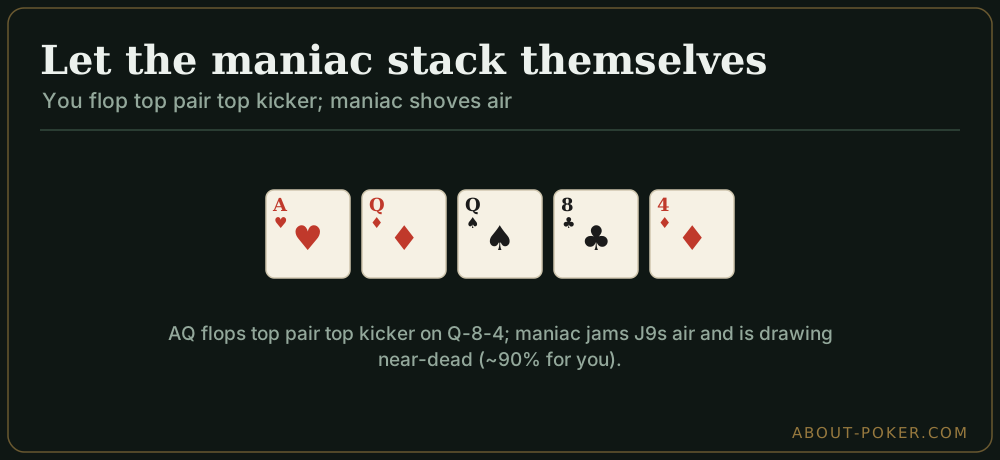
You’re in the cutoff with A♥ Q♦. A known maniac raises 4x from early position. Everyone folds to you.
Against a tight player, a big early-position raise means a strong range and you might just call cautiously. Against the maniac, that raise means almost nothing — their range is enormous and mostly weak. Ace-queen is crushing it, so you three-bet.
The maniac calls. Flop: Q♠ 8♣ 4♦. You’ve flopped top pair, top kicker. You check to induce, because you know what’s coming. The maniac shoves for two-thirds of the effective stack with, say, J♠ 9♠ — bottom-of-the-barrel air with a backdoor draw. You snap-call. Your top pair is a huge favorite, roughly 90% to win, and the maniac’s relentless pressure just stacked them instead of you. That’s the maniac dynamic in a single hand: let them bet, then be there with the goods.
How to beat a maniac
The counter-strategy is patience wearing a poker face:
- Tighten up. Fold your junk and wait for hands that dominate their wide range.
- Let them bet for you. Check-call and check-raise with strong hands instead of betting them off their bluffs.
- Call down lighter. Because their range is so weak, hands you’d normally fold become profitable calls.
- Value bet relentlessly. When you have it, make it big — a maniac will pay.
- Sit to their left if you can. Acting after the maniac lets you react to their aggression with full information.
Managing the variance
Beating a maniac is profitable but bumpy. You’ll get it in as a big favorite and still lose sometimes — that’s normal, and it does not mean the strategy is wrong. The maniac’s whole game is variance, and to harvest their chips you have to be willing to ride the swings. Stay disciplined, don’t tilt when a strong hand loses, and trust that the math pays out over a full session.
For the rest of the player nicknames and table vocabulary, browse the full poker glossary.
Frequently asked
What is a maniac in poker?
A maniac is a player who bets, raises, and re-raises with almost any hand, far beyond what the cards justify. Their aggression is reflexive rather than calculated, so they build enormous pots with weak holdings and end up donating chips over time.
Is a maniac the same as a LAG?
No. Both are loose and aggressive, but a LAG (loose-aggressive) picks spots and knows when to stop. A maniac has no brakes — they apply pressure everywhere, all the time, regardless of the board or their hand. A LAG wins long-term; a maniac loses.
How do you beat a maniac?
Play tight, let them do the betting for you, and call down or trap with strong hands instead of trying to out-bluff them. Value bet relentlessly, avoid marginal spots out of position, and be willing to call lighter because their range is so wide.
Are maniacs profitable to play against?
Yes, a maniac is usually one of the most profitable opponents at the table — for patient players. Their wild betting means you get paid big when you have a real hand. The variance is high, but the long-run edge is large if you stay disciplined.