What Is Overbet in Poker?
An overbet is a bet larger than the size of the pot. Learn why players overbet for value and as bluffs, when boards allow it, and a worked example.
On this page · 6 sections
An overbet is a bet larger than the current size of the pot — for instance, betting 150 into a pot of 100. Most bets in Hold’em fall between a third and a full pot, so an overbet stands out. It is a deliberately large sizing used to squeeze maximum value from strong hands and to apply maximum pressure when bluffing. Used at the right moment, it is one of the most powerful tools in the game; used carelessly, it just burns chips.
Where the term comes from
The name is literal. A “pot-sized bet” is the reference point, and anything larger is an “over”-bet. The word signals that the player has chosen to break from standard sizing on purpose. In modern strategy, solvers have shown that overbets are correct far more often than players used to think, especially on later streets where ranges are already defined.
Why players overbet
There are two main motives, and a good overbetting range contains both.
- Maximum value. When you hold a very strong hand and your opponent has a hand they cannot fold — like top pair or an overpair — a big bet extracts far more than a standard value bet. If they are going to call anyway, charge them the most.
- Maximum pressure. As a bluff, an overbet creates the most fold equity. Facing a huge bet, an opponent needs a very strong hand to continue, so their marginal hands fold.
The reason both work at once is polarization: an overbetting range is made of the nuts and near-nuts on one side and bluffs on the other, with nothing in between. Your opponent cannot tell which they are facing, so they are stuck making an expensive guess.
Worked example: overbetting the river
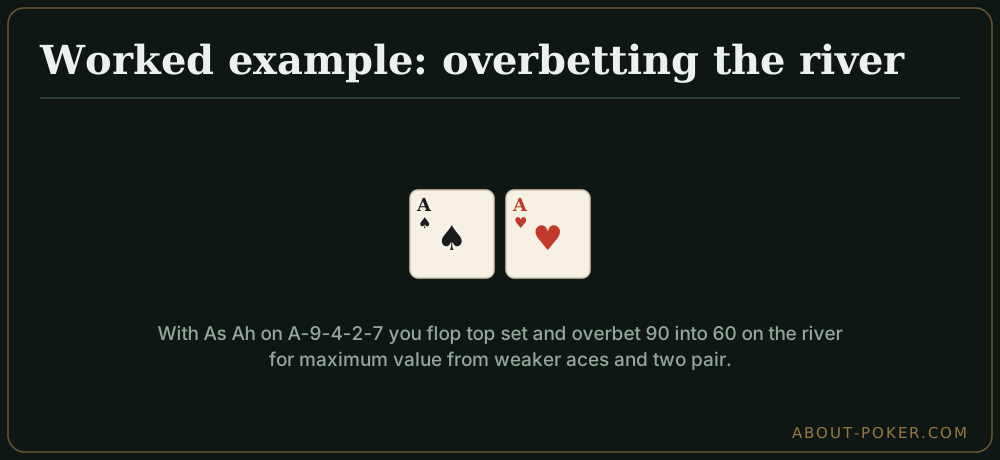
You raise preflop with A♠ A♥ and get one caller. The board runs out:
A♦ 9♣ 4♠ 2♥ 7♦
You have top set — the near-nuts on a board with no completed straights or flushes. The pot is 60 and you both have 200 behind. Instead of betting 40, you overbet 90 into 60.
Why so large? Because your opponent’s likely hands — a weaker ace, two pair, or a stubborn middle pair — will often call one big bet on this dry runout, and you want to win the most from them. A tiny bet leaves value on the table. And because you would use this same large size with your bluffs, they cannot fold every time you overbet without also folding to your bluffs. The overbet forces the mistake.
Now flip it: on that same board with a busted flush draw like K♠ Q♠, the overbet becomes a pure bluff. Your opponent, holding a mediocre pair, has to fold most of the time because your sizing screams “I have a monster.” Same bet, opposite hand — that is polarization at work.
When overbets work best
Overbet on spots that heavily favor your range — where you can credibly hold the nuts and your opponent cannot. That usually means:
- Later streets (turn and river), where ranges are defined.
- Boards that hit your range hard — high or paired boards after you raised preflop.
- Runouts that miss the caller — bricks that leave them with capped, second-best hands.
- Against opponents who pay off with too-weak hands or who overfold to pressure.
The opposite tool is the underbet, a tiny bet used when your whole range is fairly strong and you want thin calls. Choosing between huge and tiny is a big part of advanced sizing.
Common mistakes
- Overbetting a merged range. If you overbet medium-strength hands, you get called by better and folded on by worse — the worst of both worlds. Keep the range polarized.
- Overbetting on the wrong board. A coordinated board that hit the caller’s range is a poor overbet spot; you get raised or called by strong hands.
- Only overbetting for value. If you never bluff at the size, sharp opponents fold everything but the nuts. Balance value with bluffs.
- Ignoring stack depth. An overbet only makes sense when there are enough chips behind to make the sizing meaningful.
Quick checklist before you overbet
- Does this board and runout favor my range over my opponent’s?
- Is my hand either very strong (value) or a clean bluff, not something in between?
- Will my opponent call too light or fold too much to a big bet?
- Are stacks deep enough for the large size to matter?
Get those right and the overbet becomes a scalpel, not a hammer. It wins big pots with the nuts and steals big pots with air, all under the same intimidating sizing. Keep expanding your toolkit in the poker terms glossary.
Frequently asked
What is an overbet in poker?
An overbet is a bet larger than the current size of the pot — for example, betting 150 into a pot of 100. It is a large sizing used to maximize value with strong hands or to apply maximum pressure as a bluff, and it is most effective on boards where your range is much stronger than your opponent's.
Why do players overbet?
Players overbet to get maximum value from strong hands when an opponent has a hand they cannot fold, and to create maximum fold equity when bluffing. A large bet also polarizes your range, making your bluffs and value bets look identical and putting your opponent to a difficult, expensive decision.
When should you overbet?
Overbet on boards and runouts that heavily favor your range — where you can credibly hold the nuts and your opponent cannot. Overbetting works best on the turn and river, with a polarized range of very strong hands and bluffs, against opponents who will pay off with second-best hands.
Is an overbet always a bluff?
No. Overbets are usually polarized, meaning they contain both very strong value hands and bluffs. A balanced overbetting range mixes the two, so a thinking opponent cannot simply fold or call — sometimes you have the nuts, and sometimes you have air.