What Is Odd Chip in Poker?
The odd chip is the leftover chip when a pot won't split evenly. Learn the odd-chip rule, who gets it in a chop, and how split games award odd chips.
On this page · 6 sections
An odd chip is the single leftover chip that is left over when a pot cannot be divided evenly among the players who are supposed to share it. Poker chips are indivisible, so whenever a split leaves a remainder, one lucky player takes the extra chip. The odd-chip rule decides which player that is, using a fixed, position-based tie-breaker so nobody has to argue.
You run into odd chips any time a pot is shared: a tied high hand, a high-low split, or a multiway chop. The amounts are usually tiny — one chip — but the rule matters because a consistent procedure keeps showdowns fast and fair.
Why Odd Chips Happen
A pot only divides cleanly when its size is a multiple of the number of winners times the chip denomination. Real pots rarely cooperate. If two players tie for a $101 pot, half is $50.50 — but there is no half-dollar chip in play, so one player gets $50 and the other gets $51. That extra dollar is the odd chip.
The more players share a pot, the more common odd chips become. A three-way chop of a pot that is not divisible by three leaves one or two odd chips to distribute. The rule handles all of these the same way.
The Standard Odd-Chip Rule
For an ordinary high-hand chop pot in Texas Hold’em, the near-universal cardroom rule is:
The odd chip goes to the player in the worst position — the first active seat clockwise from the button, i.e. the player closest to the small blind.
The logic is that the player out of position had the positional disadvantage all hand, so they get the tiny consolation of the odd chip. If there are two odd chips among three tied players, they are handed out starting from that worst-position seat and moving clockwise.
Odd Chips in Split Games
Split games like Omaha Hi-Lo change the rule because there are two winners by design — a high hand and a low hand. Here the convention is:
- The high hand gets the odd chip. When a pot splits between high and low and the halves are unequal, the extra chip goes to the high side.
- If the high is itself tied, the odd chip goes to the tied high player in the worst position, back to the left-of-button rule.
This is worth knowing because in Hi-Lo the odd chip always favors the high hand, which is the opposite of assuming it goes to position first.
A Worked Example
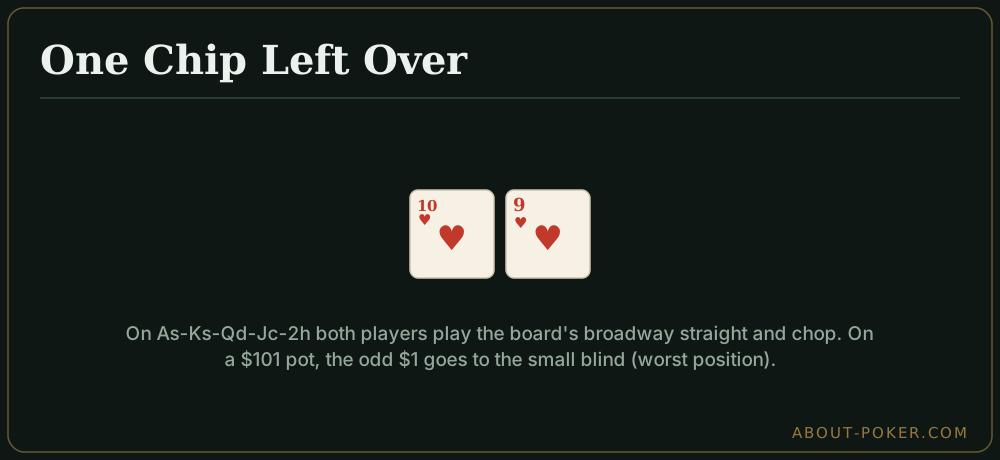
Heads up in a $1/$2 Hold’em game, both players go to showdown on a board of As-Ks-Qd-Jc-2h. Player on the button holds Th-9h and Player in the small blind holds Td-8d. Both play the board’s broadway straight — A-K-Q-J-T — using the ten in their hand. Their best five cards are identical: A-K-Q-J-T. It is a tie, so they chop.
Say the pot is $101. Half is $50.50, which cannot be paid in whole dollars. So one player gets $51 and the other $50. By the odd-chip rule, the extra $1 goes to the worst-position player — the small blind, who acts first and is closest to the left of the button. The button player takes $50, the small blind takes $51. The money is tracked exactly as in the main pot; only the leftover chip needs the special rule.
Common Mistakes and Points of Confusion
- Assuming the button gets the odd chip. It is the opposite — worst position, closest to the small blind, gets it.
- Applying the high-hand rule to a plain Hold’em chop. The high-hand-gets-it rule is for split games; ordinary Hold’em ties use the position rule.
- Arguing over pennies. The rule exists precisely so nobody argues. Let the dealer apply it and move on.
- Forgetting it also applies to side pots. Each pot that is chopped resolves its own odd chip independently.
Quick Checklist
Whenever a pot will not split into whole chips, one odd chip is left over. In standard Hold’em, it goes to the worst-position seat, left of the button. In high-low split games, it goes to the high hand. Know which game you are in, let the dealer apply the rule, and the odd chip becomes a non-event. For more rules and definitions, browse the terms glossary.
Frequently asked
What is an odd chip in poker?
An odd chip is the single leftover chip that remains when a pot cannot be divided evenly among tied players. For example, if a $101 pot is split between two players, one gets $50 and one gets $51 — that extra dollar is the odd chip, awarded by a fixed rule.
Who gets the odd chip in a split pot?
In most cardrooms the odd chip goes to the player in the worst position — the first active seat clockwise from the button, closest to the small blind. This is the standard rule for a high-hand chop in Texas Hold'em.
How is the odd chip awarded in high-low split games?
In split games like Omaha Hi-Lo, the high hand receives the odd chip. If the high half itself is tied, then the odd chip goes to the tied high player in the worst position, following the usual left-of-button rule.
Why does the odd chip rule exist?
It exists to settle ties fairly and quickly when a pot will not divide evenly into whole chips. Without a fixed rule, players would argue over who gets the leftover chip, so cardrooms adopt a consistent, position-based tie-breaker.