What Is Open Limp in Poker?
An open limp in poker means being first in the pot by just calling the big blind instead of raising. Learn why it's usually a leak and its rare good uses.
On this page · 7 sections
Open limping is one of the first habits strong players learn to cut from their game. It feels safe and cheap, but it quietly bleeds chips by surrendering initiative and building the kinds of pots you least want to play.
The Core Answer
An open limp is when the first player to voluntarily put chips in the pot does so by just calling the big blind rather than raising. The word “open” means you are opening the action — no one has entered before you — and “limp” means you flat-call instead of raise. This is different from an over-limp, where you limp behind another player who already limped. For more on the general term, see what a limp is.
The short verdict: as the first player in, you should almost always raise or fold, not limp. Open limping gives away the two biggest advantages in poker — the betting lead and the ability to win the pot without a showdown.
Why It Is Usually a Leak
When you open limp, three bad things tend to happen. First, you give up the chance to win the blinds immediately, since a limp rarely folds anyone out. Second, you encourage a multiway pot, where even good hands lose value and are harder to play. Third, you let the big blind see a free or cheap flop, so you hand a free card to a random hand that might have folded to a raise. By raising instead, you take initiative, thin the field, and often pick up dead money uncontested.
A Worked Example
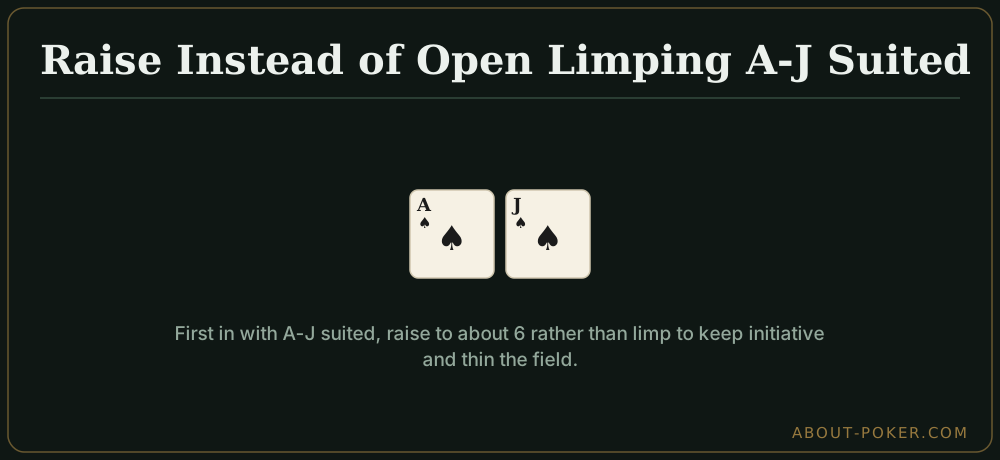
You are under the gun in a 1/2 game with A-J suited, a clearly raise-worthy hand. If you open limp for 2, a couple of players limp behind, and the big blind checks. Now you are four-handed to a flop, out of position, with no idea where you stand and no betting lead. You flop top pair but face a raise on a wet board and have to guess.
Compare that to raising to 6. Often the field folds and you take it down, or one player calls and you play a heads-up pot in control with the initiative. The same hand becomes far easier to play and far more profitable simply because you raised instead of limped.
The Rare Good Uses
Open limping is not banned outright — it just belongs in narrow spots. In some tournament situations with very short stacks, or in extremely passive live games where a limp-reraise trap can be set with premium hands, a deliberate limp can be part of a plan. A few short-stack strategies also use a limp as a cheaper way to see flops. But these are exceptions built on specific reads, not a default. If you find yourself limping “to see a cheap flop,” you are almost certainly leaking.
Attacking Open Limpers
If you are not the one limping, open limpers are a gift. A limp usually signals a weak, capped range, which is the perfect target for an isolation raise. Raise to fold out the field and play a heads-up pot in position against a player who has already shown weakness. Even a tight nit who limps their whole range can be exploited once you know their limps are rarely strong.
Open Limp Versus Open Raise: The Math
The reason raising beats open limping comes down to two forms of profit. A raise wins the pot outright some percentage of the time when everyone folds — pure fold equity you get zero of when you limp. A raise also builds a bigger pot for the times you do have the best hand, and it lets you represent strength on later streets. Open limping surrenders all of that. Consider a full-ring table where a raise from early position takes the blinds uncontested maybe a third of the time. Over hundreds of hands, those uncontested wins add up to a meaningful chunk of your win rate that limpers simply forfeit. On top of that, limping into multiway pots lowers your equity, since your one pair is worth far less against four opponents than against one. The math consistently favors raising or folding first in.
Common Mistakes and Checklist
The core mistake is limping as a comfort move to avoid commitment. Before you enter a pot first in, ask three questions. Is this hand strong enough to raise? If not, is it strong enough to play at all, or should I fold? And do I have a specific, read-based reason to limp rather than raise? If the honest answer to the last question is no, raise or fold. That single discipline removes one of the most common leaks in new players’ games.
Frequently asked
What is an open limp in poker?
An open limp is when the first player to voluntarily enter the pot just calls the big blind instead of raising. Because no one has entered before them, they are 'opening' the action by limping rather than raising.
Is open limping a bad play?
In most cash games it is a leak. Open limping gives up the initiative, invites multiway pots, and lets the blinds see a cheap flop. Raising or folding is almost always better than open limping first in.
When is open limping okay?
Open limping has narrow uses, mainly in some tournament formats with tiny stacks, in very passive live games as a trap with strong hands, or specific short-stack strategies. For most players it should be rare.