What Is Polarised Range in Poker?
A polarised range is one made of strong value hands and bluffs, with the medium hands removed. Here's what it means and when to use a polarised bet.
On this page · 6 sections
A polarised range is one of the most useful shapes to understand once you start thinking in terms of ranges rather than single hands. Put simply, it’s a betting range built from two extremes: strong value hands at the top and bluffs at the bottom, with the medium hands deliberately left out. Picture the strength spectrum as a line and imagine keeping only the two ends — the “poles.” That’s why it’s called polarised.
What the term means
Every time you bet, you’re betting with a group of hands, not just the one in front of you — that’s your range. A polarised range splits into two buckets:
- Value hands: strong holdings that want to get called and expect to win at showdown.
- Bluffs: weak holdings that can’t win at showdown unless the opponent folds.
What’s missing is the middle — the medium-strength hands that are too good to bluff with but not strong enough to bet big for value. Those hands prefer to check and try to reach a cheap showdown. When you take them out and keep only the top and bottom, your range is polarised.
Why polarise?
The point of polarising is to bet big. When your range is only nutted hands and bluffs, a large bet or overbet makes perfect sense: your value hands want maximum money in, and your bluffs want maximum fold pressure. The opponent is put to a tough decision for a big price with hands that can only ever bluff-catch.
A polarised, large bet also charges the opponent’s entire continuing range the same steep price. Because your medium hands aren’t in the betting range, you’re never betting big with a hand that hates getting raised. It’s a clean, high-pressure structure — and it’s especially strong when you hold a nut advantage on a board where you can credibly have the best hands and your opponent can’t.
A worked example
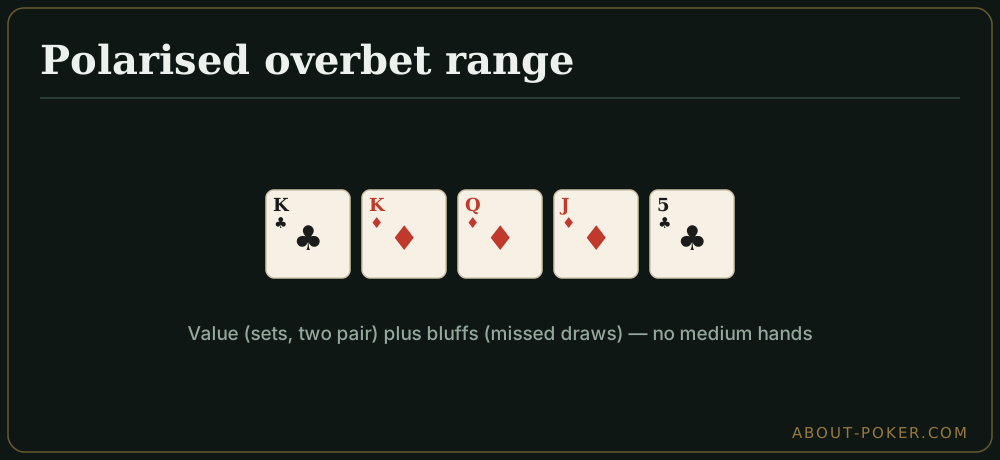
You raised preflop and bet the flop and turn on a board of K♦ 9♠ 4♣ 7♥. On the river a 2♦ bricks off. You decide to overbet, betting 150 percent of the pot. What’s in that range?
- Value: sets (KK, 99, 44), two pair like K9, and strong top pairs — hands that beat almost everything your opponent calls with.
- Bluffs: missed draws and floats like Q♦J♦ or A♦5♦ that have no showdown value.
What you leave out: a hand like KJ (top pair, decent kicker). It’s a fine hand, but it’s a medium hand here — too strong to turn into a bluff, not strong enough to want a raise from a big overbet. So it checks and tries to win a small pot at showdown. By overbetting only your best hands and your air, you make the overbet coherent. The opponent calling with a hand like A9 (middle pair) is now guessing, and you profit whether they call your value or fold to your bluff.
Polarised vs. condensed and linear
Polarised is best understood next to its opposites. A condensed range is the reverse — it’s dense with medium hands and light on both the nuts and pure air, which is why it prefers to check or bet small. A linear (or merged) range bets a continuous band from the top through solid medium hands; it fits small sizings that get called by many worse hands.
The rule of thumb: big bet, polarised range; small bet, linear or merged range. Matching your sizing to your range shape is one of the core mechanics of sound betting.
Common mistakes
- Overbetting with the wrong hands. If you overbet with medium hands, you’re not polarised — you’ll get raised off value and called by better.
- Not enough bluffs. A polarised range with only value hands is easy to fold against. You need a credible number of bluffs to make the strong hands get paid.
- Too many bluffs. Overloading on bluffs makes your big bets unprofitable when the opponent simply calls more.
- Polarising on the wrong board. If you don’t hold the nut hands your opponent fears, a big polarised bet lacks credibility.
When it changes
Polarisation gets stronger as the hand goes on. On the river, with no more cards to come, ranges naturally split into “I have it” and “I don’t” — the perfect setting for a polarised overbet. Earlier streets, where equities are still fluid, lean more toward merged betting. And against calling stations who never fold, cut the bluffs and bet only value; against players who fold too much, lean on the bluff side of the pole. Adjust the balance to the opponent, but keep the shape: two ends, empty middle.
Frequently asked
What is a polarised range in poker?
A polarised range is a betting or raising range made up of strong value hands and bluffs, with the medium-strength hands left out. It's shaped like two poles — the top and the bottom — with the middle removed.
When should you use a polarised range?
Polarised ranges fit large bets and overbets, later streets, and spots where you have a nut advantage. Betting big with only strong hands and bluffs maximizes pressure and lets you charge the opponent's whole calling range.
What's the difference between polarised and linear ranges?
A polarised range is value plus bluffs with no middle. A linear (or merged) range includes the top hands plus solid medium hands, betting a continuous band of strength. Linear ranges suit smaller bets; polarised ranges suit large ones.
What bet size goes with a polarised range?
Big sizings — full pot and overbets — pair naturally with polarised ranges. The large size makes bluffs profitable when they work and extracts maximum value when the strong hands are called.