What Is Pot Commitment in Poker?
Pot commitment is when the pot is so large relative to your remaining stack that folding is mathematically wrong. Learn how to calculate it and plan.
On this page · 6 sections
Pot commitment is the situation where the pot has grown so large relative to your remaining stack that folding is mathematically wrong. Once you’re committed, the pot odds are so good that you should call with a wide range — and the real skill is deciding, before the chips fly, whether you want to be in that position at all.
The definition
You’re pot committed when the money already in the middle, plus the price you’re being offered, makes calling correct even with a hand you’d normally fold. It’s not about ego or “I’ve come this far” — it’s about the math. When calling only needs, say, 25% equity and your hand has more than that, you call. Full stop.
The concept is closely tied to being pot committed on a specific street, but “pot commitment” more broadly is about planning your whole hand around whether the stacks will get in.
The role of pot odds
Commitment is really a pot-odds statement. If the pot is 80 and you must call 20, you’re getting 80-to-20, or 4-to-1. That means you only need to win 20% of the time to break even (20 ÷ (80 + 20) = 20%). Almost any pair or draw clears that bar, so you’re committed.
The general formula: required equity to call = amount to call ÷ (pot after your call). As the pot swells and the bet-to-pot ratio shrinks, the required equity drops toward zero — and commitment kicks in.
Stack-to-pot ratio: planning commitment early
The cleanest way to think about commitment is the stack-to-pot ratio, or SPR — your effective stack divided by the pot at the start of the flop.
- Low SPR (under ~4): you’re committed with strong hands almost by default. Top pair or an overpair is usually enough to get it in.
- High SPR (7+): you have room to fold; one pair is rarely worth stacks.
Because SPR is set the moment the flop is dealt, commitment decisions are made preflop far more often than players realize. Building a bigger preflop pot lowers the SPR and pre-commits you; keeping it small preserves the option to fold.
A worked hand
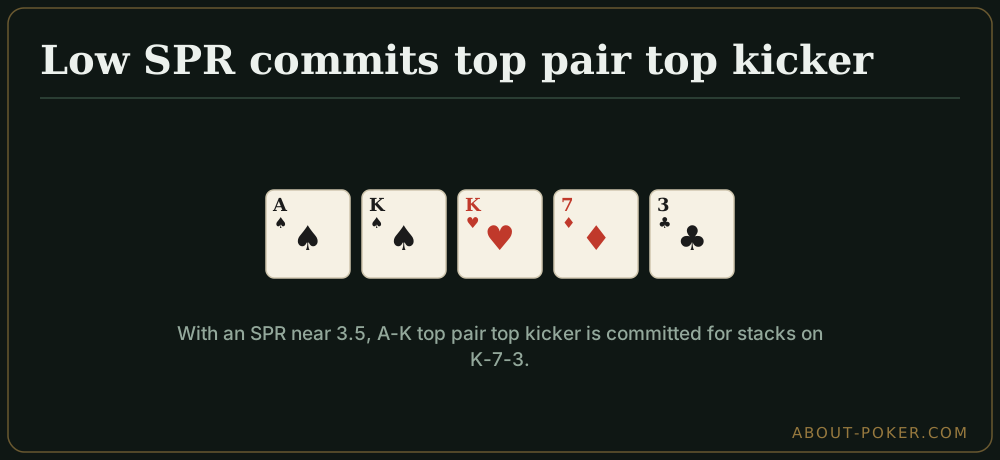
You have 100 big blinds and open A♠ K♠. A player 3-bets to 12, and you call. The pot is now 25 with 88 behind — an SPR of about 3.5. That’s already a commitment-flavored SPR for a strong hand.
The flop is K♥ 7♦ 3♣ — top pair top kicker. Your opponent bets 16 into 25. You raise to 44, they shove for 88 total. You must call 44 more into a pot of roughly 157, getting about 3.5-to-1, needing only ~22% equity. Against their 3-betting range of overpairs, worse kings, and the occasional bluff, top pair top kicker crushes that number. You’re committed — calling is clearly correct.
The lesson isn’t “I called off with one pair.” It’s that the low SPR, created back when you flatted the 3-bet, made this a commitment spot in advance. If you don’t want to stack off top pair, the time to act was preflop — by 4-betting or folding, not agonizing on the flop.
Common mistakes with commitment
- Committing with weak hands. Being priced in doesn’t mean you had to build the pot. The error was earlier, when the pot got big with a marginal holding.
- Folding when actually committed. If the odds say call, folding a hand like top pair into a pot laying 4-to-1 lights money on fire.
- Ignoring SPR. Players who don’t track stack-off thresholds stumble into commitment blind.
- Making tiny bets that commit you anyway. A “small” turn bet can leave an SPR so low you can’t fold the river — plan the whole street sequence.
Quick checklist
- What are my exact pot odds? Convert the call to a required-equity percentage.
- What’s the SPR? Low SPR means plan to commit with strong hands; high SPR means keep pots small.
- Did I want to be committed here, and if so, with which hands? Decide before the big bet, not after.
- Does my hand clear the required equity? If yes, call — commitment isn’t the time for hero folds.
Master commitment and you stop making agonizing river decisions, because you’ll have already answered them on the flop.
Frequently asked
What is pot commitment in poker?
Pot commitment is the point where the pot has grown so large relative to your remaining stack that calling is correct with a wide range because you are getting overwhelming pot odds. Once committed, folding is usually a mathematical mistake.
When are you pot committed?
You are typically pot committed when the amount left in your stack is small compared to the pot, often when you have already put in a third or more of your stack and the remaining bet gives you good odds. A low stack-to-pot ratio is the clearest sign.
How do you calculate pot commitment?
Compare the price of the call to the pot and to your remaining stack. If the pot odds mean you only need a small percentage of equity to break even, and your stack is short relative to the pot, you are committed. Stack-to-pot ratio below about 3 to 4 usually signals commitment for strong hands.
Should you fold when pot committed?
Almost never with a reasonable hand. If the odds say a call is profitable, folding burns equity you already own. The real skill is deciding before the big money goes in whether you want to be committed at all.