What Is Run It Twice in Poker?
Run it twice deals two boards on an all-in to split the pot and cut variance. How it works, the math behind it, and when to agree to it.
On this page · 6 sections
Running it twice is an agreement made when players are all-in: instead of dealing the remaining community cards once, the dealer deals them out two separate times, and each runout is worth half the pot. It’s a tool for reducing variance — the wild swings of luck — without changing anyone’s expected value. It’s most common in cash games, especially high-stakes ones, and requires every player in the pot to agree.
The idea is simple. If you get your money in as a big favorite, one bad river can still cost you the whole pot. Running it twice splits that risk across two independent boards, so a single miracle card can only cost the other player half.
How Run It Twice Works
The mechanics kick in only after all betting is done and players are all-in. Suppose two players are all-in on the flop. With everyone’s agreement, the dealer:
- Deals the first turn and river — this is board one, worth half the pot.
- Reshuffles nothing; using the same live deck, deals a second turn and river — board two, the other half.
Whoever has the best hand on each board wins that half. Three outcomes are possible: you win both boards and scoop the whole pot, you win one and lose one and split it, or you lose both and get nothing. Some rooms even allow running it three or four times, splitting the pot into thirds or quarters.
The Math: Variance Down, EV Unchanged
This is the part players most often get wrong, so it’s worth being precise. Running it twice does not change your equity. If you’re an 80% favorite to win the hand, you expect to collect about 80% of the total money on average whether the board runs once or twice.
What changes is the distribution of results. Run once, an 80% favorite wins the whole pot 80% of the time and loses it all 20% of the time — a big, lumpy swing. Run twice, that same favorite most often wins both halves, sometimes splits, and only rarely loses both. The average is identical; the ride is smoother. Statistically, splitting the pot across two independent runouts reduces the standard deviation of the result.
A Worked Example
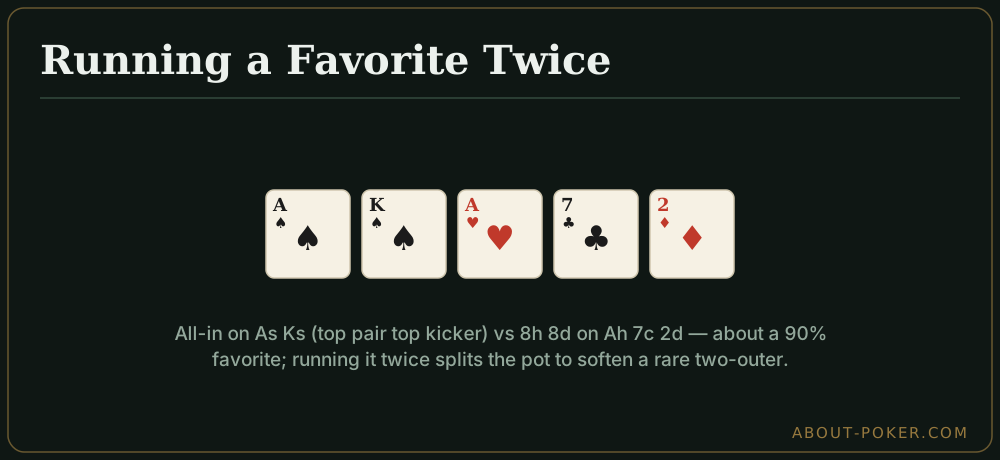
You’re all-in on the flop holding As Ks on a board of Ah 7c 2d — top pair, top kicker. Your opponent holds 8h 8d for an underpair, and their only realistic outs are two remaining eights (they’re drawing to a set). You’re roughly a 90% favorite with two cards to come.
Run once, you win about 90% of the time — but that 10% loss takes the entire pot. Agree to run it twice, and the deck deals two turn-river pairs. On board one you might hold; on board two an 8 might peel off, giving your opponent a set to win that half. You’d split the pot: half to you, half to them. Your overall expectation was the same 90%, but instead of an all-or-nothing outcome you cushioned a bad beat into a break-even split. That is exactly the point.
When to Agree to Run It Twice
Running it twice is a personal and bankroll decision:
- Say yes if you want to smooth out variance, especially when a lot of your stack or buy-in is on the line and you’re a clear favorite or underdog. It protects a favorite from a one-card disaster and is a courtesy to the whole table.
- Say no if you’re a small underdog and want maximum gamble, or if you simply prefer decisive single runouts. Some players decline for pace or personal preference.
There’s no strategic penalty for running it twice — since EV is unchanged, it’s purely about how much swing you’re comfortable with. It’s a common courtesy to protect against a brutal cooler, where two strong hands collide and losing the whole pot on one card would sting badly.
Rules and Etiquette
A few practical points:
- Everyone must agree. One dissenting player means the hand runs once.
- It’s usually a cash-game thing. Most tournaments prohibit it because chips must have a single, defined value for the standings.
- Not every room allows it. Check the house policy before assuming it’s an option.
- Decide before the cards come. Once the dealer starts the runout, the agreement is locked.
The Bottom Line
Run it twice deals the remaining board two times on an all-in, splitting the pot to cut variance while leaving expected value untouched. It’s a favorite’s safety net and a gambler’s optional skip. Understand that it smooths results without changing the long-run math, agree with a clear head, and remember that everyone at the table has to be on board.
Frequently asked
What does run it twice mean in poker?
Run it twice means that when players are all-in, the remaining community cards are dealt out two separate times, each for half the pot. If you win one board and lose the other, you split the pot; win both and you scoop it all.
Does running it twice reduce variance?
Yes. Running it twice lowers the swings without changing anyone's expected value. Because the pot is split across two independent runouts, a single unlucky river can only cost you half the pot instead of all of it.
Does run it twice change your equity?
No. Your long-run expectation is identical whether you run it once or multiple times. If you're an 80% favorite, you'll win roughly 80% of the total across the two boards on average — it only smooths the results.
Do all players have to agree to run it twice?
Yes. Everyone still contesting the all-in pot must agree before the dealer runs multiple boards. If any player declines, the hand is run once as normal. Not every casino or game allows it.