What Is Rundown in Poker?
A rundown is four connected cards in Pot-Limit Omaha, like JT98. Learn what makes rundowns strong, how gaps and suits change their value, and how to play them.
On this page · 6 sections
A rundown is one of the most important starting-hand shapes in Pot-Limit Omaha (PLO). It simply means four cards in a row, or close to it, such as JT98, 9876, or QJT9. Because every card connects with its neighbors, a rundown can make straights and straight draws in many more ways than a scattered, disconnected hand. If you are moving from Hold’em to Omaha, learning to recognize and value rundowns is one of the fastest ways to plug leaks.
What a rundown actually is
In Omaha you are dealt four cards and must use exactly two of them with three from the board. A rundown maximizes how those two-card combinations interact with the board. Take JT98. From those four cards you can pull JT, J9, J8, T9, T8, and 98, six different two-card connectors. Each of those combos reaches toward straights around the same middle-of-the-deck region. That density is what makes rundowns special: they are not four random cards, they are a coordinated straight-making machine.
The purest rundown has no gaps at all, four consecutive ranks like 8765. Once you add gaps the hand loses some of its connectivity, but small gaps are often fine, as we will see below.
Why rundowns are so strong
The value of a rundown comes from how often it flops a big draw. A random Omaha hand flops a strong straight draw only occasionally. A tight, connected rundown flops an open-ended straight draw or better a large share of the time, and it frequently flops a combo draw that combines a straight draw with a flush draw. Combo draws are the engine of Omaha profit because they can be favorites even against made hands.
Rundowns also make the nut end of straights more often than dominated holdings. In PLO, making the second-best straight is a genuine way to lose your stack, so having the cards to reach the nuts matters enormously. High rundowns like KQJT make top-end straights; low rundowns can be trap-prone because they often make the “idiot end.”
Suits and gaps change everything
Not all rundowns are equal. Three factors move a rundown up or down in value:
- Suitedness. A double-suited rundown (two cards of one suit, two of another) is dramatically better than an unsuited one because it adds nut and second-nut flush draws on top of the straight potential. JT98 double suited is a genuine premium hand.
- Rank height. Higher rundowns make higher, safer straights and give you overcards. JT98 is far stronger than 5432, which frequently makes the low end of a straight.
- Gaps. A one-gap rundown like JT87 (missing the 9) is still very good. A double-gap hand like J986 is much weaker and often not worth playing out of position.
A quick mental ranking: JT98 double suited > JT98 single suited > JT87 double suited > 6543 unsuited. The last hand looks connected but makes weak straights and has no flush help.
A worked example
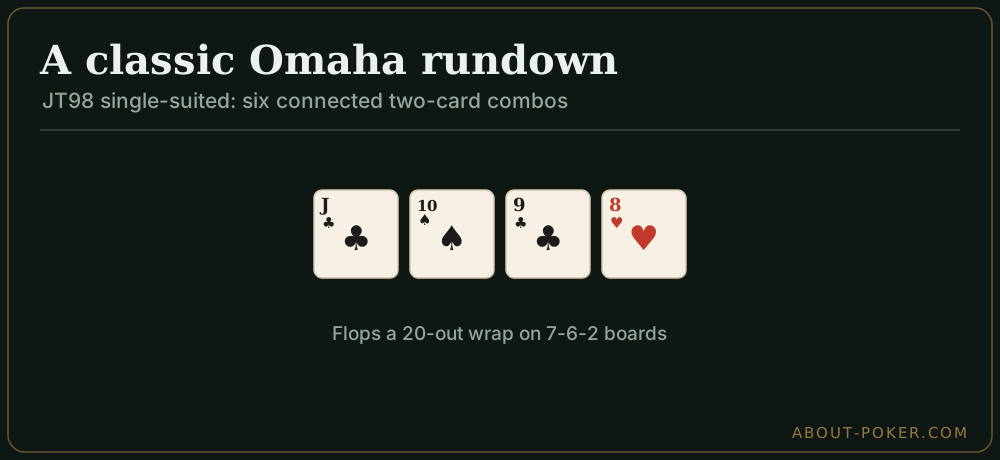
Say you hold Jc Ts 9c 8h, a single-suited JT98 rundown, and the flop comes 7d 6c 2s. You have flopped a monster wrap. Any 5, 8, 9, or 10 makes you a straight: that is roughly 20 clean outs to a straight, plus your backdoor club flush draw. Against a bare overpair like aces, a wrap this size is often a favorite by the river. This is exactly the spot rundowns are built for, and it is why you can commit chips aggressively when you flop into your hand’s core strength.
Now swap in a disconnected hand, Jc Ts 9c 2h, on that same flop. You have only a couple of two-card straight combos working and no wrap. The 2 is dead weight, sometimes called a dangler. That single change turns a stack-off spot into a marginal fold.
Common mistakes with rundowns
- Overplaying low rundowns. 5432 and similar hands make the bottom end of straights. When the money goes in, you are frequently drawing to the losing straight. Treat these with real caution.
- Ignoring suits. New Omaha players call raises with pretty-looking but unsuited middling rundowns. Without flush backup, these hands realize far less equity than they appear to.
- Playing rundowns like Hold’em connectors. In Omaha the field is bigger and draws are stronger. You should be looking to get large draws all-in, not to peel one card and give up.
- Forgetting position. A rundown out of position still flops big, but it is much harder to realize its equity. Prefer to play them in position or as the raiser.
Quick checklist before you play a rundown
Ask three questions: Is it high or double suited? Are the gaps small or none? Can I play it in position? A high, double-suited, gapless rundown in position is an easy raise. A low, unsuited, double-gapped rundown out of position is an easy fold. Most rundowns fall in between, and your read on the opponent and your seat should decide it. Master this shape and you will already understand a large chunk of winning Omaha strategy.
Frequently asked
What is a rundown in poker?
A rundown is a Pot-Limit Omaha starting hand made of four cards in sequence, such as JT98 or 8765. All four cards work together to make straights and straight draws, which is why rundowns are among the strongest playable hands in Omaha.
Is a rundown a good hand in Omaha?
Yes, high, connected rundowns are premium Omaha hands, especially when they are double suited. They flop huge straight and combo draws far more often than random four-card holdings. A double-suited rundown like JT98 double suited is a top-tier hand you can play aggressively.
What is the difference between a rundown and a wrap?
A rundown describes your starting hand, four connected cards preflop. A wrap is a postflop straight draw, when your connected cards combine with the board to give you 13 or more outs to a straight. Rundowns are the hands most likely to flop wraps.