What Is Runner Runner in Poker?
Runner runner means catching both the turn and river to complete a hand. The exact odds, why it matters as backdoor equity, and a clear worked example.
On this page · 6 sections
A runner runner in poker is a hand you complete only by catching both the turn and the river — two perfect cards in a row. The phrase is used for the payoff, as in “he made a runner runner flush,” and the odds are long: most runner runner hands are somewhere around 20-to-1 or worse against. That is exactly why hitting one feels lucky and why running into one feels like a suck out.
What runner runner actually means
On the flop, you have five known cards — two hole cards and three board cards. A normal draw needs just one more card to complete. A runner runner draw needs two. You are not one card away from a flush or straight; you are two specific cards away, and you must catch both without help in between.
The same situation is called a backdoor draw while it is still live on the flop. “Backdoor” is the flop-stage word for the possibility; “runner runner” is the after-the-fact word for when it actually lands. Both refer to needing turn and river to cooperate.
The exact odds
The math is just two chances multiplied together. Take a backdoor flush: on the flop you hold two of a suit and one more falls on the board, so you have three of that suit and ten remain in the 47 unseen cards. To make the flush you need one of those ten on the turn (about 10/47), then one of the nine remaining on the river (about 9/46). Multiply: roughly 0.213 times 0.196, which is about 0.042 — a hair over 4 percent, or close to 23-to-1 against.
A runner runner straight is usually longer odds still, because fewer cards help and often the two cards must come in a specific relationship. A rough table shortcut many players use: treat a backdoor flush as worth about 4 percent of equity, and a typical backdoor straight as worth about 1.5 to 2.5 percent. In outs terms, a live backdoor draw is often counted as roughly one and a half “clean” outs of added value.
Why backdoor equity still matters
Four percent sounds too small to care about, and on its own it is. The reason strong players track backdoor equity is that it stacks on top of everything else. A hand with two overcards plus a backdoor flush plus a backdoor straight has several thin edges that add up, turning a marginal continuation-bet or float into a clearly profitable one.
Backdoor equity also improves dramatically on the turn if the first perfect card arrives. The moment you pick up the runner card on the turn, your 4 percent backdoor flush becomes a roughly 20 percent flush draw — a real draw you can now semi-bluff hard. That is why players keep barreling turns that bring their backdoor to life.
A worked example
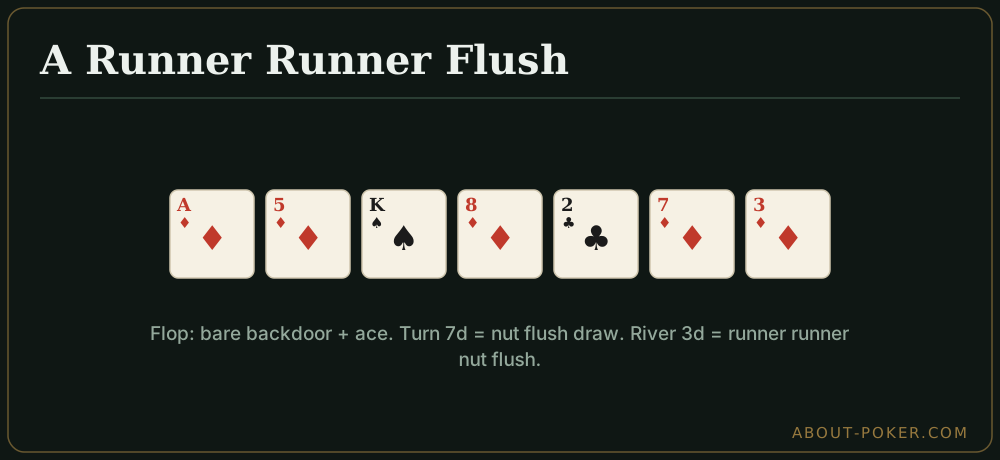
You hold A♦ 5♦ and the flop comes K♦ 8♦ 2♣. You have no pair and no made hand, but you hold two diamonds with one more on the board — a backdoor flush draw, plus an overcard ace. The turn is the 7♦. Now you have the nut flush draw with nine outs. The river is the 3♦, completing A♦ 5♦ inside a five-diamond board: you have made a runner runner flush, and specifically the nut flush.
From the flop, that exact outcome was only about a 4 percent shot. But notice the path: on the flop you had a cheap reason to continue thanks to the backdoor and the ace; on the turn the draw became strong enough to bet aggressively; on the river it got there. This is the normal life cycle of a runner runner hand, and it shows why backdoor draws are worth continuing with when the price is right.
How opponents and boards change it
Against opponents who fold too much, backdoor equity barely matters because you win most pots with a bet anyway. Against calling stations, backdoors matter more, because when you get called you want a way to actually improve — and a runner runner card gives your bluff a chance to become the best hand.
Board texture is the big filter. On a monotone or two-tone board, backdoor flush chances are gone or reduced because a third card of your suit may complete an opponent too. On a rainbow, disconnected board, your backdoor draws are cleaner and more valuable. Always read whether a runner runner would give you the best hand or hand someone else a bigger one.
Common mistakes and a checklist
The biggest error is over-relying on runner runner. Calling a large flop bet with only backdoor equity and nothing else is a slow leak — 4 percent almost never justifies the price alone. The opposite mistake is ignoring backdoors entirely and folding hands that actually had enough combined equity to continue. Before you continue on a bet, ask three quick questions: do I have overcards or a pair, do I have a backdoor flush, and do I have a backdoor straight? If two or more are yes, you usually have a call or a semi-bluff. If it is a bare backdoor and nothing else against a big bet, let it go.
Frequently asked
What does runner runner mean in poker?
Runner runner means you needed both the turn and the river to complete your hand, catching two perfect cards in a row. It is the same idea as a backdoor draw once both cards arrive. Common examples are a runner runner flush or a runner runner straight.
What are the odds of hitting a runner runner flush?
About 4.2 percent, or roughly 23-to-1 against. You must catch your suit on the turn (about 10 in 47) and then again on the river (about 9 in 46), and multiplying those two chances gives roughly 1 in 24.
Is a backdoor draw the same as runner runner?
Yes, they describe the same situation from different moments. On the flop you have a backdoor draw; if you then catch both perfect cards, you hit runner runner. Backdoor equity is worth about three or four clean outs of extra value.