What Is Runout in Poker?
A runout is how the remaining board cards fall after the money is in. Here's what a runout is, why players say 'good' or 'bad' runout, and how to think about it.
On this page · 7 sections
A runout is how the remaining community cards fall after the meaningful betting is done — most often the turn and river once players are all-in. When the chips are committed and there is nothing left to decide, players “run it out” and watch the board complete. The exact cards that come are the runout.
The word captures the moment poker stops being a game of decisions and becomes, briefly, a game of chance. Understanding runouts helps you separate the quality of your decision from the luck of the cards — a distinction that is central to thinking about the game correctly.
What counts as the runout
Any cards yet to come after the action is settled make up the runout. If two players get all-in on the flop, the runout is the turn and river. If they get in on the turn, the runout is just the river. The term implies the decisions are over and we are simply watching the board finish.
Players describe runouts as good or bad relative to their own hand. A card that helps you or keeps you ahead is a good runout; a card that helps your opponent or completes their draw is a bad one. These labels are personal — the same river is a dream for one player and a nightmare for the other.
A worked example
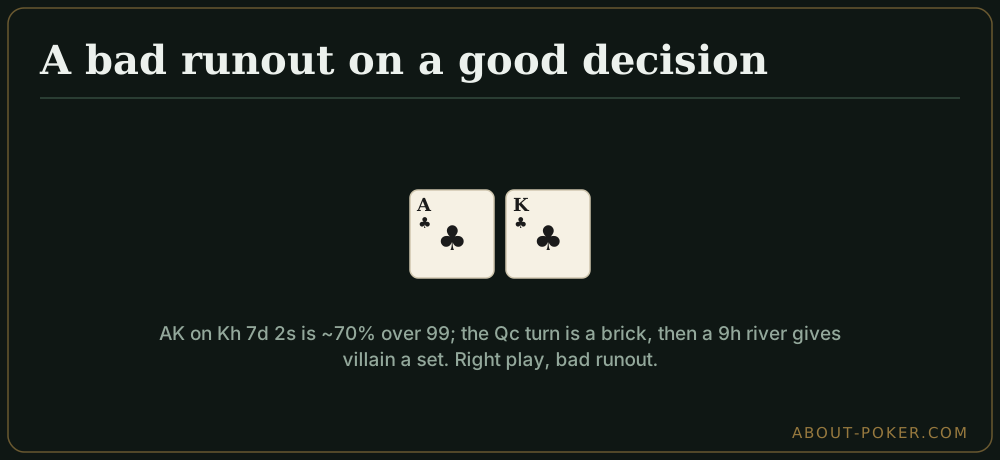
You get all-in on the flop with Ac Kc on a board of Kh 7d 2s. Your opponent turns over 9d 9s. You have top pair with a great kicker; they have a pocket pair below your king. You are well ahead — roughly a 70 to 30 favorite with two cards to come.
Now the runout matters. The turn is the Qc — a brick for your opponent. It misses their set, changes nothing, and even gives you a backdoor flush draw. Good runout so far. The river is the 9h. That is a terrible runout for you: your opponent hits their two-outer and makes a set of nines to win the pot.
Here is the key: your decision was correct. You got the money in a 70 percent favorite. The bad runout cost you the pot but not the play. Over many repetitions, getting it in that good prints money.
Good process, bad runout
This is why strong players obsess over decisions, not results. You cannot control the runout — only whether you got your chips in with the right equity. Losing to a bad runout when you were the favorite is expected variance, not a mistake. Winning after getting it in bad is a warning sign disguised as a win.
When a hand feels unfair, ask whether the loss came from a bad decision or simply a bad runout. If it was the runout, there is nothing to fix. If it was the decision, that is where the lesson lives.
Runouts and running it twice
Because runouts are pure variance, high-stakes players often agree to run it twice on big all-ins. The remaining board is dealt two separate times, each for half the pot. This does not change anyone’s long-run expectation — a 70 percent favorite is still expected to win 70 percent of the total — but it cuts the swings of any single runout roughly in half. It is a way to smooth out the luck that runouts inject.
Runouts and coolers
A particularly brutal runout that hands a strong second-best hand to your opponent can turn into a cooler — a spot where both players play well and one simply loses to a hand they could not have folded. When a nasty river completes a hand you had no way to avoid stacking off against, that is variance, not a leak.
Common mistakes
- Result-oriented thinking. Judging your play by how the runout landed rather than by the equity you had when the money went in.
- Tilting on bad runouts. A string of bad runouts is normal variance. Chasing losses because the board keeps betraying you compounds the damage.
- Ignoring runout risk when deep. With cards to come and stacks behind, factor in how many bad runout cards exist before committing further chips.
Quick checklist
After any all-in, ask:
- Did I get my money in ahead — what was my equity?
- Was the result a product of my decision or just the runout?
- Is there a real leak to fix, or was this simply variance?
Separate the decision from the runout every time, and you will keep improving whether the board is kind to you or not.
Frequently asked
What does runout mean in poker?
The runout is how the remaining community cards come out after a betting decision, especially once players are all-in. If the flop is set and money is in, the turn and river are 'the runout.'
What is a good runout versus a bad runout?
A good runout is a sequence of board cards that helps your hand or preserves your lead; a bad runout is one that helps your opponent or completes their draw. The terms are relative to the hand you are holding.
What is a brick on the runout?
A brick is a runout card that changes nothing — it misses every draw and does not pair anyone. If you are ahead and want the board to stay safe, you are rooting for bricks.