What Is Time Bank in Poker?
A time bank is a reserve of extra seconds you can spend on a tough decision. Here's how time banks work online and live, and how to use them wisely.
On this page · 6 sections
A time bank is a reserve of extra seconds a player can draw on to make a difficult decision after their normal turn timer expires. It exists to prevent the game from stalling while still giving players room to think through genuinely tough spots. You will meet time banks constantly online and, more and more, in live tournaments running a shot clock.
Think of it as an emergency fuel tank for thinking. Your regular turn timer covers routine decisions. When a spot is hard enough that the base clock is not enough, the time bank kicks in so you are not forced into a rushed fold.
How a time bank works online
Every online poker site puts a short base timer on each decision — commonly 15 to 30 seconds. Make your action inside that window and nothing is touched. If the base timer runs out and you still have not acted, the software automatically starts drawing from your time bank: a separate pool of seconds unique to you.
The bank is finite. On many sites it holds 30 to 60 seconds and refills slowly over time or resets at the start of each blind level. Burn through the whole bank without acting and your hand is folded (or checked, if checking is free). So the time bank is a cushion, not an infinite pause.
A worked example
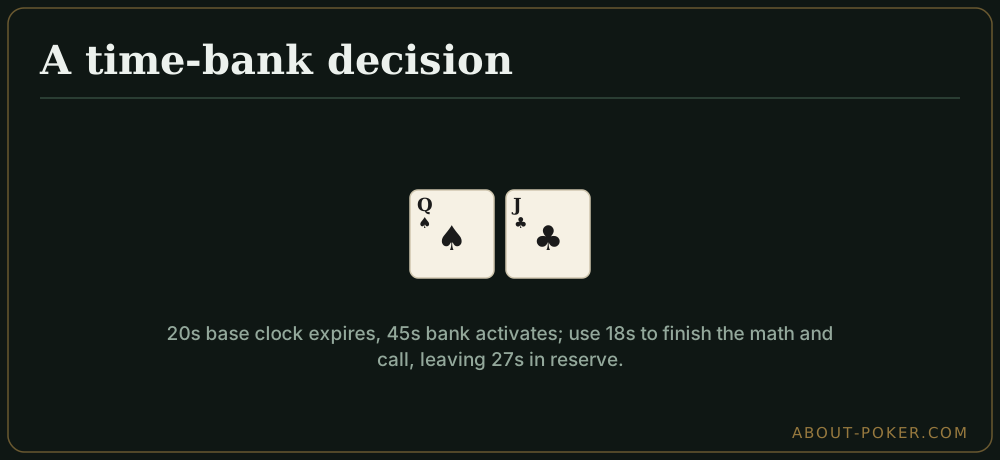
You are deep in an online tournament with a 20-second base clock and a 45-second time bank. You open-raise, the big blind three-bets, and you face an all-in decision on the turn with a marginal hand.
Twenty seconds pass while you count the pot and estimate your opponent’s range — the base timer expires. Now the time bank activates and starts counting down from 45. You use another 18 seconds to finish the math, decide the all-in call is slightly profitable, and click call with 27 seconds of bank still in reserve.
Because you only dipped into the bank once and briefly, it will refill for the next hard spot. Had you dawdled on three easy hands in a row and drained it, you would have had nothing left for this genuinely close decision.
Live shot clocks and time-bank chips
Live poker used to run on the honor system, and slow players could grind a table to a halt. Modern tournaments increasingly use a shot clock: a fixed base time per decision, often 30 seconds, enforced by a dealer or an app. To handle rare tough spots, each player is given a small number of time-bank chips or cards.
Playing one buys you an extension — say another 30 or 60 seconds — for that single decision. You might get one chip per level, or a fixed set for the whole event. Once they are gone, you live on the base clock. This mirrors the online model: a firm default with a limited reserve for the spots that truly deserve extra thought.
How to use your time bank well
- Protect it for real decisions. Do not burn bank seconds tanking over a routine fold. Save the reserve for close, high-stakes spots like river bluff-catches and marginal all-in calls.
- Act instantly on trivial hands. Snap-folding junk and snap-checking when appropriate keeps your bank full and, online, keeps the table moving.
- Do not fake a tank. Deliberately using time to feign a hard decision, then acting strong, edges toward angle-shooting and, at showdown, toward a slow roll. Use the clock to think, not to deceive.
- Watch the refill rules. Know whether your bank refills over time, per hand, or per level. That tells you how freely you can spend it.
Common mistakes
New players make two opposite errors. Some rush every decision to avoid “holding up the table,” folding good hands and skipping the very math the bank exists to allow. Others tank on every hand, drain their bank early, and then get auto-folded in the one spot that mattered. The fix is calibration: spend time proportional to how hard and how expensive the decision is.
Good hand reading actually reduces your reliance on the bank, because you have already narrowed your opponent’s range before the action reaches you.
Quick checklist
Before you let the clock run into your bank, ask:
- Is this decision actually close, or am I stalling out of habit?
- How much does getting it wrong cost me — chips, a tournament life, a big pot?
- Do I have bank left, and when does it refill?
If the spot is close and expensive and you have reserve to spend, that is exactly what a time bank is for. Everything else should be a snap decision.
Frequently asked
What does time bank mean in poker?
A time bank is a reserve of extra decision time that activates after your normal turn clock runs out. It lets you spend additional seconds on a genuinely hard decision without being folded automatically.
How does a time bank work online?
Each hand you get a short base timer, often 15 to 30 seconds. If you need more, the site draws from your personal time bank, a pool of extra seconds that slowly refills or is topped up between levels.
Do live poker tournaments have time banks?
Increasingly, yes. Many live events now use a shot clock with time-bank chips or cards. Each player gets a base amount of time per decision plus a limited number of extensions to use across the event.