What Is Uncapped Range in Poker?
An uncapped range still contains the nuts. Learn what uncapped range means in poker, why it lets you barrel big, and how to spot it in real hands.
On this page · 7 sections
An uncapped range is one of the most powerful positions you can hold in a poker hand, even though it describes something invisible: the hands you could have, not the hand you actually hold. A range is uncapped when it still contains the strongest possible holdings on that board. Nothing about the way you played the hand has ruled out the nuts, a set, or a monster draw that got there. Your opponent cannot breathe easy, because for all they know, you have the best possible hand.
What “uncapped” actually means
Every action in poker sends a message about your range of hands. When you call instead of raise, or check instead of bet, you sometimes remove the very strongest hands from your story, because those hands would usually have played faster. When the top of your range is gone, you are “capped.” An uncapped range is the opposite: the strongest hands are still plausibly in your holdings.
The key word is plausibly. It does not matter whether you literally hold the nuts. What matters is that a thinking opponent cannot dismiss the possibility. If your line is consistent with holding the top of the range, you get to apply the pressure that only a strong range can support.
Why an uncapped range wins you money
The practical value of an uncapped range is that it lets you bet big and bet often. Large bets and overbets only make sense when your range contains hands strong enough to want a huge pot. If a hero calls your overbet and you could easily have the nuts, they are risking a very expensive mistake. That fear is what folds out their medium-strength hands.
This is why an uncapped range pairs so naturally with a polarised range betting strategy. You threaten with your strongest value hands, and you add bluffs that fit the same story. Because the nuts is credibly present, your bluffs borrow its power.
A worked example
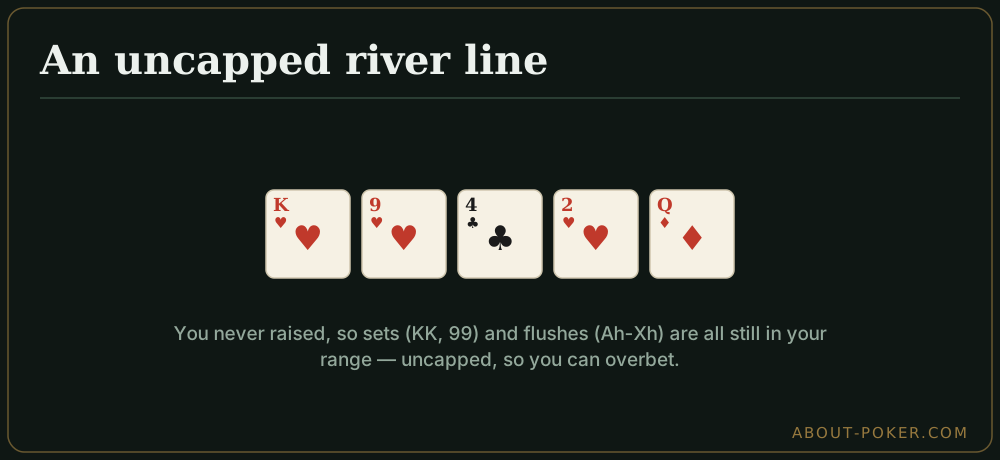
You raise from the button with a wide, strong range and the big blind calls. The flop comes Kh 9h 4c. You bet, they call. The turn is the 2h, completing the flush. You bet again, they call. The river is the Qd.
Now think about your range. You never raised the flop or turn, you just kept betting, so your line is consistent with slow, powerful hands: sets like KK and 99, and flushes such as Ah Xh. None of those hands wanted to blow up the pot early. Your range is uncapped, because the flush and the sets are all still there.
So on the river you can fire an overbet. Your opponent might hold Kx for top pair, a genuinely good hand, but they must fear the flush and the sets that your line screams. That is the moment an uncapped range prints money: you can bet 150% of the pot with your value and your bluffs, and top pair often folds.
Uncapped versus capped
The mirror image is a capped range, where the strongest hands are no longer possible. If you had just called a preflop three-bet and then check-called every street, your range would rarely contain aces or kings, because those hands usually re-raise. An observant opponent attacks a capped range relentlessly, betting big precisely because you cannot have the nuts.
The lesson works both ways. When your opponent’s line caps them, you get to be the aggressor. When your own line keeps you uncapped, protect that advantage by not raising away your strong hands too early.
How to keep your range uncapped
You do not want to be uncapped in every spot; sometimes fast-playing is correct. But when you want the option to apply pressure later, you protect the top of your range by taking passive-looking lines with some monsters. Slow-playing a set on a dry flop, for instance, keeps sets in your calling and checking range, which keeps you uncapped when the pressure spots arrive.
Balance matters. If you always slow-play the nuts, your bets become pure bluffs and observant players exploit that. Mix strong hands across your fast and slow lines so both your betting range and your checking range stay uncapped.
Common mistakes
The biggest mistake is failing to notice when your opponent is uncapped and barreling into them anyway. If they could easily have the nuts, your bluffs have nowhere to go and your thin value bets get raised. Respect an uncapped opponent by checking back more and bluffing less.
The second mistake is capping yourself without realizing it. Every time you fail to raise a strong hand, ask whether you are quietly removing the nuts from your story on future streets, and whether that is what you actually want.
Quick checklist
- Does my line still allow the nuts, sets, and completed draws? If yes, I am uncapped.
- Is my opponent’s line missing its strongest hands? If yes, attack the cap.
- Am I planning a big bet or overbet? Confirm my range is uncapped first.
- Am I slow-playing too many monsters and accidentally turning my bets into pure bluffs?
Frequently asked
What does uncapped range mean in poker?
An uncapped range is a set of hands that still includes the strongest possible holdings, such as the nuts and near-nuts. Because your range is not limited to medium-strength hands, opponents cannot assume they are ahead when facing your aggression.
Is an uncapped range good or bad?
Having an uncapped range is an advantage. It means you can apply maximum pressure with large bets and overbets because your opponent has to worry about the top of your range, not just your bluffs and marginal hands.
How do I know if my range is uncapped?
Ask whether the strongest hands are still logically in your range given how the hand played out. If you took a line that a set, a straight, or a flush would also take, your range is uncapped. If those hands would have raised earlier, your range is likely capped.