Overvaluing Top Pair
Top pair top kicker feels like a monster and gets stacks in trouble. Learn to size the pot, count streets, and fold one pair when the story only fits stronger hands.
On this page · 7 sections
Top pair top kicker — you hold A-K, the flop comes king-high, and suddenly the hand feels unbeatable. It isn’t. Overvaluing top pair is one of the most expensive leaks in poker precisely because the hand is good enough to win many pots and just weak enough to lose the biggest ones. Learning to treat it as a strong-but-foldable hand is a defining skill of winning players.
Why top pair feels stronger than it is
One pair beats a lot: every worse pair, every unpaired hand, every busted draw. At showdown, top pair top kicker wins far more often than it loses. That’s exactly what makes it dangerous — you get rewarded for playing it aggressively most of the time, which trains you to keep firing even in the spots where you’re crushed.
The trap is that the pots where top pair loses tend to be the big ones. Your opponent doesn’t build a huge pot with a worse pair; they build it with two pair, a set, or a straight. So while top pair wins many small pots, one poorly-judged stack-off can erase a whole session of profit. It’s the same problem overpairs have — see playing overpairs in cash games for the parallel.
The worked example that costs beginners stacks
You hold A♣K♦ in a $1/$2 cash game with $200 stacks. The flop comes K♠ 9♥ 6♠. You bet, a tight and passive player calls. Turn is the 4♠ — completing a possible flush. You bet again, and now this passive player check-raises you all in.
Ask the only question that matters: what does this player raise here? A passive player who has done nothing all session is representing flushes, two pair (K9, 96), sets, and possibly a slow-played big hand. What worse hands does he raise? Almost none — a worse king wouldn’t jam into your betting. Your top pair top kicker beats essentially nothing in his raising range. Despite holding the “best top pair possible,” this is a fold. Calling because “I have top pair, top kicker” is how a $200 stack disappears.
Counting streets before you commit
The core skill is deciding, in advance, how many streets your top pair can profitably bet. On a dry board like K♦7♣2♠ against one opponent, top pair top kicker is strong enough to bet all three streets for value — few hands beat you and many worse hands call. On a wet board like K♥T♥9♠, plan for one or two streets and be ready to shut down when the turn or river brings scare cards.
The mistake is defaulting to “bet-bet-bet” or “call-call-call” without a plan. When you know before the flop bet that this is a one-street hand on this texture, you don’t get married to it when the pressure mounts. This street-counting habit fixes several leaks at once — it’s a theme throughout top postflop leaks.
Position and opponent change everything
Top pair is far more playable in position, where you can control the pot and see your opponent’s action before deciding. Out of position, the same hand becomes a guessing game, and guessing with one pair for a stack is a losing proposition.
Opponent type matters just as much. Against a loose, aggressive player who bluffs and value-bets thinly, top pair calls down more comfortably — their betting range is wide and full of worse hands. Against a tight, passive player (a “nit”), aggression means strength almost every time, and your top pair should fold to significant heat far sooner. Reading the player behind the bet is what turns a fold into a good fold instead of a weak one.
Multiway pots demand extra caution
The more players in the pot, the more likely someone has connected harder than top pair. In a four-way pot, someone flopping two pair, a set, or a strong draw is common, and your one pair is often not the best hand even on the flop.
The practical adjustment is to bet for value and protection but be far quicker to give up when you face resistance from multiple opponents. A three-street value plan that works heads-up becomes a one-street, pot-control plan four ways. When two players show real interest, top pair is frequently drawing thin.
Don’t overcorrect into folding everything
The point isn’t to fear top pair — it’s to price it correctly. Against calling stations and loose players, top pair should be betting for value aggressively, because they’ll pay you off with worse. The leak is only in the specific spots where a big investment can only be called by better hands. The difference between overvaluing top pair and correctly folding it is the same discipline that fixes calling too much: every big call needs a reason beyond “but I have a pair.”
The top-pair checklist
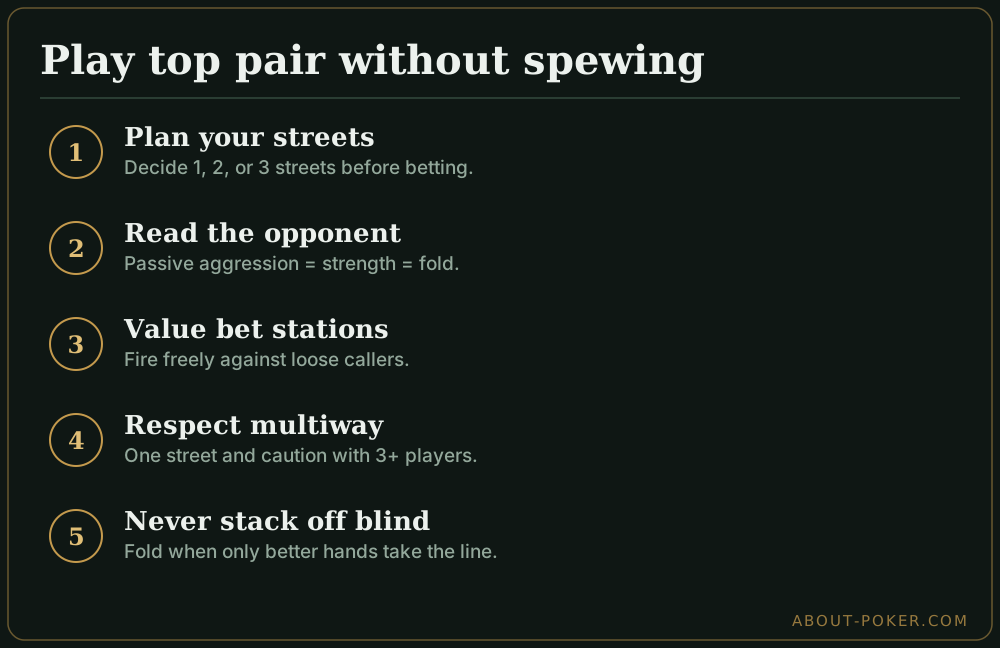
- Decide how many streets to bet before you fire the first one.
- Against passive players, treat heavy aggression on scary boards as a fold.
- Value bet freely against calling stations and loose players.
- Play top pair much more cautiously out of position and multiway.
- Never stack off with one pair when only stronger hands take the line.
Top pair wins its share of pots — just make sure it isn’t the hand that loses your whole stack.
Frequently asked
Is top pair a strong hand in poker?
Top pair with a good kicker is a solid hand for winning small and medium pots, but it's still just one pair. It loses to two pair, sets, straights, and flushes, so it's rarely worth stacking off for 100 big blinds against a passive opponent's aggression.
When should I fold top pair top kicker?
Fold when the action only makes sense for stronger hands: a passive player raising and re-raising on a board that completes sets, two pair, straights, or flushes. If almost nothing you beat plays that way, top pair is a fold no matter how pretty it looks.
How many streets should I bet with top pair?
On dry boards against one opponent, top pair top kicker can often bet all three streets for thin value. On wet or paired boards, or against multiple players, plan for one or two streets and be ready to check and fold to heavy pressure.