Facing a Check-Raise
How to respond when you're check-raised: read the value-to-bluff mix by board and street, use pot odds, and decide whether to fold, call, or 3-bet.
On this page · 6 sections
Getting check-raised puts you on the back foot: you bet expecting to take the lead, and instead your opponent has fired back and now has the initiative. Facing a check-raise well is about answering three questions quickly — how strong is this raise on this board, what are my pot odds, and which of my hands beat the part of the range that’s bluffing? Answer those and you stop paying off the nuts while also refusing to fold the best hand to a busted draw.
First, size up the raise
A check-raise is almost always polarized, because it costs the raiser extra chips out of position after they showed weakness. That expense pushes the middle of their range into a check-call and leaves the extremes: strong made hands that want to build a pot, plus draws and air used as semi-bluffs. Your job is to estimate the value-to-bluff ratio for this specific spot. The deeper mechanics of decoding that mix live in reading check-raises, and it pays to understand how the raise is built from the other seat, covered in check-raising in poker.
Board texture decides how much to respect it
The board tells you which way the raise leans. On a wet, connected flop like 9-8-7 two-tone, the raiser has a pile of draws and combo draws to bluff with, so the check-raise is draw-heavy — you should continue more of your strong made hands because you’re ahead of a large slice of the range right now. On a dry flop like K-7-2 rainbow, there are almost no draws available, so a check-raise is value-heavy: sets and two pair dominate, and your marginal holdings should fold. Same raise, opposite meaning, because the texture changed which bluffs exist.
Run the pot odds
Once you have a rough read, do the math. If the pot is 100 and you’re raised to make it a total call of 40 into a 240 pot, you’re getting 6-to-1 and need roughly 14 percent equity to call profitably. Draws usually clear that bar easily; pure bluff-catchers do not, since they only beat the air in the range. Weigh implied odds when you can stack them on a later street with a set or a completed draw, and weigh reverse implied odds when your hand is the kind that keeps paying off when you’re beat, like top pair with a weak kicker.
A worked example
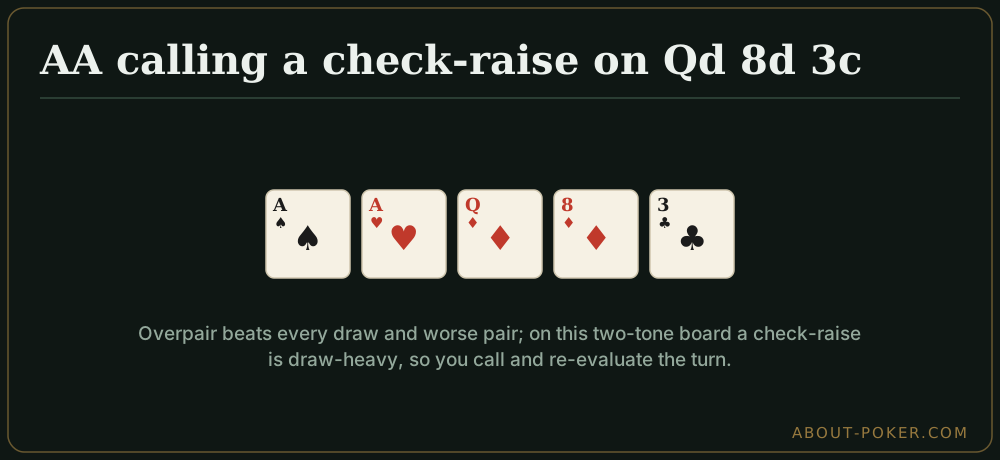
You raise the button with As Ah, the big blind calls, and the flop comes Qd 8d 3c. You continuation bet 5 into 11, and villain check-raises to 16. On a two-tone, semi-connected board, a balanced player has flush draws, straight-ish draws with a diamond, sets, and two pair. Your aces are an overpair that beats every draw and every worse made hand — you’re crushing the bluffs and only behind sets and the rare two pair. Against a balanced range you call comfortably and re-evaluate the turn. If the same raise came on Kd 7s 2c against a player who never bluff-raises dry boards, aces are still ahead of most of the range, but you’d proceed far more cautiously and be ready to fold to heavy turn and river pressure.
Common mistakes when facing a check-raise
The biggest leak is treating every check-raise as the nuts and folding all your strong-but-not-monster hands. Against most opponents that over-folds enormously, because they do have some draws and light value. The opposite leak — calling down with any pair because “he could be bluffing” — bleeds chips against the passive players who only ever raise for value. A third mistake is auto-3-betting when you flop a set or two pair on a wet board; sometimes calling keeps their bluffs in and lets them barrel off. Counting combos at the table, as laid out in counting combos at the table, turns these guesses into estimates.
A quick decision checklist
Before you act, run through this: Is the board wet or dry, and does that make the raise draw-heavy or value-heavy? Is this player capable of bluff-raising at all? What are my pot odds, and does my hand beat the bluffs? Do I have implied odds to draw, or reverse implied odds that make my made hand dangerous? Continue with hands that beat the bluffs and have equity or blockers, fold the pure bluff-catchers against value-heavy raisers, and reserve 3-bets for your best value and your strongest semi-bluffs. Do that consistently and facing a check-raise stops being a scary spot and becomes just another read.
Frequently asked
Should I fold top pair to a check-raise?
It depends on the board and the opponent. On a wet board versus a balanced check-raiser, strong top pairs often continue because they beat the draws in the range. Against a passive player who only check-raises the nuts, folding a marginal top pair is correct.
How much equity do I need to call a check-raise?
Use pot odds. If the raise lays you 3-to-1, you need about 25 percent equity to call. Add implied odds when you can win a big pot on later streets, and subtract for reverse implied odds when your hand can easily be second best.
When should I 3-bet a check-raise instead of calling?
3-bet your very strongest hands for value and your best semi-bluffs — big combo draws with blockers. Flatting is usually better with medium-strength hands and pure bluff-catchers because raising folds out worse and gets called by better.
Do most players bluff-raise enough?
No. Most live and low-stakes players check-raise far too value-heavy, especially on dry boards. You can over-fold your bluff-catchers against them and lose very little.