Narrowing Ranges on the Turn
The turn splits ranges hard. Learn how the turn card and the second barrel remove hands, with a worked example and a checklist for confident turn reads.
On this page · 6 sections
If the flop opens the funnel, the turn tightens it hard. Ranges that were still fairly wide after the flop get cut down fast, because the pot is larger, the bets are bigger, and marginal hands can no longer afford to hang around. Narrowing on the turn is about two things: what the turn card did to the board, and what the second barrel — or the decision to check — says about the hands still in play.
The turn compresses everything
By the turn the field is usually two players, the pot has grown, and pot odds have shifted. A hand that floated the flop cheaply now faces a second bet into a bigger pot, and most of those weak floats simply cannot continue at a profit. That economic pressure is why a turn call carries so much more information than a flop call: it removes the bluffs and the pure air that a small flop bet let linger.
Your turn read builds directly on the flop work — you should already have a narrowed set from narrowing ranges on the flop. The turn subtracts again from that smaller set.
Read the turn card first
Before interpreting the action, ask what the card changed.
- A blank (an offsuit low card that misses draws) leaves your flop read almost intact. The hands that were ahead stay ahead; the hands that were drawing are now drawing thinner.
- A draw-completing card (a third suit card, or a straight-filling card) widens the strong end of both ranges and gives previously-drawing hands a reason to bet or raise. You must re-run the read for the new texture.
- A board-pairing card creates full houses and trips for a few combos and can turn the current top pair into a weaker relative hand. It also gives the aggressor new bluffing candidates.
This is the same texture-first discipline you use on the flop, extended one street. For the full picture of turn play beyond just reading, see how to play the turn.
The second barrel narrows both ranges
The turn bet — the second barrel — is one of the most information-rich actions in poker, because a well-built barreling range is deliberately split between value and semi-bluffs. When your opponent double barrels, they are representing the strong end; when they check, they usually cap themselves. Understanding the structure of double and triple barreling helps you read both sides of it.
- A turn bet-and-continue by the caller (a raise or a call of the second barrel) keeps top pairs with good kickers, sets, two pair, and genuine draws — and sheds weak pairs and floats.
- A turn check-back by the flop bettor removes the nuts and the pure air, leaving a medium, capped range that is ripe for river pressure.
- A turn check-call in position or out often means a hand that wants to get to showdown cheaply — a mid-strength pair or a made hand not strong enough to raise.
A worked example
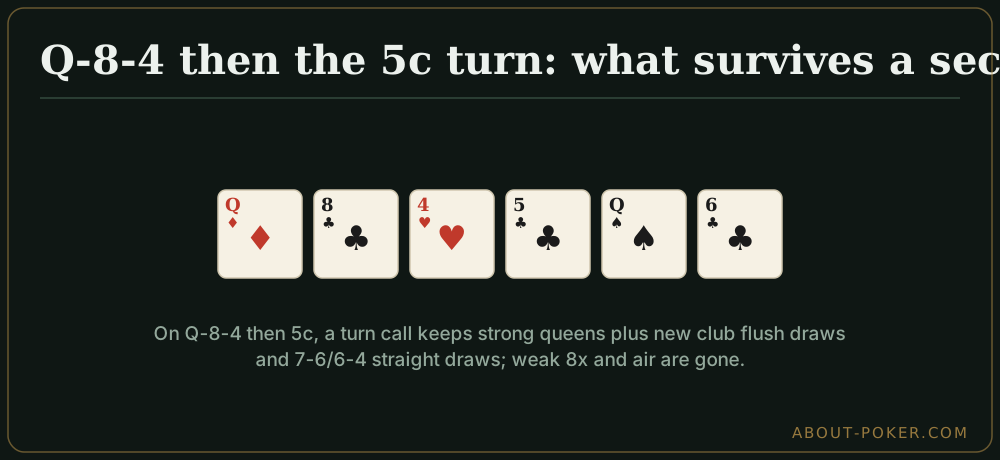
You raise, the big blind calls, and the flop is Q-8-4 rainbow. You c-bet, they call. From your flop narrowing, their range is roughly any queen, some 8x, small pairs, and a few gutshots like J-T or T-9. The turn is the 5 of clubs, putting a flush draw on board and adding a straight card for hands like 7-6.
Now you barrel two-thirds pot and they call again. What survives? The queens are still there, 8x has mostly given up unless it has a draw, and the call now includes the new club flush draws and the 7-6 and 6-4 type straight draws the turn created. What is gone: the pure air and the weakest 8x that could not face two bets. Their range has compressed to strong queens plus a defined block of draws. That read tells you exactly how to play the river: value bet against the queens on blanks, and be ready for the draws to bet or bluff-raise when a club or straight card lands.
Common mistakes
The biggest turn error is failing to update for the card — running the flop read forward as if the turn were always a blank. The second is misreading a check-back as weakness when it is really a capped-but-decent hand slowing down. The third is ignoring your own range: if your second barrel is credible, their continuing range is genuinely narrow, and you can trust it.
A turn-narrowing checklist
- Start from the flop-narrowed range.
- Classify the turn card: blank, draw-completer, or board-pairer.
- Re-run the read for the new texture before interpreting the action.
- Treat a turn call as strong — it removes most floats and air.
- Read a check-back as a capped, medium range to attack on the river.
Do this consistently and the river arrives with the range already tight enough to make value bets and bluff-catches almost mechanical.
Frequently asked
Why does the turn narrow ranges so much?
By the turn only two players are usually left, the pot is bigger, and the second barrel forces a real decision. Weak hands that floated the flop cannot keep calling profitably, so a turn call is a strong signal that removes most of the marginal holdings.
How does the turn card itself change the read?
A blank turn leaves the flop read mostly intact. A card that completes a draw or pairs the board expands the strong end of both ranges and changes which hands would continue, so you must re-run the read for the new texture.
What does a turn check-back tell you?
When a player who bet the flop checks the turn, they usually give up the top and bottom of their range — they rarely have the nuts and rarely have pure air. That leaves a capped, medium-strength range you can pressure on the river.