Narrowing Ranges on the Flop
Turn a preflop range into a flop read: use the texture, the action, and bet sizing to remove hands and picture what your opponent keeps, with a worked example.
On this page · 6 sections
The flop is where hand reading goes from theory to work. You arrive with a preflop range for your opponent, and the flop plus their action lets you start deleting hands. Every check, call, and raise is a filter: some hands would take that line and some would not. Narrowing on the flop is simply the discipline of asking, for each action, “which hands in the range actually do this here?” and crossing off the rest.
Start from the preflop range
You cannot narrow what you never assigned. Before the flop even lands, you should already have a picture — the group of hands your opponent got here with, weighted by position and player type. If you have not built that habit yet, the work of assigning a preflop range comes first. On the flop you are subtracting from that set, not inventing a new one.
The flop texture does the heavy lifting
The board decides which hands each action makes sense with, so read the texture first. A dry, disconnected board like K-7-2 rainbow supports very few draws, so a raise there is almost purely value — sets, two pair, strong top pairs. A wet board like 9-8-6 two-tone is packed with straight and flush draws, so the same raise now includes plenty of semi-bluffs. This is why board texture and range advantage and the distinction between wet and dry boards sit at the center of hand reading: the texture defines the vocabulary of possible hands.
- On dry boards: raises are strong and thin, calls are top pairs and a few floats, and folds are the rest.
- On wet boards: raises split into made hands and big draws, calls widen to include weaker pairs and gutshots, and the whole range is more fluid.
Actions and sizes narrow the range
Once texture sets the menu, the action and sizing pick the dish.
- A call keeps pairs, draws, and some floats, and sheds total air that had no reason to continue. Against a c-bet, a caller on a wet board is often on a draw.
- A raise keeps strong made hands and, on wet boards, semi-bluffs, while shedding weak pairs that would rather call or fold.
- A check-back by the preflop raiser usually removes the strongest value and the pure air, leaving a middling, capped range — a signal you can attack later.
- Sizing matters: small bets come from wide merged ranges betting cheaply, while large bets and check-raises skew polarized toward strong hands and draws.
Reading sizing alongside texture is what separates a real hand read from a guess. A tiny bet on a dry board is a range bet; a pot-sized check-raise on a wet board is a genuine two-way threat.
A worked example
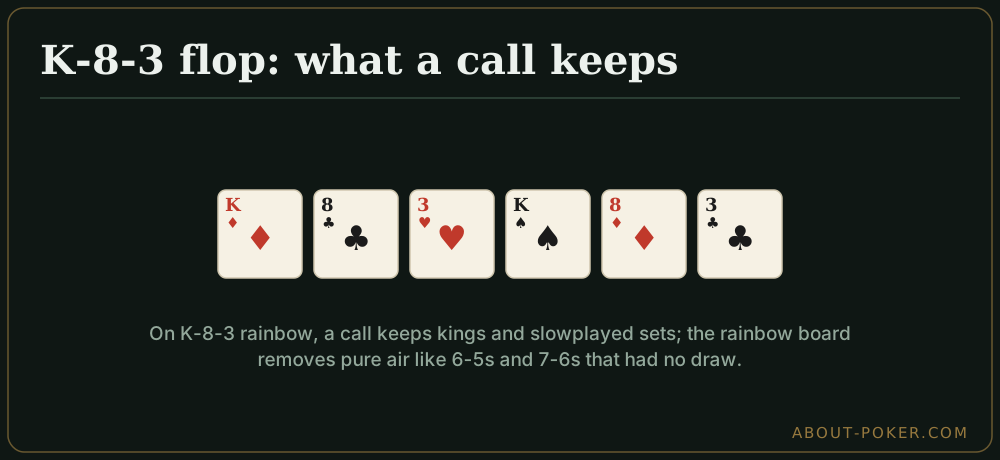
You raise A-Q from the cutoff and the big blind calls. Their preflop range is wide — suited connectors, small pairs, broadway hands, suited aces. The flop is K-8-3 rainbow. You continuation bet a third of the pot and they call.
Now narrow. On this dry, high-card board, a call keeps: any king (K-8s, K-Qo, K-Jo, K-Ts, and so on), pocket pairs from 88 down to 33 that flopped a set or want to see a turn (88, 33 for sets; 44 through 77 as reluctant calls), and the occasional floating suited ace or gutshot like Q-J or J-T. What the call removes is most of their pure air — hands like 6-5s and 7-6s that whiffed completely and have no draw on a rainbow board. So their continuing range is roughly kings, a few slow-played sets, and a thin layer of floats. That read directly shapes your turn plan: fire again on cards that scare their floats and bluff-catchers, slow down on cards that improve their kings.
Common mistakes
The classic error is treating a call as automatically weak and a raise as automatically strong, ignoring the board. On a wet board a call is frequently a powerful draw, not a weak pair. Another mistake is forgetting your own continuation bet range — if your c-bet is well constructed, the way they respond tells you more. Finally, do not overcommit; a flop read is provisional, and the turn will confirm or refute it.
A flop-narrowing checklist
- Begin from the assigned preflop range.
- Read the texture first — it sets which hands each action fits.
- Interpret calls, raises, and check-backs through that texture.
- Layer in bet sizing: small equals wide, large equals polarized.
- Keep the read provisional and ready to update on the turn.
Narrow well on the flop and the turn becomes a short, confident step rather than a fresh mystery.
Frequently asked
How do you narrow a range on the flop?
Start with the opponent's preflop range, then remove hands based on how they act. A call keeps pairs, draws, and some floats while shedding total air; a raise keeps strong made hands and semi-bluffs while shedding weak pairs. The board texture decides which hands each action makes sense with.
Does bet sizing help narrow ranges on the flop?
Yes. Small bets usually come from wide, merged ranges that want to bet cheaply; large bets and check-raises are more polarized toward strong hands and draws. Reading the sizing alongside the texture tells you which part of the range is acting.
What is the biggest mistake when reading flop ranges?
Assuming a call is weak and a raise is strong without considering the board. On a wet board, a call can easily be a strong draw; on a dry board, a raise is rarely a bluff. Always interpret the action through the specific texture.