Playing Draws in Position
How to play flush and straight draws when you have position: when to semi-bluff, when to take the free card, and how to turn draws into profit with control.
On this page · 7 sections
Playing a draw is already one of the most profitable spots in poker, and having position turns it up a level. When you act last on every postflop street, you see what your opponent does before you commit a chip. That single advantage — information plus the ability to take a free card — lets you realize your equity more cheaply than any out-of-position player ever can. This guide covers how to squeeze the most out of flush draws, straight draws, and combo draws when you have the button or last-to-act seat.
Why position multiplies a draw’s value
A draw’s raw equity does not change with your seat. A nine-out flush draw is about 36% to complete by the river on the flop and roughly 18% on a single card. What position changes is your equity realization — how much of that 36% you actually capture. Out of position you often have to guess whether to bet, and you can get blown off your draw by a check-raise. In position you never guess. If your opponent checks, you can bet for a semi-bluff or check back and see a free card. If they bet, you know exactly what price you are getting before deciding to call, raise, or fold.
That control is worth a surprising amount. Solvers consistently show the same draw earning meaningfully more EV in position than out of it, purely from cheaper realization and the free-card option.
The two ways a draw makes money
Every draw profits from two independent sources:
- Fold equity: you bet, and a better hand folds now. You win the pot without improving.
- Pot equity: you get to the river and hit, winning a bigger pot.
The semi-bluff combines both. When you bet a draw in position, you win immediately when they fold, and you still have your outs when they call. Because you close the action, you also control how large the pot grows relative to your equity — a concept covered in pot control.
The free-card play
The signature in-position move is the free card. You raise the flop with a draw, get called, and when the opponent checks the turn you check behind. You have now seen two cards (turn and river) for the price of one bet. Nobody out of position can do this without risking a check-raise.
Use it when your draw is weak enough that betting has thin fold equity — a bare gutshot, for example — or when you would rather realize equity cheaply than bloat the pot. Skip it when you have a monster combo draw with big fold equity; those want to build the pot.
A worked hand
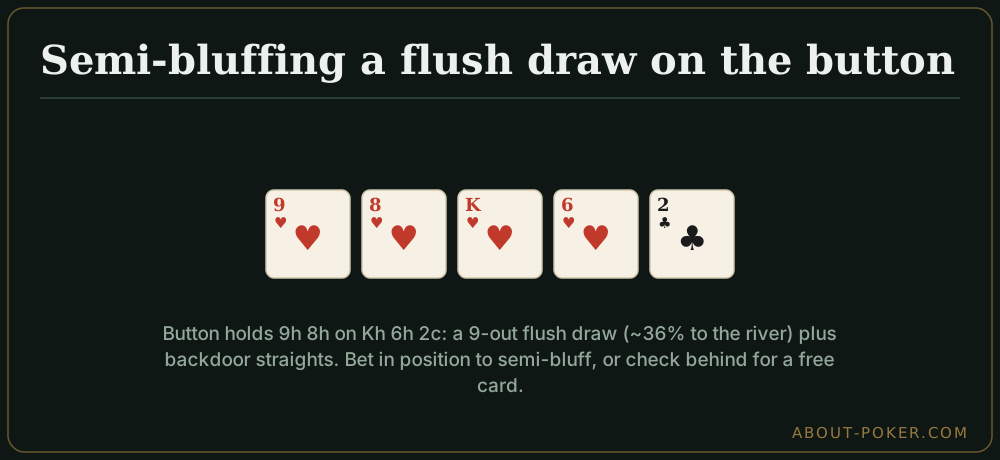
You open the button with 9h-8h, the big blind calls. Flop comes Kh-6h-2c. The big blind checks. You have a nine-out flush draw (about 36% to the river) plus two backdoor straight outs.
This is a classic semi-bluff. You bet 50% pot. Two good things happen: many of the big blind’s weak hands (small pairs, ace-highs that missed) fold now, and when called you still have your flush draw live. If the big blind check-calls and the turn bricks with the 3c, and he checks again, you can now check behind to take the free river card — you keep your equity without risking a check-raise, and you get to bluff the river if a scare card comes. That flexibility is unavailable out of position, where you’d have to either fire again blind or check and surrender initiative.
Compare that with playing the same hand out of position: you’d often have to bet and fold to a raise, or check and let the free card go to your opponent instead. Position hands you the option every time.
Sizing your semi-bluffs
Match your bet size to what your draw needs to accomplish. On dry boards a smaller bet (around 33% pot) denies equity cheaply and keeps your bluffing range wide. On wet, connected boards where you hold a big combo draw, a larger bet (66% pot or more) leans on your fold equity and builds a pot you’re happy to play when you hit. The stronger and more disguised the draw, the more you can lean toward larger sizings and even overbets on later streets. For a deeper look at reading the runout, see wet vs dry board texture.
Common mistakes
- Auto-betting every draw. Betting is not always best. With a weak gutshot and no fold equity, checking behind to take the free card is often higher EV.
- Never taking the free card. If you always bet, observant opponents check-raise you off equity. Mixing in checks protects your checking range.
- Ignoring implied odds. In position your implied odds are better because you can extract more when you hit. A speculative call that’s marginal on pot odds alone can be clearly profitable once implied odds are added — review what are pot odds to price these spots.
- Playing draws like made hands. A draw wants either fold equity now or a cheap look at the next card. Bloating the pot with no fold equity and mediocre outs burns money.
In-position draw checklist
- Count your outs and estimate equity (rule of 4 and 2).
- Ask if betting folds out better hands — if yes, you have fold equity, lean toward semi-bluffing.
- If checked to with a weak draw and little fold equity, take the free card.
- Size up with big combo draws, size down with thin draws on dry boards.
- Add implied odds: in position you win more when you hit, so borderline calls tilt profitable.
Play draws in position aggressively when you have fold equity, passively (free card) when you don’t, and let the seat do the heavy lifting on realizing your equity. For more on aggressive last-to-act play, compare this with floating in position.
Frequently asked
Should you always bet a draw when you're in position?
No. Bet (semi-bluff) when you have fold equity and your bet threatens the range. But position also lets you take a free card by checking behind, which is best when your draw is disguised, you have showdown value, or a bet would only fold out worse and get called by better.
What is the biggest advantage of drawing in position?
You act last on every street, so you always know what your opponent did before you decide. That lets you take free cards when checked to, bet for value or as a semi-bluff when it's best, and control the pot size to match your equity.
How much equity does a flush draw have in position?
The draw's equity is the same regardless of position: about 36% to hit by the river from the flop with nine outs, and about 18% per single card. Position doesn't change the odds — it changes how cheaply and how profitably you get to realize them.
When should I take a free card instead of betting my draw?
Take the free card when betting has little fold equity, when a raise would put you in a tough spot, or when checking keeps worse hands bluffing into you. It is strongest with weaker draws like gutshots that can't stand a check-raise.