Playing Dry Flops
Dry flops reward the preflop aggressor. Learn how to identify dry boards, size your c-bets, defend as the caller, and turn a range edge into steady profit.
On this page · 7 sections
A dry flop is the single most profitable texture for the player who took the lead before the flop. When the board comes down disconnected and unpaired — think K-7-2 with three different suits — almost nothing about it helps the person who merely called your raise. Understanding why that is true, and how to press the advantage on one street after another, is one of the highest-return skills in postflop poker.
What Makes a Flop Dry
A dry board has three qualities: no flush draw (it is rainbow, or at worst two of a suit), no obvious straight draw (the ranks are spread far apart), and typically a high card that connects with a raising range. Classic examples are K-7-2 rainbow, A-8-3 rainbow, and Q-6-2 rainbow. Contrast that with a coordinated board like 9-8-7 with two hearts, where dozens of turn cards swing the hand — the wet vs dry board texture comparison spells out the difference street by street.
The word that matters here is static. On a static board, the hand that is best on the flop is usually still best on the river. Turn and river cards rarely rearrange the order of hands, so equities do not shift much. That stability is exactly why the aggressor can attack cheaply: there is little to protect against.
Why the Raiser Owns the Board
Range advantage drives everything. As the preflop raiser you open with a range full of big cards — A-K, A-Q, K-Q, K-J, and every pocket pair. On K-7-2 rainbow you make top pair with all of your king combos and hold an overpair with aces and queens. The caller, who flatted rather than three-bet, holds far fewer kings, is missing the strongest aces, and connects with the 7 and 2 only weakly. When you compare both ranges on this texture — see range vs range on dry boards — the raiser will hold something like 55–60% of the total equity and a big lead in the top of the range.
That lopsided picture is what unlocks the range bet: because you are ahead across your whole range, you can bet every hand for a small size and still profit.
How to Bet a Dry Flop
The standard play is to c-bet small — around one-third of the pot — with a very high frequency, often close to your entire range. A small bet does three things at once. It denies equity to the many unpaired hands the caller holds, it charges backdoor draws a little, and it sets up two more streets of pressure while risking almost nothing.
You do not need a big bet because the board barely helps your opponent. Save large sizes for wet boards where you must charge draws. On K-7-2 rainbow, one-third pot with your whole range is a textbook, hard-to-counter strategy — see c-betting dry flops for the sizing math in depth.
A Worked Example
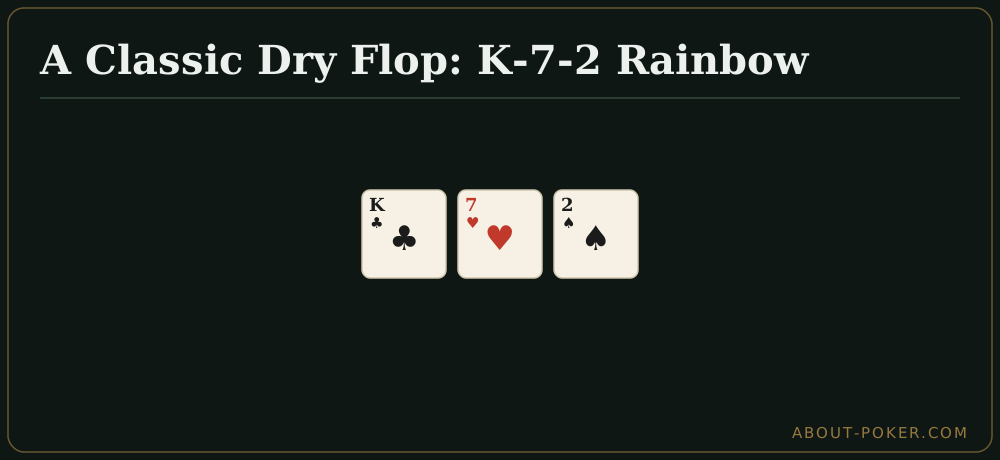
You open A♠K♦ from the cutoff to 2.5bb, the big blind calls, and the flop comes K♣-7♥-2♠. The pot is roughly 5.5bb. You bet one-third, about 1.8bb.
You hold top pair with the best kicker, so you are betting for pure value. But notice you would make the exact same 1.8bb bet with A♠Q♠ (two overcards and a backdoor flush) and with 4♥5♥ if that were in your range — because a small bet is cheap enough that even your air prints money through fold equity. The caller can only continue with a king, a pair, or a draw with some backup, and folds a large slice of hands that each hand you a pot without a fight. When called, you keep barreling most turns because your equity is still ahead and the board stays static.
Playing Dry Flops as the Caller
Defense is quieter but still matters. Against a small c-bet you should call fairly wide — the price is good and you are only risking a third of the pot to see a turn. Continue with any pair, ace-high with a backdoor draw, and hands that pick up equity on later streets. Fold your complete air that has no path to improve.
Raising is rare on dry boards. Because the texture is static there is little to protect, so a check-raise mostly turns your hand face-up as either a set or a bluff. If you do raise as a bluff, pick hands with a relevant blocker — like an ace that blocks top pair on a K-high board — so you fold out more of the raiser’s continuing range.
Common Mistakes
- Betting too big. Firing pot on a dry board wastes money; the small size already gets the folds you want.
- Giving up after one barrel. Static boards mean your turn equity holds — keep the pressure on blank turns rather than checking and surrendering.
- Over-defending as the caller. Calling three streets with bottom pair on K-7-2 bleeds chips; the aggressor’s range is simply too strong.
- Slowplaying sets needlessly. With few draws to charge you can sometimes slowplay, but on dry boards your value hands rarely get outdrawn, so betting for thin value on later streets usually earns more.
Dry-Flop Checklist
Before you act on a dry board, run through this: Who has the range advantage (almost always the raiser)? Is the board static enough that the current best hand stays best? Can I bet small and often to attack the caller’s many weak hands? As the caller, do I have a pair or a backdoor draw worth continuing, or is this a clean fold? Answer those four and the dry-flop decision tree gets short and profitable.
Frequently asked
What is a dry flop?
A dry flop is an uncoordinated board with no flush draw and few straight draws, usually one high card and two disconnected blanks — for example K-7-2 rainbow. Very few turn cards change who is ahead, which makes these boards static and cheap to bet.
Who has the advantage on dry flops?
The preflop raiser almost always does. Their range is packed with the big cards that pair these boards, while the caller holds far fewer top-pair combos and almost no sets. That range advantage is why the raiser can bet small with their whole range.
How do you defend a dry flop as the caller?
Call with your pairs and backdoor equity, fold your total air, and pick a few hands with blockers to raise as bluffs. Because the board is static you rarely need to raise for protection — you mostly call to realize equity and reevaluate on the turn.