Reading Flop Texture
Reading flop texture is the master skill of postflop poker. Learn the four axes — connectedness, suits, high cards, and pairing — and how each shapes your bet.
On this page · 6 sections
Reading flop texture is the master skill of postflop poker. Every decision you make after the flop — whether to bet, how much, whether to bluff, whether to fold — flows from a single question: what does this board do to each player’s range? Learn to read texture accurately and the rest of postflop play organizes itself around it.
The Four Axes of Texture
A flop is not just wet or dry; it lives on four separate dimensions, and you read all four at a glance:
- Connectedness — how close the ranks are. 9-8-7 is maximally connected (a made straight already sits on the board), while K-8-3 is fully disconnected with no straight draws.
- Suit pattern — rainbow (three suits, no flush draw), two-tone (two of a suit, a flush draw exists), or monotone (three of a suit, a flush already possible).
- High cards — does the board contain a broadway card the raiser is likely to hold? A-K-4 favors the aggressor far more than 7-6-5.
- Pairing — a paired board like K-K-4 or 8-8-3 removes many combos and changes who holds trips.
Every board is a combination of these four. K-7-2 rainbow scores low-connected, rainbow, one high card, unpaired — the driest of dry. 9-8-7 two-tone scores high-connected, flush draw present, no high card — soaking wet. The wet vs dry board texture guide walks the full spectrum between those poles.
From Texture to Range Advantage
The reason texture matters is that it reallocates equity between ranges. As the preflop raiser you hold big cards; as the caller you hold more middling connectors and suited hands. A high, disconnected board like A-K-4 hits your raising range hard and the caller’s barely at all, handing you a big edge. A low, connected board like 6-5-4 does the opposite — it smacks the caller’s suited connectors while missing your ace-high hands.
This link between board and range is the whole game — board texture and range advantage covers exactly how to estimate who is ahead on any given flop. The practical shortcut: high and disconnected favors the raiser; low and connected favors the caller; everything else sits in between.
Texture Decides Your Bet Size
Once you know who the board favors and how many draws exist, sizing follows almost automatically. On dry, static boards you bet small and often, because there is nothing to charge and you are ahead across your range. On wet, dynamic boards you bet bigger and more selectively, because you must charge draws and protect your strong hands while equities run close. This mapping is direct enough that c-bet sizing by board texture can practically be read off the four axes above.
A Worked Example
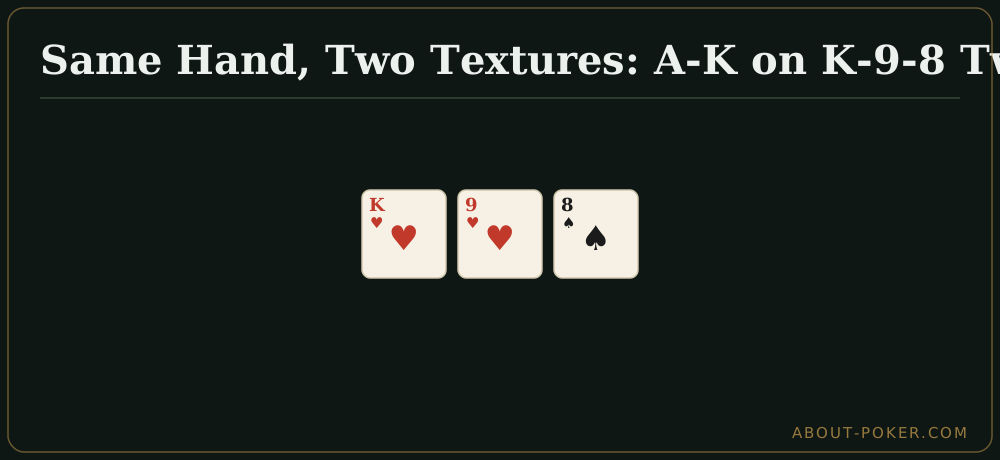
Two boards, same hole cards, opposite plays. You hold A♠K♠ as the preflop raiser on the button, big blind called.
Board A: K♦-8♥-3♣ rainbow. Read it: disconnected, rainbow, one high card, unpaired — bone dry and raiser-favored. You have top pair, top kicker and hold a range edge. Correct play: bet small, one-third pot, planning to barrel most turns because the board is static and few cards hurt you.
Board B: K♥-9♥-8♠. Read it: connected, two-tone flush draw, high card, unpaired — wet and dynamic. You still have top pair, top kicker, but now dozens of turn cards (hearts, tens, jacks, sevens) threaten you and the caller’s range is full of draws. Correct play: bet bigger, around two-thirds pot, to charge the draws — and be ready to slow down if a scare card lands. Same hand, same position, but the texture flips the size and the plan.
Common Mistakes
- Reading only wet-or-dry. Ignoring the high-card and pairing axes leads to misjudging who the board favors.
- Using one bet size for every board. A fixed c-bet ignores the whole point of reading texture — size to the draws and the range edge.
- Forgetting the caller’s perspective. Texture that helps you as the raiser hurts you as the caller; read the board from the other seat too.
- Overvaluing top pair on wet boards. The same top pair that is a monster on K-8-3 is a marginal hand on K-9-8 two-tone.
Texture-Reading Checklist
At every flop, run the four axes in one breath: How connected are the ranks? What is the suit pattern? Is there a high card, and does it favor the raiser or the caller? Is the board paired? Then ask the two follow-ups that convert texture into action: Who holds the range advantage, and how many draws must I account for? Master that thirty-second read and you will always know why you are betting — not just that you are.
Frequently asked
What is flop texture?
Flop texture describes how the three community cards interact — how connected the ranks are, how many suits appear, whether high cards or a pair are present. Texture determines how many draws exist and which player's range the board favors, so it drives nearly every postflop decision.
What are the main types of flop texture?
The big split is wet versus dry. Wet boards are coordinated and draw-heavy (9-8-7 two-tone); dry boards are disconnected with few draws (K-7-2 rainbow). Within those you also read for high cards, pairing, and monotone or two-tone suit patterns.
Why does flop texture matter?
Texture tells you who has the range and nut advantage, how much you need to bet to protect and charge draws, and how likely the turn is to change the hand. Reading it correctly is what separates a mechanical c-bettor from a player who bets the right size for the right reason.