How to Play Seven-Six Suited (76s)
76s is the textbook mid suited connector: flops straights and flushes, plays great in position. Learn where to open 76 suited and how to realize its equity.
On this page · 6 sections
Seven-six suited (76s) is the archetypal mid suited connector — the hand poker players picture when they talk about connectors at all. It has almost no high-card value, yet it’s a genuinely profitable holding because of how it flops: straights, flushes, and the draws that lead to them. The whole point of 76s is playability, not showdown strength. Play it in the right spots and it prints; play it out of position into a tight range and it bleeds.
Where 76s belongs preflop
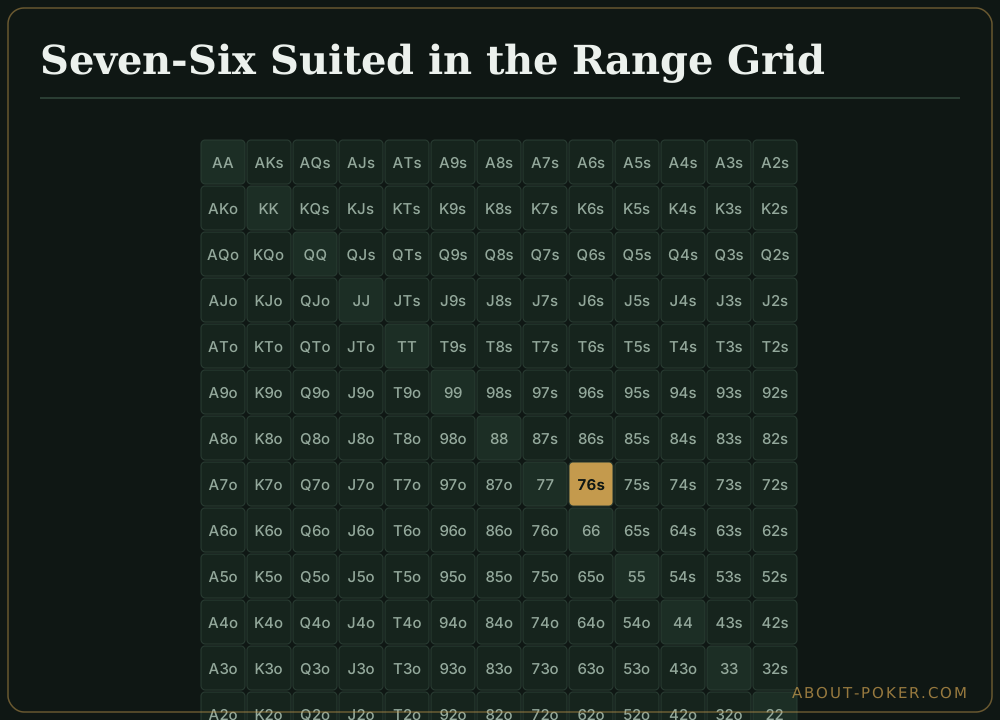
- Early position (full ring): usually a fold. You’ll often be out of position for the whole hand, which kills a speculative hand’s ability to realize equity.
- Middle position: a marginal open, clearly playable at 6-max.
- Cutoff and button: standard opens. This is 76s’ home — you act last postflop and can control the pot size.
- Small blind: a fine raise-first hand when you can get heads-up or take the pot down preflop.
- Big blind: defend widely against a single raise; the price is good and you flop well.
For the full positional map, see the preflop opening ranges hub. 76s sits right at the boundary of “add it in late position, cut it early.”
Why 76s connects so well
The strength of 76s is the quality of its draws. Because both cards can be at the top or middle of a straight, 76s flops open-ended straight draws far more often than a gapped hand. Combined with the flush draw from being suited, it hits a strong draw or better on a large share of flops.
Just as important, its made hands are disguised. When you flop a straight with 76s on a board like 5-8-9, opponents holding an overpair or top pair rarely put you on it, so you get paid. That’s the connector’s edge: you win small pots often and occasionally stack someone who can’t fold.
76s plays almost identically to its close cousins — the logic here is the same one that drives nine-eight suited, just with slightly lower absolute card strength.
A worked example
You open 7♠6♠ on the button. The big blind calls. The flop comes 5♦ 8♣ K♥.
You’ve flopped an open-ended straight draw — any four or nine completes your straight, giving you eight outs. As a bare draw with two cards to come, that’s roughly 31% equity against a made hand, and more once you add backdoor flush and pair outs. The king is scary for the big blind’s calling range, so a continuation bet does double duty: it can fold out weak pairs and it builds a pot for when you hit.
Turn is the 2♥, a brick. You can barrel again as a semi-bluff — you still have eight clean outs and credible fold equity. If the river brings a four or nine, you make a straight the big blind will struggle to read, and you bet for maximum value. Every branch works because 76s flopped real equity, not just backdoors. Getting these decisions right is the heart of playing draws postflop.
Realizing equity is everything
A speculative hand is only worth its price if you can realize its equity — actually see the turn and river often enough to hit. Two things drive that:
- Position. In position you can take free cards, bluff more credibly, and pot-control. This is why 76s is a button hand and an early-position fold.
- Stack depth. Deeper stacks pay off big when your disguised straights and flushes land, boosting implied odds. Short-stacked, 76s loses much of its appeal because you can’t win a big pot.
Against a player who calls too much and never pays off draws, 76s falls in value — you can’t get the implied-odds payday that justifies the hand. Against deep, sticky opponents in position, it’s one of the best hands to have.
Postflop shorthand
- Open-ender or flush draw: semi-bluff aggressively in position; you have equity and fold equity.
- Flopped straight or flush: slow down only on the most coordinated boards; usually bet to build the pot while your hand is disguised.
- Middle pair or a pair of sevens/sixes: a marginal made hand — pot-control and get to showdown cheaply.
- Total air: fold to resistance; 76s has no showdown value when it whiffs.
Where to go next
76s teaches the core connector lesson: value comes from playability and position, not from your cards at showdown. Slot it into your late-position opens via preflop opening ranges, compare it to its bigger sibling in nine-eight suited, and tie it all back to the preflop strategy hub.
Frequently asked
Is 76 suited a good hand?
Yes, 76s is one of the best mid suited connectors. It flops open-ended straight draws and flush draws frequently and makes well-disguised straights, which lets it win big pots when it connects. Its value comes from playability in position, not raw high-card strength.
From what positions should I open 76s?
76s is a standard open from the cutoff, button, and small blind at most tables, and it becomes a middle-position open at 6-max. From early position at a full table it's usually a fold, since it needs favorable position and multiway potential to realize equity.
Should I 3-bet with 76 suited?
Occasionally. 76s makes a reasonable 3-bet bluff because it retains real equity when called, but it's generally better as a flat-call in position where you can see cheap flops multiway. Higher connectors and suited aces are stronger 3-bet bluff choices.