How to Play Four-Two Suited (42s)
Four-two suited is a low, one-gap suited hand that folds almost everywhere. Here is the narrow big-blind window where 42s plays and how to handle it.
On this page · 7 sections
Four-two suited (42s) is one of the lowest playable-looking hands in Hold’em, and the word “playable” is doing a lot of work. It is a one-gap suited hand, so it can make the occasional straight (3-4-5-6 or similar wheel-adjacent runs), and being suited gives it a flush to chase. But both cards are tiny, which means even when 42s pairs or hits top pair it is routinely outkicked, and its straights are low enough to lose to bigger straights on connected boards. Against a random hand it wins only about 46% heads-up. In practice 42s is a fold nearly everywhere, with one narrow home: cheap big-blind defense.
The one home: cheap big-blind defense
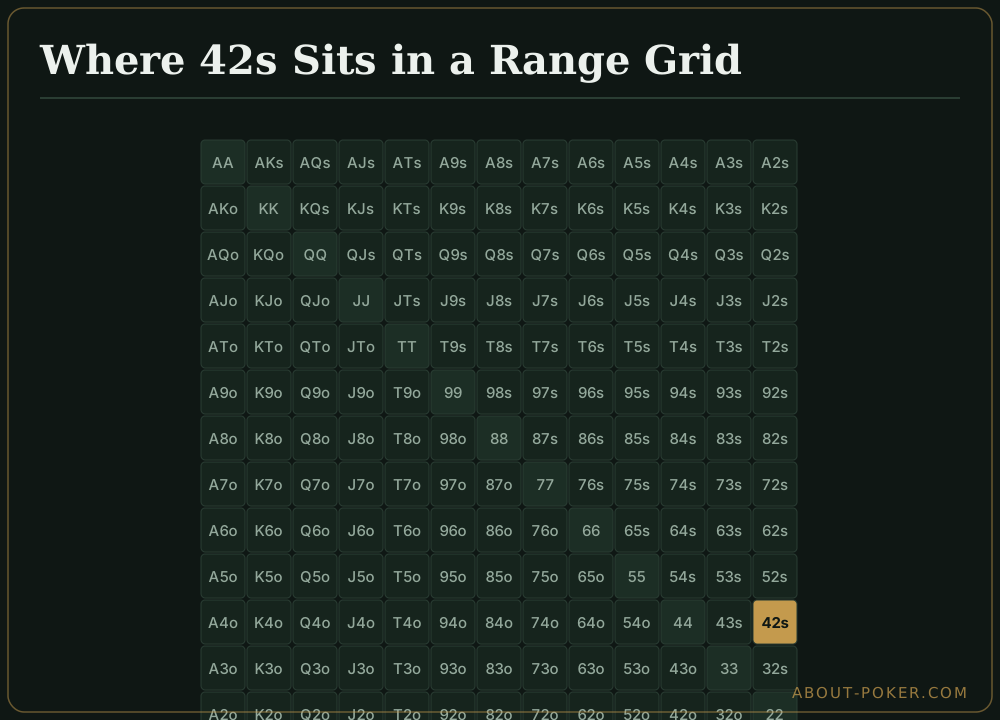
The single legitimate spot for 42s is defending the big blind at a good price against a wide opener. When a button or cutoff makes a small raise and you are closing the action, you are partly invested already, no one can raise behind you, and the suit plus one-gap connectivity give you something to draw to. This is the far edge of blind defense, where you defend far wider than you would ever open.
Even there, 42s is a marginal defend and one of the first hands to fold as the price gets worse or the opener’s range tightens. As an open it is always a fold — it is weaker than five-two suited, which itself already fails to qualify from any standard seat. Your preflop opening ranges should list 42s as a fold from all nine positions.
Why the low cards hurt
Suitedness and a single gap give 42s a floor of equity, but the low rank of both cards caps its ceiling hard. When you pair the four you are outkicked by nearly every hand that pairs the same card; when you pair the two you are behind almost everything. Your straights use small cards, so on a board like 3-4-5 you can flop the low end of a straight and still lose to a hand holding the 6-7. The flush is the one holding that reliably wins a big pot, which is the entire reason the suit keeps 42s out of pure-junk territory.
A worked example
You defend the big blind with 4♥2♥ against a button open, and the flop comes 3♥-5♥-9♠. This is a dream flop for 42s: you have both a flush draw (any heart) and an open-ended straight draw (any 6 or any ace-low wheel card gives you a straight, and here a 6 completes 3-4-5-6). With so many outs you can continue aggressively, semi-bluffing with real equity behind your line.
Contrast that with a flop of A♣-4♦-9♠. Here you have flopped a pair of fours with a terrible kicker on an ace-high board. Against a button’s continuation bet you are behind top pair, better fours are unlikely but bigger pairs and aces are everywhere, and you have no draw. This is a check-fold, not a bluff — and it shows why 42s only wants to play the flops that give it real draws.
How 42s compares to nearby suited junk
Placing 42s among its neighbors makes the fold obvious. Suited connectors like 54s and 65s are true no-gap hands with strong two-way straight potential and far better playability, and even they open only from late position at most. 42s trades away much of that connectivity — its one gap and rock-bottom cards mean its straights are few and low — so it lands well below the connectors on the strength ladder. It is roughly a peer of 32s and 43s in the “suited but barely” tier, all of which live only in cheap big-blind defense. The practical lesson is to stop treating “suited” as a license to play: the ranks and the connectivity matter far more than the shared suit, and by those measures 42s is a defend-cheap-or-fold hand.
When the price actually justifies a defend
The defend is a pot-odds decision, and the size of the open sets it. If the button min-raises to 2 big blinds and you’ve already posted 1, you’re getting 3.5-to-1 to call (you put in 1 more to win the 3.5 already out there) — a great price that lets marginal hands like 42s continue. If instead the open is a full 3 big blinds, you’re calling 2 to win 4.5, roughly 2.25-to-1, and 42s slides from a thin defend to a fold. The bigger the raise, the tighter your defending range, and 42s is always among the first hands cut as the price worsens.
Two other factors tighten it further. Against a cutoff or lojack open the range is narrower and stronger than a button open, so 42s should fold even at a good price. And in a multiway pot — where another player has already called the open — 42s gets worse, not better: you’ll rarely win unimproved and your low straights and flushes can be beaten by bigger versions of the same hand. Save 42s for the specific case it was built for: heads-up in the big blind, cheap price, wide button opener.
A quick postflop checklist for 42s
Because 42s makes so many second-best hands, a simple filter keeps you out of trouble after the flop:
- Flush draw? Continue. Nine outs to a flush is enough equity to peel or semi-bluff.
- Open-ended straight draw? Continue, but note whether you’re drawing to the low end — on 3-4-5 your 6 makes a straight a 6-7 also makes bigger, so play it more carefully.
- Made straight or two pair? Bet for value, but respect action on boards where a higher straight is possible.
- Bare pair of fours or twos? Give up. This is the trap hand — it feels like something and is almost always beaten. Check-fold rather than bluff off chips.
- Nothing at all? Fold to any bet. 42s has no business floating without a draw.
The through-line is the same as the range advice: 42s is a draw-or-fold hand. When it flops a real draw it can play aggressively; when it flops a weak pair it should quietly disappear.
The takeaway
42s is a fold-first hand. Do not open it from any seat, and use it only for the cheapest, widest big-blind defends. When you do play it, continue with flushes and straight draws and fold your weak pairs. Recognizing that 42s is a draw-or-fold hand — never a make-a-pair-and-hope hand — keeps it from turning into a chip leak.
Frequently asked
Is four-two suited worth playing?
Rarely. 42s is a very low one-gap suited hand whose only regular home is cheap big-blind defense against wide late-position opens. From every other seat it is a fold, and even in the big blind it is one of the weaker defends.
Can you open four-two suited?
No, not in a standard range. 42s sits below even the widest button and small-blind opens. Folding it preflop from every seat is correct and costs nothing meaningful over the long run.
How should you play 42s after the flop?
Continue mainly with a flush draw, an open-ended straight draw, or a strong made hand like two pair or a straight. A bare pair of fours or twos is almost always second-best, so give up on those boards rather than bluffing off chips.